


Grey and Gold Table
A grey and gold table combines stone and metal finishes to anchor a room with classical balance and decorative weight.
Grey and Gold Table
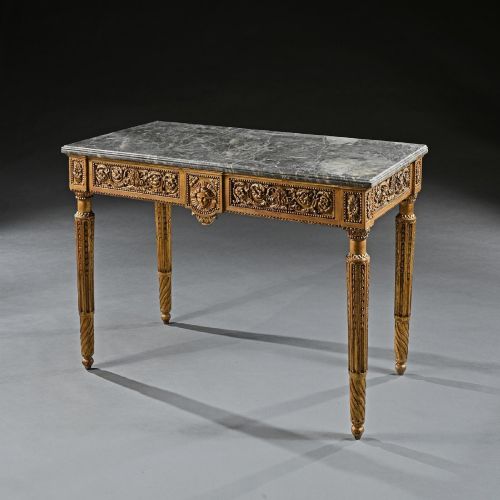
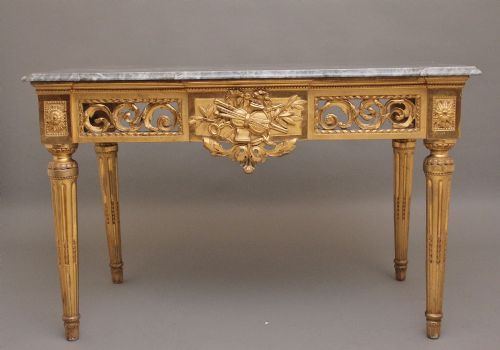
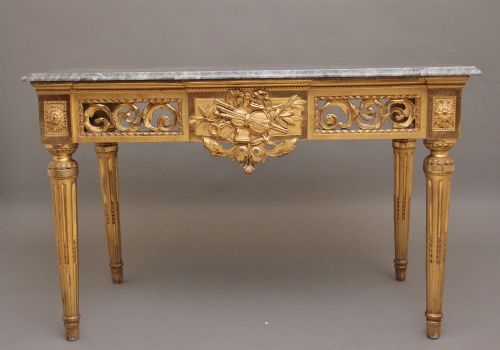
A grey and gold table encompasses marble-topped console tables, centre tables, and side pieces spanning the eighteenth and nineteenth centuries. These furnishings range from Italian and French neoclassical designs to Victorian country house examples and Japonisme occasional pieces.
The versions most frequently met on this page feature pale or dark marble tops paired with gilded wood, gilt bronze, or ormolu frames. Console tables and centre tables dominate the selection, often carrying the stylistic weight of the Louis XVI period or Rococo Revival taste.
How they were made
The construction relies on heavy natural marble slabs cut and polished to form the upper surface, resting upon structural timber frames. These wooden bases receive carved decoration before the application of gold leaf or parcel-gilt finishes.
Metal elements such as ormolu and gilt bronze are cast and chased to mount the wood or stone, while ebonised wood provides dark contrast against the reflective metallic gilding.
Listings feature marble tops paired with giltwood, ebonised wood, and ormolu across eighteenth and nineteenth-century forms.
What varies in quality
The refinement of the carving on the wooden or giltwood frame distinguishes superior pieces from standard workshop output. Crisp, deeply undercut foliage and architectural details show a maker's hand.
The quality of the marble top and the density of the gilding, whether gold leaf or liquid gold, determine the visual depth of the piece. Attribution to known makers adds historical weight to the physical execution.
Paul Sormani
The Grey and Gold Table Glossary
- Console table
- A table designed to stand against a wall, frequently fixed with brackets and featuring a heavy marble top.
- Centre table
- A freestanding table intended to occupy the middle of a room, finished with detail on all sides.
- Giltwood
- Timber that has been coated with a thin layer of gold leaf over a prepared gesso ground.
- Ormolu
- Gilt bronze mounted onto furniture or clocks, created through a mercury gilding process that imparts a rich lustre.
- Neoclassical
- A style drawing on classical antiquity, characterised by straight lines, symmetry, and restrained ornament.
Grey and Gold Table: Frequently Asked Questions
Where should I place a console table?
Console tables sit best against a flat wall in a hallway, drawing room, or dining space where their decorative front can be appreciated. They often support mirrors or decorative objects without obstructing room flow.
Because these tables are shallow by design, they occupy minimal floor space while providing a stable surface for lamps or ornaments.
How do I clean a marble top?
Marble requires gentle cleaning with a damp cloth and neutral soap, avoiding acidic substances that etch the polished stone surface. Regular dusting keeps the porous material free from grime.
Heavier marks need professional attention to preserve the original sheen without wearing away the stone.
Are these tables sturdy enough for daily use?
Most antique console tables rely on wall fixings for total stability, particularly when carrying heavy marble slabs. Centre tables stand independently on four legs or a central pillar.
Placing items with moderate weight is suitable, though heavy loads should be avoided on older joinery.
What defines Louis XVI style?
Louis XVI style emerged in France during the eighteenth century, favouring straight legs, classical symmetry, and restrained geometric ornament over curved rococo excess. It draws heavily on Roman and Greek architectural motifs.
Pieces from this aesthetic often incorporate fluted columns, gilt bronze mounts, and crisp rectangular proportions.