



Green Guilloche Enamel
Green guilloche enamel pieces combine machine-turned metalwork with translucent coloured glass coatings, offering collectors intricate geometric patterns on sterling silver and silver gilt items.
Green Guilloche Enamel
Green guilloche enamel items encompass wearable ornaments and small functional tablewares, with brooches and scent bottles appearing most frequently among the current selections. These objects originate primarily from early twentieth-century workshops, spanning Edwardian, Art Nouveau, and Art Deco periods.
Buyers will encounter items ranging from butterfly brooches to cased salt cellars and vanity jars. Sterling silver and silver gilt serve as the predominant base metals beneath the translucent green glass layers.
Scandinavian and British makers dominate the available selection, reflecting distinct regional tastes in engine-turned metalwork from the 1900s through to the 1960s.
Materials and technique
Craftsmen utilised mechanical lathes to engrave precise, repeating geometric patterns into a metal base, typically sterling silver or silver gilt. This engine-turned process forms the distinctive foundation of guilloche decoration.
Vitreous enamel, consisting of powdered glass fused under high heat, was applied over the engraved metal. The translucent nature of this enamel allowed the underlying machine-turned patterns to remain visible, creating depth and shifting light effects.
Green Guilloche Enamel Retail Price Guide 2026
Typical asking prices for green guilloche enamel among the pieces listed under this phrase on Sellingantiques today, from the lower quarter to the upper quarter. They describe what is for sale here now, not the wider market.
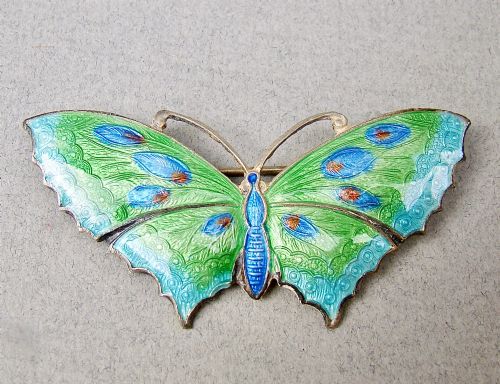
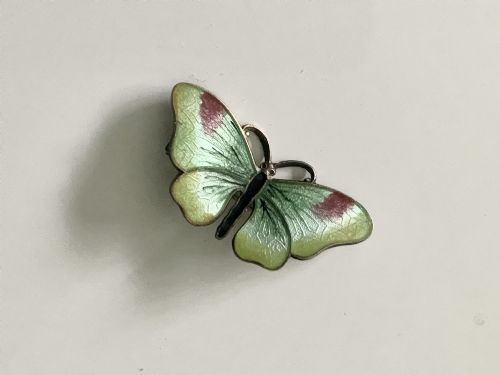
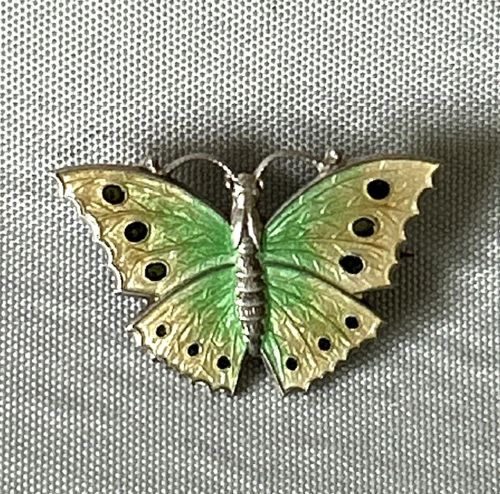
Several small winged creatures made their way into the collection, permanently frozen in silver and green glass.
Assessing quality and execution
The precision of the underlying engine-turned engraving dictates the initial standard of the piece, with sharper, deeper geometric cuts providing superior visual interplay beneath the translucent coating. Artisans who maintained exact symmetry across curved surfaces achieved the most refined results.
The application and firing of the vitreous enamel layer further separate standard items from finer works. Smooth, even surfaces without bubbling or discolouration indicate superior kiln control during production.
Aksel Holmsen·Charles Horner·Meyle & Mayer·Henry Perkins·Mappin & Webb
The Green Guilloche Enamel Glossary
- Guilloche
- A decorative technique where a mechanical lathe engraves precise, intricate geometric patterns into metal. This technique creates the signature patterned background seen beneath translucent enamel.
- Vitreous enamel
- A material made by fusing powdered glass to a metallic substrate through high-temperature firing. This process forms a glossy, durable coloured coating.
- Silver gilt
- Sterling silver that has been coated with a thin layer of gold. This treatment provides a rich warm tone alongside the underlying silver structure.
- Engine-turned
- A method of mechanical engraving utilising specialised machinery to cut exact mathematical patterns into metal surfaces. It forms the basis of guilloche decoration.
Green Guilloche Enamel: Frequently Asked Questions
What periods do these pieces date from?
The available items span from the Edwardian era and Art Nouveau period through to Art Deco designs of the 1930s and mid-century examples.
Stylistic shifts in the engravings and mounts help distinguish the earlier 1900s works from the later 1950s and 1960s Scandinavian productions.
Are these items made of solid silver?
Many items utilise sterling silver or silver gilt as the primary structural metal beneath the enamel decoration.
Certain pieces incorporate glass bodies combined with sterling silver collars and caps, particularly in scent bottles and vanity jars.
How were salt and pepper shakers used?
Salt and pepper shakers served functional roles on formal dining tables during the early twentieth century, often accompanied by matching mustard pots.
Cased pairs of open salt cellars frequently included small spoons and glass liners to protect the silver and enamel interiors from corrosive salt.