


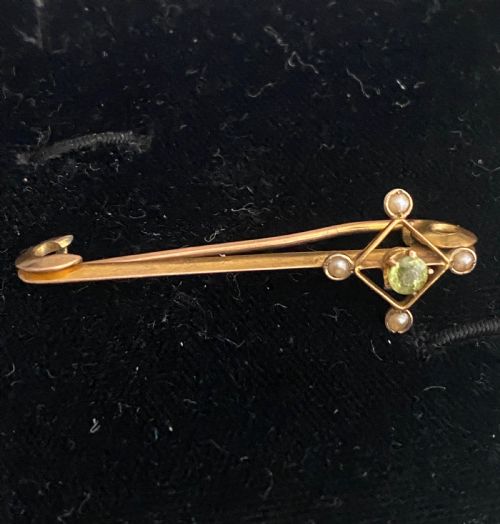
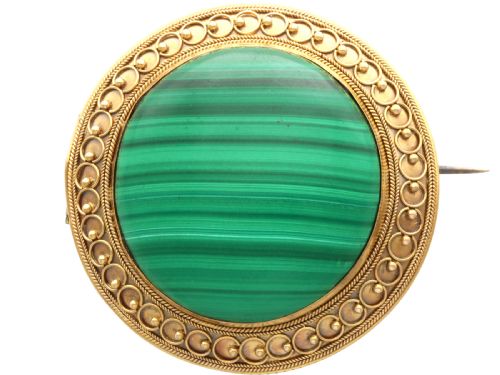


Green Gemstone Gold Brooch
A green gemstone gold brooch combines vibrant stones with precious metal, offering classic elegance for everyday wear.
Green Gemstone Gold Brooch
A green gemstone gold brooch brings together gold settings and green stones across Victorian, Edwardian, and Art Deco periods. Buyers seek these pieces for their distinct period character and the bright contrast of peridot, emerald, and malachite against yellow, white, or silver-backed gold.
The selection ranges from delicate cluster pins set with seed pearls to substantial pendant brooches featuring trellis work or star motifs. Most examples date from the late nineteenth century through to the 1930s, encompassing styles from Imperial Russian to clean geometric Art Deco designs.
Common forms include bar brooches and convertible pendant brooches that transition easily from lapel pins to necklaces. Each piece demonstrates the distinct aesthetic priorities of its decade, whether the flowing organic lines of the Edwardian era or the structured planes of the 1920s.
Materials and construction methods
Goldsmiths utilised various purities of yellow and white gold, alongside silver-topped gold settings designed to enhance the brilliance of mounted diamonds. Gemstones such as peridot, emerald, and chrysoprase were hand-cut and secured using traditional claw and collet settings.
Makers integrated delicate seed pearls and split pearls as decorative accents, often strung on fine wire or glued and pegged into position. Backings frequently incorporate hinged pin stems with C-clasps or safety catches characteristic of nineteenth and early twentieth-century jewellery production.
Green Gemstone Gold Brooch Retail Price Guide 2026
Typical asking prices for green gemstone gold brooch among the pieces listed under this phrase on Sellingantiques today, from the lower quarter to the upper quarter. They describe what is for sale here now, not the wider market.
Assessment of quality and execution
Superior examples display precise stone-setting, symmetrical arrangements, and well-balanced proportions between the central green gemstone and surrounding diamonds or pearls. The depth of colour and clarity in stones like peridot and emerald dictate the visual impact of the piece.
The complexity of the metalwork, such as pierced trellis designs or multi-layered star motifs, distinguishes standard production from finer masterwork. Original fitted cases and documented maker provenance further elevate the standing of an individual item.
G. Colani
The Green Gemstone Gold Brooch Glossary
- Peridot
- A transparent yellowish-green gemstone frequently utilised in Edwardian and Victorian jewellery. It provides the characteristic vivid green hue seen in many period cluster and pendant brooches.
- Seed Pearl
- Very small natural or cultured pearls, often half-drilled and mounted in clusters around a central stone. They are typical decorative elements in late nineteenth-century designs.
- Trellis Brooch
- A brooch featuring an openwork geometric lattice framework, often set with multiple gemstones and diamonds. This technique creates a light, airy structure while securing numerous stones.
- Cabochon
- A gemstone shaped and polished with a smooth, rounded convex surface rather than faceted. This cut is common for opaque stones like chalcedony, malachite, and bloodstone.
Green Gemstone Gold Brooch: Frequently Asked Questions
How do I date an antique brooch?
Dating relies on examining the mounting style, metal purity marks, and gemstone cut characteristics. Victorian pieces often feature heavy yellow gold and chalcedony, while Edwardian examples favour lighter platinum-topped gold, peridot, and seed pearls.
Art Deco items introduce geometric lines, white gold, and materials like black onyx and chrysoprase. Consulting hallmarking conventions and specific design motifs helps narrow the production era further.
Are peridot brooches fragile?
Peridot has a moderate hardness on the Mohs scale, meaning it can scratch if stored improperly against harder gemstones like diamonds. Care should be taken to store antique brooches in individual compartments or lined boxes.
Cleaning requires warm soapy water and a soft brush, avoiding harsh ultrasonic cleaners that might dislodge delicate seed pearls. Gentle handling ensures the longevity of these historic settings.
What is Imperial Russian jewellery?
Imperial Russian pieces originate from the workshops operating under the Tsarist regime, known for exceptional gemstone selection and meticulous metalwork. These items often incorporate fine peridots, diamonds, and distinctive case documentation from notable retail houses.
Such pieces represent the height of nineteenth-century European craftsmanship and command attention for their intricate trellis designs and superior stone pairing.