


Green Field Landscape Art
Green field landscape art captures pastoral scenes across Britain, offering pastoral calm and traditional countryside charm.
Green Field Landscape Art
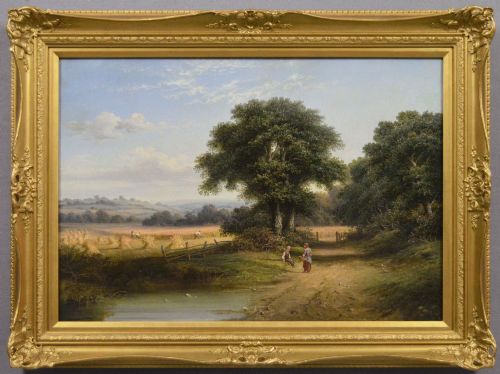
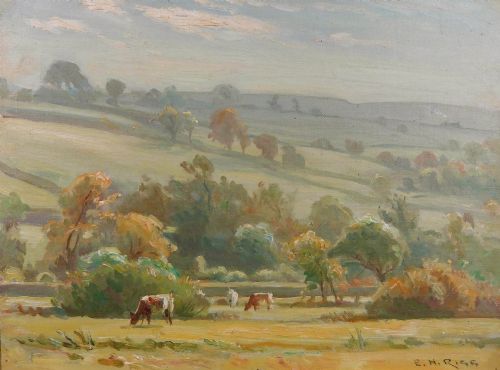
Green field landscape art encompasses original paintings portraying rural meadows, harvest scenes, and agricultural life across the British countryside. These works capture the changing light and agrarian rhythms of fields, riverscapes, and pastures through various historical periods.
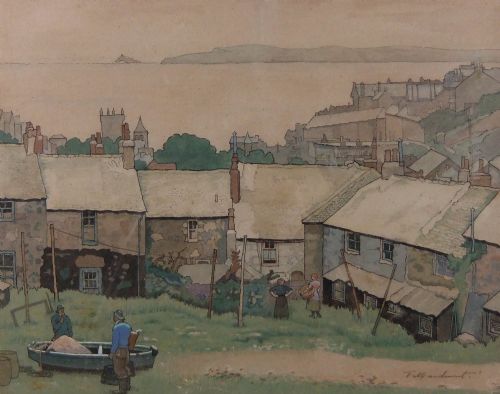
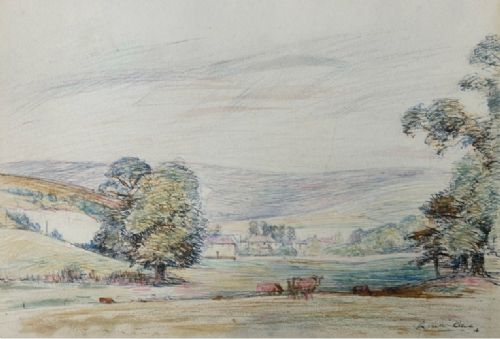
The selections available here range from Victorian pastoral watercolours to early twentieth-century oil paintings and mid-century topographical works. Buyers frequently encounter framed watercolours and oil paintings depicting figures in fields, cattle grazing, and haymaking.
Originating predominantly from British and English school traditions, these paintings reflect both regional topography and idealised rural views. The subjects span nineteenth-century studies to later twentieth-century coastal and inland meadows.
Materials and methods
Artists painted primarily in oil on canvas or applied watercolour to paper, utilising traditional pigments to capture natural light and vegetation. Oil paintings often retain heavy brushwork and texture, while watercolours rely on transparent washes and delicate line work.
Support materials include prepared canvas stretched over wooden frames, heavy-weight paper, and occasionally wood panels. Many works are housed in period frames, including ebonised and giltwood moulding which complement the painted surface.
Listings span periods from the nineteenth century through the 1950s, utilising oil, watercolour, and gouache on canvas, paper, and wood.
Evaluating quality
Quality rests upon the artist's ability to handle atmospheric light, perspective, and the tonal variations of green foliage and earth. Superior works demonstrate confident brushwork and precise compositional balance rather than mechanical repetition of rural clichés.
The handling of natural elements such as skies, water, and grazing animals distinguishes accomplished paintings from routine topographical sketches. Preservation of the original pigment vibrancy and the integrity of the canvas or paper surface also determine distinction.
Walter Heath Williams·Ernest Higgins Rigg·Thomas Maidment·Oswald Garside·William Greaves·James William Booth·John Atkinson·Henry H Parker·Herbert Royle·Arthur Claude Strachan·Claude Muncaster·Thomas E Francis
The Green Field Landscape Art Glossary
- Watercolour
- A painting method where fine pigment is suspended in water-based solution, applied to paper. It allows for translucent washes that capture luminous skies and gentle field contours.
- Oil on canvas
- Pigment mixed with drying oil applied to woven fabric stretched across a wooden frame. This medium permits rich impasto texture and deep colour saturation.
- Giltwood
- Wood carved and coated with a thin layer of gold leaf or gilt powder. It frequently frames traditional nineteenth-century landscapes to enhance the visual warmth of the artwork.
- Topographical landscape
- A work depicting a specific real-world location with geographical accuracy. These pieces serve as historical records of particular rural and river views.
- Impressionism
- An art style focusing on accurate depiction of light in its changing qualities. British practitioners adapted these principles to capture domestic pastoral settings.
Green Field Landscape Art: Frequently Asked Questions
What subjects appear in these landscapes?
Paintings typically depict agricultural scenes, including harvest fields, cattle grazing by rivers, ploughing teams, and rural pathways. These motifs reflect traditional British farming life and pastoral scenery.
Artists focused on capturing seasonal changes, from spring blossoms in Provence to summer haymaking in Yorkshire and Lancashire.
How should I frame these watercolours?
Watercolours require conservation mounting with acid-free materials to prevent paper degradation and discolouration over time. Glazing with protective glass safeguards the delicate pigments from ultraviolet light damage.
Traditional wood frames or gilt mouldings complement the period aesthetic of nineteenth and early twentieth-century works.
Where were these artists active?
Makers worked across various British regions, documenting local topography in Yorkshire, Lancashire, Sussex, and the Scottish Grampians. Others travelled to continental locations including France and Spain.
Regional art schools and coastal colonies like St Ives strongly influenced the palette and technique of these rural painters.
How do I identify the period?
Period indicators include costume details on figures, painting substrates, framing styles, and the distinct artistic movements recorded in signatures. Victorian pastoral works often feature narrative detail, whereas early twentieth-century pieces lean towards looser brushwork.
Examine the reverse of the canvas or paper for artist inscriptions, gallery labels, and exhibition stamps.