
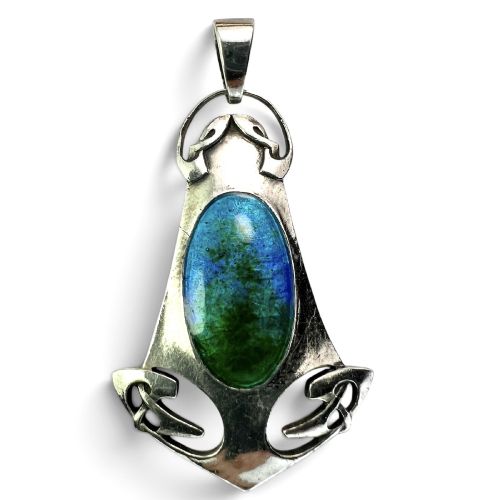
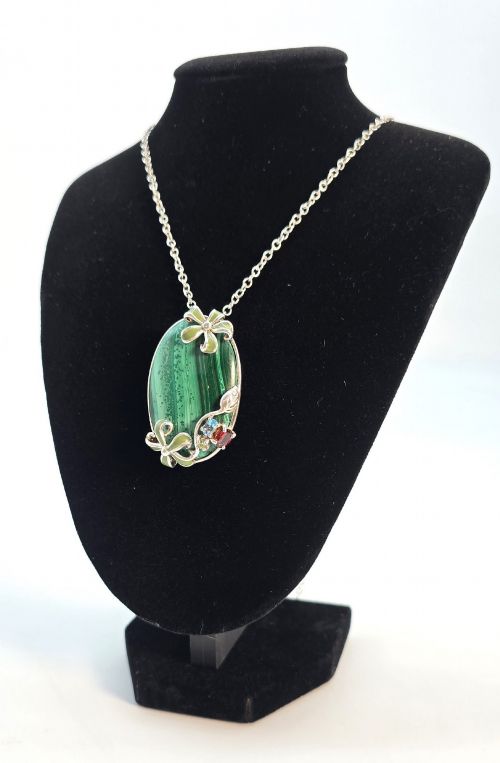


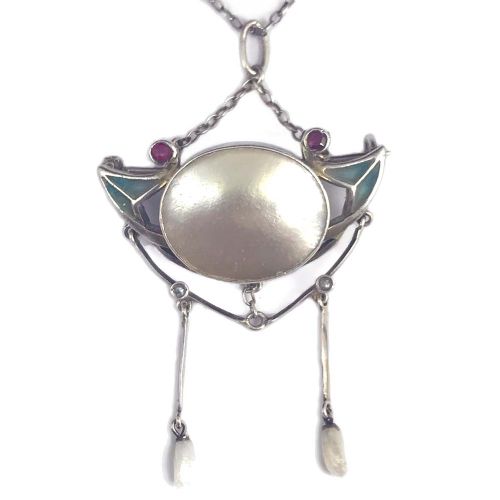

Green Enamel Silver Pendant
These green enamel silver pendant pieces combine vitreous colour and precious metal work, offering striking wearable design from historical periods.
Green Enamel Silver Pendant
A green enamel silver pendant is a decorative neck ornament featuring coloured vitreous glass set in silver metalwork, frequently appearing in forms from the nineteenth century through to the mid-twentieth century. The selection ranges widely across distinct historical design movements, including Art Nouveau, Arts and Crafts, and Edwardian aesthetic periods.
Makers working during the nineteen hundred period produced notable shield, butterfly, and heart shapes, often incorporating natural motifs central to the Arts and Crafts philosophy. Alongside standalone pendants, the listings reveal combined necklace pieces and convertible brooch formats utilising silver gilt and sterling silver.
Victorian and Austro Hungarian examples from the nineteenth century demonstrate elaborate multi gem settings featuring pearls and citrines alongside green enamel work. Later mid-century items adopt modernist geometric lines, reflecting changing tastes in jewellery manufacture across successive decades.
Materials and construction methods
Craftspeople integrated natural gemstones such as pearls, seed pearls, citrines, malachite, and chrysoprase directly into the silver framework alongside the enamel work. These elements were soldered and riveted together by hand, creating layered festoon necklaces, lockets, and pendant drops.
Listings span the nineteenth century, Edwardian era, and the nineteen hundreds, featuring silver, silver gilt, and vitreous enamel alongside pearls and citrines.
Assessing quality in silver and enamel jewellery
Quality rests upon the precision of the enamel work and the clarity of the translucent glass cells, particularly in delicate plique a jour pieces where structural integrity requires exceptional skill. Master smiths achieved smooth gradients and secure fusion between the vitreous paste and the silver wire partitions.
The sophistication of the metal framing and the inclusion of matched natural gemstones like seed pearls and chrysoprase separate standard production from workshop masterpieces. Signed pieces associated with documented designers show superior chasing, balanced proportions, and refined finishing on the reverse.
Murrle Bennett·Archibald Knox·Liberty and Co·Levinger and Bissinger·Otto Prutscher·Meyle and Mayer·Heinrich Levinger·Charles Horner·Martin Mayer·Ludwig Knupfer·Theodor Fahrner
The Green Enamel Silver Pendant Glossary
- Plique a jour
- Enamelling technique resembling miniature stained glass where transparent enamel is fired in open metal cells without a backplate. This allows maximum light transmission through the green coloured glass.
- Silver gilt
- Sterling silver that has been coated with a thin layer of gold on its surface. This treatment provides a warm golden tone while retaining the underlying strength of silver.
- Festoon necklace
- A decorative neck chain featuring draped garlands of linked metal, stones, or enamel drops. Popularised during the Arts and Crafts era.
- Vitreous enamel
- Glass powder fused to a metal surface through high temperature firing. It creates a durable, glossy coloured finish that resists fading over time.
Green Enamel Silver Pendant: Frequently Asked Questions
What is plique a jour enamel?
Plique a jour is a specialised glass firing technique where enamel is suspended within open wire compartments. It creates a translucent window effect that catches the light.
This method requires advanced skill from the jeweller to prevent the glass from cracking during the cooling process.
How do I date these pendants?
Dating relies on stylistic markers, such as the flowing organic curves typical of nineteen hundred Art Nouveau design. Structural fasteners and maker marks also help determine the period.
Edwardian pieces often feature delicate heart and bow motifs, while mid-century items show streamlined modernist geometries.
Were these items worn as brooches too?
Many historical designs were manufactured with dual mountings allowing them to function as both pendants and brooches. Jewelers added hinged pin stems and loops to the reverse side.
This versatility was common in the Edwardian and Arts and Crafts periods.
What gems accompany the enamel?
Makers frequently paired green enamel with pearls, seed pearls, citrines, chrysoprase, and malachite. These stones complemented the botanical themes favoured by Arts and Crafts designers.
Austro Hungarian examples also incorporated multi gem clusters into the silver framework.