






Green Canal Scene Art
Green canal scene art captures the quiet stillness of inland waterways through oils and watercolours spanning the Victorian era to the mid-twentieth century.
Green Canal Scene Art
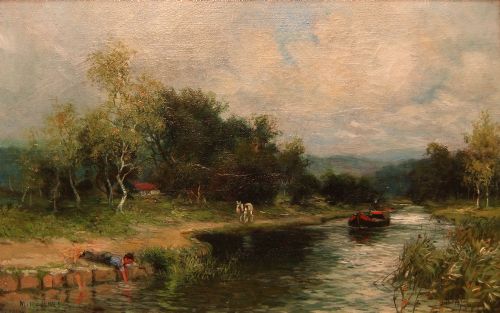
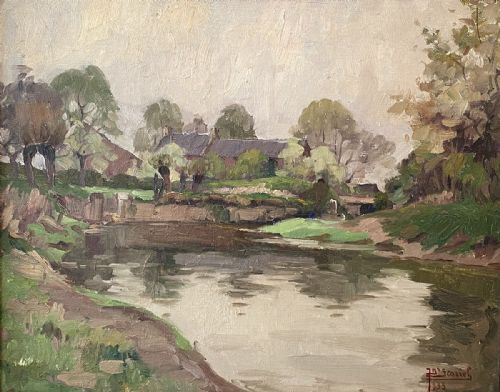
When you search for green canal scene art, you encounter oil paintings and watercolour paintings that depict rivers, locks, barges, and waterways rendered primarily in natural verdant tones. These works capture pastoral and urban aquatic views created across various decades, stretching from the nineteenth century into the mid-twentieth century.
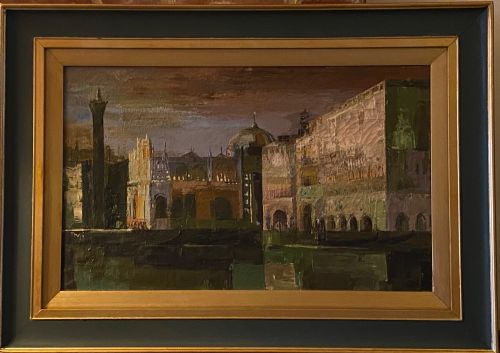
The pieces you are most likely to meet on this page span the Victorian period, the Edwardian era, and the mid-century modern landscape tradition. They feature Flemish, Dutch, and British river views, alongside Venetian canal settings executed by European artists working in impressionist and post-impressionist styles.
Each composition focuses on the interplay of water, boats, and surrounding foliage, presenting tranquil mooring scenes and busy lock gates. The subjects range from French and Dutch canals to English river landscapes, recorded by painters who worked outdoors or in studios during the 1900s, 1910s, 1940s, and 1950s.
How they were made
The artists responsible for green canal scene art applied oil paint to stretched canvas or watercolour pigments onto paper, capturing light and atmosphere across water. Many of these works employ visible brushwork characteristic of impressionist and mid-century impressionist techniques, building texture and depth with layered pigments.
Support materials include prepared canvas boards and heavy wove paper, occasionally housed within period frames adorned with gilt and gesso moulding. The construction of these frames relies on carved wood finished with gold leaf or painted plaster ornament that reflects the aesthetic of the Victorian and mid-century periods.
Green Canal Scene Art Retail Price Guide 2026
Typical asking prices for green canal scene art among the pieces listed under this phrase on Sellingantiques today, from the lower quarter to the upper quarter. They describe what is for sale here now, not the wider market.
Several barges pictured on these canals have quietly floated through the twentieth century without changing their painted moorings.
What varies in quality
The distinction between standard works and exceptional examples of green canal scene art rests upon the confidence of the brushwork and the subtlety of the colour palette. Stronger pieces display a sophisticated handling of light on water and atmospheric perspective, whereas lesser works rely on formulaic compositions and flat application of pigment.
Framing and preservation also dictate the standing of a piece, with original gilt and gesso frames enhancing the historical context of Victorian and early twentieth-century canvases. Works that retain their original stretcher bars, untouched paint surfaces, and legible artist signatures command greater regard among collectors of period paintings.
Antonio DeVity·Thomas Pyne·Maud Raphael Jones·Helen Donald-Smith
The Green Canal Scene Art Glossary
- Canvas
- A heavy woven fabric stretched across a wooden frame to serve as a sturdy surface for oil painting.
- Gesso
- A plaster-like mixture applied to wood frames to create a smooth base for gilding and ornamentation.
- Gilt
- A thin layer of gold leaf applied to the surface of picture frames for decorative enrichment.
- Impressionism
- An art style characterised by relatively small, thin yet visible brush strokes and an open depiction of light.
- Watercolour
- A painting method in which the paints are made of pigments suspended in a water-based solution on paper.
Green Canal Scene Art: Frequently Asked Questions
What periods do these paintings come from?
The selection includes works from the nineteenth century, the Victorian era, and the Edwardian period, alongside dated pieces from 1900, 1910, 1920, 1930, 1940, 1950, and 1960.
Mid-century impressionism and post-impressionism represent the later decades of this timeline, while earlier examples reflect nineteenth-century academic and landscape traditions.
What materials were used to create them?
Artists painted primarily with oil paint on canvas and watercolours on paper, utilising traditional supports of wood and canvas.
Frames incorporate materials such as gilt and gesso over wooden mouldings to enclose and protect the paintings.
How should I display a canvas painting?
Canvas paintings require placement away from direct sunlight and excessive moisture to protect the oil pigments and the underlying fabric.
Period frames help support the canvas structure and should be handled with care when hanging the artwork on a wall.
How do I identify a watercolour painting?
Watercolour paintings are executed on paper supports, often protected behind glass within a paper mount and a wooden frame.
These works rely on the reflective quality of the white paper shining through translucent washes of water-based pigment.