


Grand Canal Venice Painting
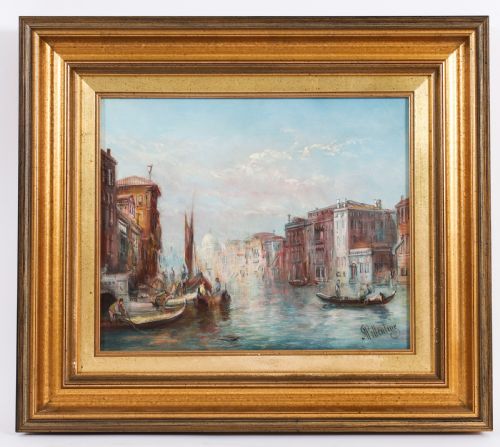
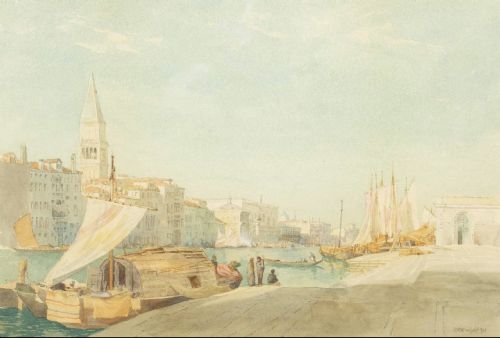
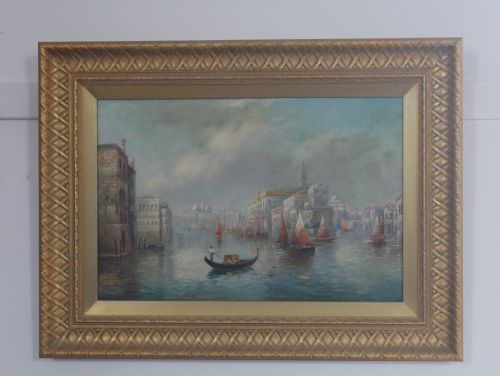
A grand canal venice painting brings the light and architecture of the lagoon into a room through oil on canvas or delicate watercolour.
Grand Canal Venice Painting
A grand canal venice painting captures the historic waterways, palazzos, and famous monuments such as the Doge's Palace, the Dogana, and Santa Maria della Salute. These works range from 19th-century veduta and Victorian fine art to later impressionist interpretations.
The most common formats met here are framed oil paintings on canvas and detailed watercolour paintings on paper. Subjects frequently include gondolas passing beneath bridges or sweeping townscape views along the water.
Many examples emerge from the 19th century, reflecting the popularity of Italian scenes among British and European travellers. Later pieces extend into the twentieth century, keeping the same topographical focus.
How they were made
Artists deployed oil on canvas to build rich layers of colour and texture, capturing the specific quality of light reflecting off Venetian water. Watercolours on paper offered a quicker, more fluid medium for recording atmospheric conditions during travel.
Finished works were typically housed in wood frames, often with giltwood or gilded wood surrounds that enhanced the visual presence of the scene. Pastel, gouache, and ink pen drawings also appear alongside the primary painted works.
Listings feature works spanning the Victorian era through the mid-twentieth century, executed in oil on canvas and watercolour.
What varies in quality
Quality rests on the precision of the perspective and the artist's ability to render the distinctive architecture and water reflections convincingly. Stronger works balance topographical accuracy with a luminous sense of atmosphere rather than relying on stiff mechanical repetition.
The framing contributes significantly to the overall impact, with period giltwood frames elevating the presentation of nineteenth-century canvases. Condition of the canvas, paper support, and pigment stability also separate standard decorative pieces from finer collector examples.
Alfred Pollentine·Richard Henry Wright·F J Aldridge·Antoine Bouvard Senior·William Raymond Dommersen·Vittore Zanetti Zilla·Hercules Brabazon Brabazon·William Knox·Jane Vivian
The Grand Canal Venice Painting Glossary
- Veduta
- A highly detailed, topographical painting of a cityscape, particularly popular in 18th and 19th-century Italy. These views prioritised accurate architectural rendering.
- Giltwood
- Wood that has been coated with gold leaf or gold paint, frequently used for traditional picture frames. This finish adds reflective warmth around the artwork.
- Gouache
- An opaque water-based paint that dries to a matte finish, often combined with watercolour or pastel in works on paper. It allows for brighter highlights.
- Palazzo
- A grand residential building or palace in Italy, which forms the architectural backdrop for many canal scenes. Their facades define the edges of the waterway.
- Impressionist
- A style focusing on the accurate depiction of light and its shifting qualities rather than strict detail. Artists applied loose brushwork to capture the transient atmosphere of the lagoon.
Grand Canal Venice Painting: Frequently Asked Questions
What is a veduta painting?
A veduta is a detailed, representational cityscape that records architectural landmarks with topographical precision. In Venetian art, these compositions map the canals and palazzos accurately.
Artists often produced these views for travellers completing the Grand Tour. They serve as historical records of how the city appeared in past centuries.
How should I hang these paintings?
These works suit traditional living spaces, libraries, or studies where their architectural subjects can be appreciated at eye level. Proper placement away from direct sunlight protects oil pigments and delicate watercolours.
Pairing a canvas with its period giltwood frame enhances its historical character on the wall. Ensure the wall fixings can support the weight of heavier framed oils.
Are watercolours as durable as oils?
Watercolour paintings on paper require greater protection from light and moisture than oil on canvas works. Framing under glass with acid-free mounts safeguards the paper support.
Oil paintings present a more robust surface that resists environmental changes better. Both mediums survive well when kept in stable indoor conditions.
How do I identify a 19th-century view?
Nineteenth-century pieces often display specific clothing styles on gondoliers and pedestrians, alongside framing materials typical of the Victorian era. Signatures, artist dates, and exhibition labels on the reverse provide further clues.
Stylistic approaches in this period favoured romantic or traditional Italian townscapes. Comparing the handling of light and water to documented works by known painters helps confirm the timeframe.