


Grand Canal Venice Canvas
A grand canal venice canvas brings the luminous light and historic waterways of Italy directly into a room.
Grand Canal Venice Canvas
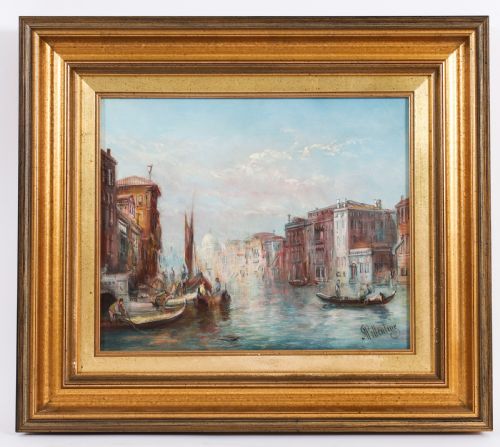
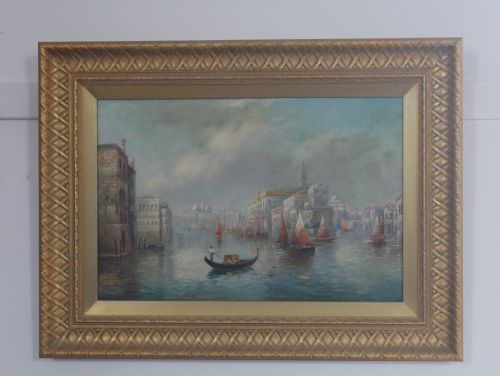
A grand canal venice canvas represents a focused tradition of townscape and veduta painting celebrating historic Italian architecture and bustling waterways. These works capture specific landmarks such as the Mocenigo Palace, the Doge's Palace, and the church of Santa Maria della Salute under characteristic Mediterranean light.
The pieces appearing on this page span from the nineteenth century into the twentieth century, showing styles that range from nineteenth-century romanticism and veduta to French post-impressionism and impressionist interpretations. Buyers will encounter both intimate cabinet-sized townscapes and larger decorative canvases.
Origins heavily reflect European artistic engagement with Venice, featuring notable nineteenth-century practitioners alongside later twentieth-century interpretations. The predominant form remains the oil painting on canvas, frequently housed within original giltwood or gesso frames.
Materials and Construction
These works are executed in oil paint upon woven canvas supports, utilising traditional ground layers and pigmented oils to achieve depth and luminosity in rendering water and stone. The handling of oil paint allows artists to build rich surface textures that reflect the shimmering atmospheric conditions of the Venetian lagoon.
Frames play an integral part in the physical makeup of these pieces, commonly constructed from wood and finished with intricate gesso mouldings and gilded surfaces. Giltwood and gilded wood frames provide both structural support and the reflective border necessary to complement the luminous quality of the paintings.
Frames associated with these paintings utilise traditional materials including wood, gesso, giltwood, and gilded wood.
Distinguishing Quality in Venetian Canvases
The standard of a grand canal venice canvas rests upon the precision of architectural perspective and the artist's ability to render the distinctive reflections of light upon water. Superior examples demonstrate confident brushwork and accurate topographical detail rather than rigid, mechanical copying.
The integrity of the canvas and the preservation of the original oil paint layer dictate the overall visual strength of the piece. Additionally, the quality and period compatibility of the accompanying giltwood or gesso frame contribute significantly to the work's complete character.
Alfred Pollentine·Marc Aldine·Antoine Bouvard Senior·E. Perez Senet·William Raymond Dommersen·Jane Vivian·J. Yates·Joseph Mallord William Turner
The Grand Canal Venice Canvas Glossary
- Veduta
- A highly detailed, topographical painting of a cityscape, most commonly associated with eighteenth and nineteenth-century views of Italian cities such as Venice. These works prize geographical accuracy alongside atmospheric effect.
- Giltwood
- Wood that has been decorated with a thin layer of gold leaf or powder, frequently utilised for ornate nineteenth-century picture frames. This finish enhances the warmth and visual presence of the framed artwork.
- Gesso
- A plaster-like mixture applied to wooden frame mouldings as a base for gilding and carving. It allows craftsmen to create sharp, decorative reliefs before applying gold leaf.
- Post-Impressionism
- An art movement extending beyond impressionism that prioritised symbolic content and expressive use of colour and brushwork. Works in this style offer a more subjective interpretation of Venetian scenes.
- Romanticism
- An artistic movement emphasising emotion, individualism, and awe in the face of nature and history. Nineteenth-century romantic views of Venice lean heavily into dramatic lighting and atmospheric skies.
Grand Canal Venice Canvas: Frequently Asked Questions
How do I identify a nineteenth-century Venetian canvas?
Nineteenth-century works typically display traditional oil painting techniques on canvas, often focusing on precise architectural veduta views of prominent landmarks like the Doge's Palace or the Grand Canal.
Examination of the canvas reverse, stretcher bars, and the style of the accompanying giltwood or gesso frame often provides further chronological context.
Where should I hang a grand canal venice canvas?
These townscape paintings suit traditional reception rooms, studies, or hallways where their rich colour palettes and historic subject matter can be appreciated at leisure.
Placement should avoid direct sunlight and excessive humidity to protect both the oil paint and the gilded wood frame.
What is the difference between veduta and impressionist styles here?
Veduta paintings prioritise topographical accuracy and meticulous detail in rendering Venetian palazzos, canals, and figures. Impressionist and post-impressionist interpretations focus more on loose brushwork and the play of atmospheric light.
Both approaches capture the essence of Venice but through distinct aesthetic lenses.
Are these canvases usually framed in wood?
Yes, the majority of these oil paintings are housed within wooden frames finished with gesso and gilding. These frames range from simple mouldings to highly ornate giltwood designs appropriate to the period of the artwork.