


Grand Canal Venice Art
Grand canal venice art brings the luminous light and historic palaces of the lagoon straight onto the wall.
Grand Canal Venice Art
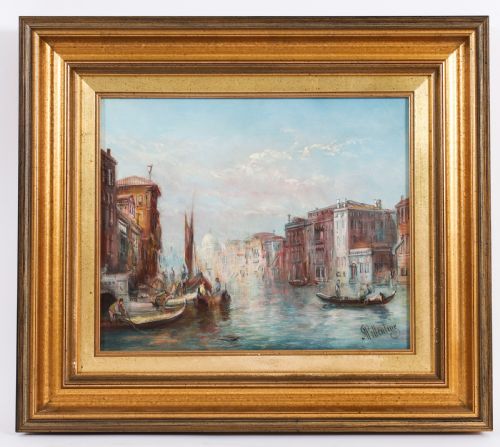
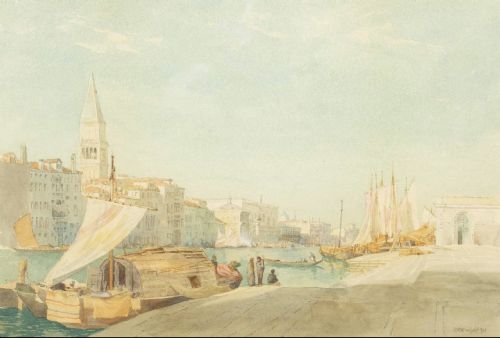
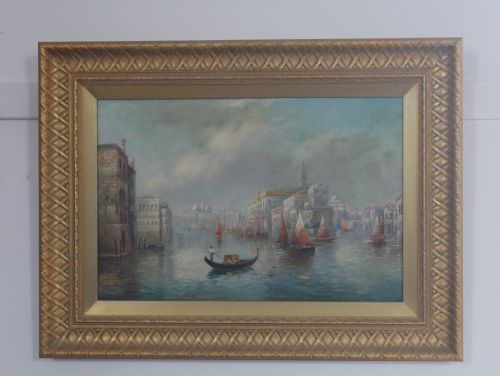
Grand canal venice art captures the famed waterways, palazzos, and gondolas through the eyes of nineteenth and twentieth-century painters. These works document historic vistas including the Doge's Palace, Santa Maria della Salute, and the Rialto area across various lighting conditions. Buyers meet both detailed architectural townscapes and looser atmospheric impressions rendered in pigment.
The most common pieces on this page are nineteenth-century oil paintings on canvas and framed watercolours on paper. Many adopt the veduta tradition of detailed topographical accuracy, while others lean towards impressionist brushwork or romanticism. Subjects frequently focus on specific landmarks such as the Mocenigo Palace or the Dogana from the water.
Piecemeal watercolours and pastel sketches sit alongside substantial oil paintings housed in giltwood frames. Dating spans from the Victorian era through the mid twentieth century, reflecting enduring artistic fascination with the Italian lagoon. Each composition frames the city's unique interface between stone architecture and open water.
Distinguishing quality
Quality rests in the artist's ability to handle perspective and the reflective surface of the water without falling into rigid illustration. Superior works show confident brushwork that breathes movement into gondolas and sky, whereas lesser pieces can feel stiff and overly formulaic in their architectural rendering. The subtlety of colour mixing determines whether the light feels luminous or flat.
The integration of the original frame with the canvas or paper often signals the overall care a piece has received over generations. Hand-carved giltwood frames that match the period of the painting elevate the visual impact compared to later, mismatched replacements. Strong provenance and clear signatures from recorded artists further set the finer examples apart from anonymous studio output.
Gondoliers navigate the painted canals in headwear that quietly dates the afternoon hustle of the lagoon.
Alfred Pollentine·Richard Henry Wright·F J Aldridge·Antoine Bouvard Senior·William Raymond Dommersen·Vittore Zanetti Zilla·Benedetto Salviati·Hercules Brabazon Brabazon·William Knox·Jane Vivian
The Grand Canal Venice Art Glossary
- Veduta
- A highly detailed, topographical painting of a cityscape, particularly popular in eighteenth and nineteenth-century Italy. These works prioritized accurate architectural rendering of famous views.
- Giltwood
- Wood that has been treated with gold leaf or gold paint for decorative effect. It frequently frames nineteenth-century paintings to enhance their visual depth.
- Gouache
- An opaque watercolour medium consisting of pigment mixed with a water-binding agent. It provides solid, flat areas of colour and sharp highlights in works on paper.
- Impressionist
- A style of painting emphasising spontaneous brushstrokes and the shifting effects of light. Artists working in this manner prioritized overall atmospheric mood over microscopic detail.
Grand Canal Venice Art: Frequently Asked Questions
How do I date an oil painting of Venice?
Dating relies on stretcher construction, canvas types, and the specific clothing styles of figures such as gondoliers in the scene. Signatures and exhibition labels on the reverse also offer reliable chronological markers.
stylistic shifts between nineteenth-century romanticism and later impressionism help narrow down the decade of creation.
Where should I hang a watercolour?
Watercolours on paper require placement away from direct sunlight to prevent the fading of delicate pigments over time. Consistent indoor humidity protects both the paper support and the surrounding mount.
Framing behind UV-filtering glass ensures the longevity of works by artists like Henry Wright or Hercules Brabazon Brabazon.
What is the difference between veduta and impressionism?
Veduta focuses on precise architectural draughtsmanship and topographical accuracy of landmarks like the Doge's Palace. Every window and stone block receives careful attention from the artist.
Impressionism sacrifices architectural strictness to capture transient effects of light and water movement through loose brushstrokes.
How are giltwood frames cared for?
Giltwood frames require dusting with a soft, dry brush to prevent the accumulation of particles in the intricate carved details. Moisture should be avoided entirely to protect the delicate gold leaf layer.
Professional conservation may be needed if the underlying wood or gesso shows signs of cracking or separation.