
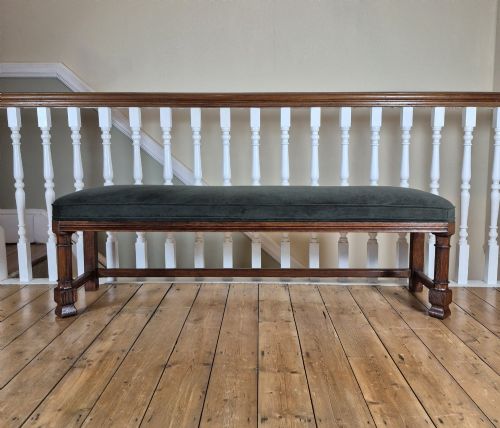
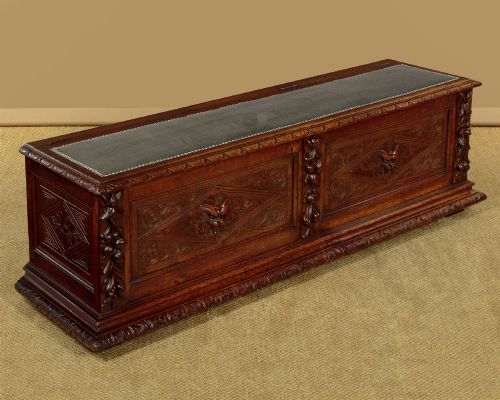
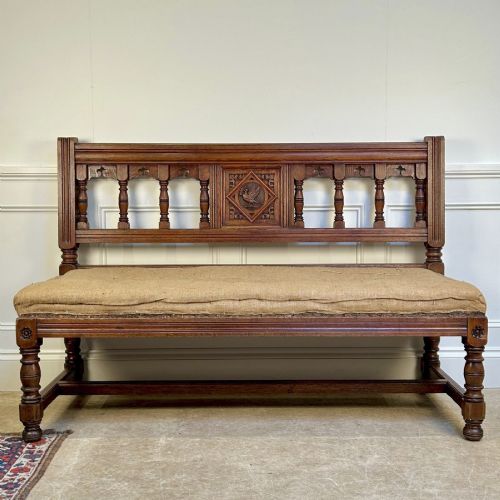

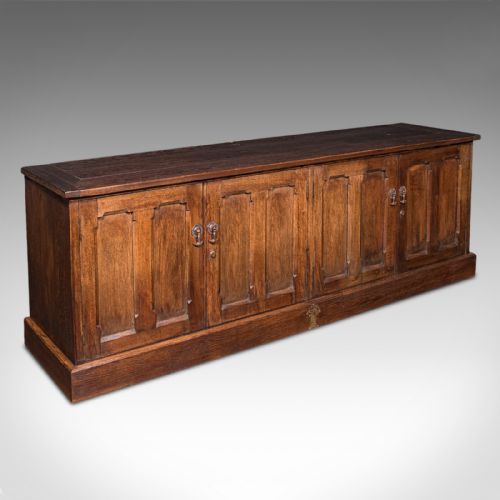


Gothic Window Seat
These gothic window seat examples combine architectural revival forms with sturdy domestic utility, offering authentic period character for hallways and alcoves.
Gothic Window Seat
A gothic window seat is a low form of seating designed to fit beneath a bay or casement, drawing on medieval architectural motifs such as pointed arches, tracery, and linenfold panels. These pieces emerge predominantly in the nineteenth century during the Gothic Revival, Victorian, and Arts and Crafts periods.
The versions most commonly met on this page are carved from oak and walnut, taking the shape of benches, hall seats, or cushioned stools upholstered in leather, velvet, or hessian. Makers also produced variations in the Reformed Gothic and Aesthetic Movement manners alongside apprentice pieces and sturdy plank benches.
Beyond placement beneath windows, these benches frequently serve in hallways, at the foot of beds, or alongside sideboards and dresser bases within period interiors.
Materials and construction
Carpenters relied heavily on solid English oak, walnut, and occasional burr elm, employing traditional mortise and tenon joints to ensure structural longevity. Timber surfaces were carved with architectural tracery or left with simple plank construction depending on the stylistic movement.
Upholstery utilised traditional stuffing secured over webbing, finished with durable coverings in leather, velvet, hessian, and patterned fabric. Metalwork details in brass and iron appear across hinges, brackets, and decorative mounts to complement the heavy woodwork.
Recorded styles span from Victorian and Gothic Revival through to Arts and Crafts, Aesthetic Movement, and Reformed Gothic.
Judging quality in construction and design
Quality rests primarily on the depth and crispness of the carving, distinguishing deeply undercut tracery and architectural mouldings from flat or mechanically churned surface work. The choice of timber also dictates standing, with dense figured oak and rich burr elm commanding higher regard than plain utility woods.
Structural integrity separates fine examples from standard pieces, marked by tight joinery, original upholstery foundations, and well-balanced proportions. Pieces bearing maker attribution or distinct stylistic adherence to Reformed Gothic or Arts and Crafts ideals show superior workshop execution.
GIllows·William Porden
The Gothic Window Seat Glossary
- Gothic Revival
- An architectural and decorative style drawing inspiration from medieval buildings, prominent throughout the nineteenth century. It manifests in pointed arches, trefoils, and heavy timber construction.
- Reformed Gothic
- A late nineteenth century design reform movement advocating for simpler, structurally honest forms inspired by medieval principles. It strips away excessive ornamentation in favour of geometric clarity.
- Aesthetic Movement
- A late Victorian design phase emphasising visual beauty over narrative function, often incorporating clean lines and refined wood tones. Walnut pieces from this circle frequently feature subtle inlay or restrained carving.
- Tracery
- Architectural stonework elements translated into woodwork, forming ornamental intersecting ribs in windows, panels, or chair backs. This is a defining visual feature of medieval design.
- Cassone
- A traditional Italian chest or coffer used for storing valuables and linens, occasionally adapted or styled as a bench seat. These storage forms share common structural joinery with early benches.
Gothic Window Seat: Frequently Asked Questions
Where should a gothic window seat go?
These benches sit naturally beneath low window alcoves, in narrow hallways, or positioned at the foot of a bedroom bed. Their narrow profile allows them to utilise transitional spaces without blocking movement through a room.
Ensure the height matches nearby tables or sills if placed directly beneath a window opening, allowing comfortable clearance for knees and cushions.
How do I care for nineteenth century oak?
Feed dry timber periodically with a traditional beeswax polish, applying sparingly with a soft cloth and buffing to a natural sheen. Avoid modern silicone sprays or excessive moisture which can damage aged finishes.
Keep wooden furniture away from direct radiator heat and strong sunlight to prevent timber shrinkage, warping, or cracking across large panels and carved friezes.
What is the difference between an oak bench and a window seat?
Window seats are generally proportioned lower and shallower than standard dining or long hall benches, specifically tailored for placement beneath architectural window heights. Many incorporate padded upholstery or squab cushions designed for seated comfort during extended periods.
Hall benches often feature high panelled backs and storage boxes beneath the seat, whereas window seats prioritize open lower frames or low box construction to maintain light flow.
How do I identify a Reformed Gothic piece?
Reformed Gothic items display a deliberate rejection of fussy Victorian ornamentation in favour of structural honesty, geometric lines, and exposed joinery. They often utilise contrasting timber inlays and incised linear decoration rather than deep relief carving.
Look for architectural rigour combined with simplified domestic utility, reflecting late nineteenth century design philosophies popularized by reformers like Charles Eastlake.