




Gothic Revival Writing Slope
These gothic revival writing slope pieces bring serious architectural presence to a desk, combining heavy timber with medieval structural motifs.
Gothic Revival Writing Slope
A gothic revival writing slope gathers the heavy ecclesiastical motifs and pointed arch forms of medieval architecture into portable or fitted desk formats. Buyers searching this phrase will find pieces spanning the Victorian and Edwardian eras, executed primarily in oak and rich exotic timbers like coromandel.
The selection ranges from compact lapdesks and slope boxes to larger Davenport desks, stationery cabinets, and inkstands. Oak forms the backbone of the domestic and Arts and Crafts examples, while luxury pieces employ coromandel with mother of pearl inlay.
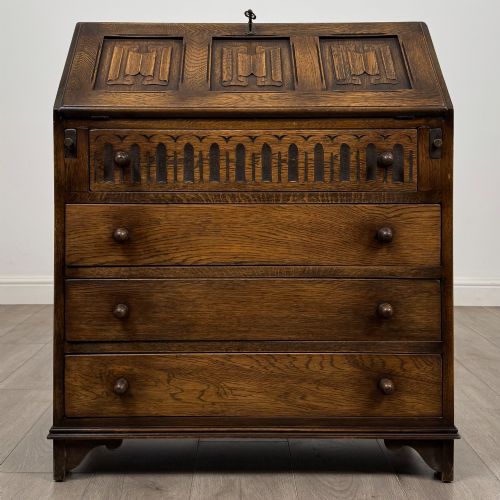
Most items you encounter date from the nineteenth century, reflecting the peak of the gothic revival movement in Britain. Forms vary from simple pitch pine sloping desks to elaborately carved linenfold bureaus and maker-signed library pieces.
How they were made
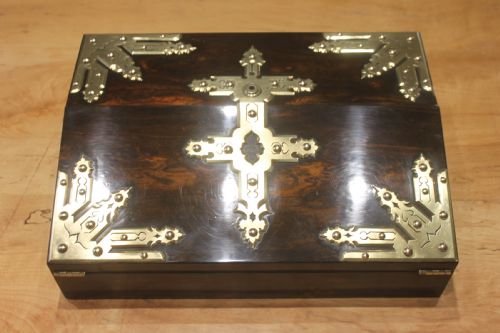
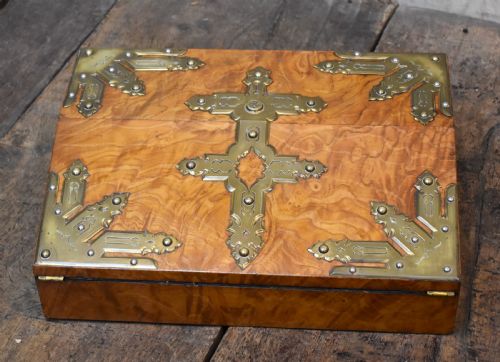
Cabinetmakers constructed these pieces using solid timbers such as oak, ash, and pitch pine, often framing them with structural mouldings that mimic stone tracery. Dense exotic hardwoods like coromandel provided a dark, contrasting canvas for brass mounts and mother of pearl escutcheons.
Carving defines the decoration, utilising deep relief techniques to produce green man motifs, linenfold panels, and pointed arch geometry. Interiors integrate fitted leather writing surfaces, glass inkwells, and secret compartments tailored for correspondence.
A sharp-eyed green man peers out from the oak carving on a Davenport desk, watching over centuries of forgotten ink stains.
What varies in quality
Quality rests upon the ambition of the timber selection and the depth of the cabinet work, moving from straightforward utility pieces in pine and oak up to richly figured coromandel veneers. Maker attribution elevates a piece significantly, particularly when signed by known workshops in London or Belfast.
The crispness of the architectural carving distinguishes standard production from exceptional work, especially on green man masks and linenfold panels. Complete internal fittings, original brass hardware, and intact leather surfaces preserve the integrity of the design.
Briggs 27 Piccadilly London·Rodman and co of Belfast
The Gothic Revival Writing Slope Glossary
- Gothic Revival
- An architectural and decorative style drawing inspiration from medieval forms, pointed arches, and heavy timber construction. It dominated British design through much of the nineteenth century.
- Coromandel
- A dense, heavily figured exotic hardwood from Southeast Asia with dark brown and black striations. It was favoured by nineteenth century makers for luxury desk boxes and stationery cabinets.
- Linenfold
- A style of wood carving that imitates folded linen drapery, frequently utilised on panels for desks and bureaus. This motif reinforces the medieval monastic aesthetic of the period.
- Davenport
- A small compact desk featuring a sloping top hinged over a pedestal of drawers. The form became popular during the Victorian era for boudoir and parlour use.
- Escutcheon
- A protective plate surrounding a keyhole, often fashioned from brass or mother of pearl on these writing slopes. It serves both a functional purpose and a decorative role in the design.
Gothic Revival Writing Slope: Frequently Asked Questions
What is a gothic revival writing slope?
A portable or stationary desk featuring medieval architectural motifs like pointed arches and heavy timber construction. They were built to hold writing materials securely while introducing ecclesiastical style to domestic interiors.
Most examples date from the Victorian period and utilise oak, pine, or coromandel woods with specialised compartments for paper and ink.
How were slope boxes used historically?
These boxes provided a portable writing surface before fitted studies became standard in every home. The slanted lid created an ergonomic angle for handwriting while the internal well stored quills and paper.
Wealthy households kept them on library tables, carrying them between rooms or using them while travelling to manage correspondence.
How do I identify a Victorian piece?
Victorian examples rely heavily on historic revival styles, showing deep relief carving, linenfold panels, or architectural mouldings. Materials like pitch pine, oak, and coromandel dominate this era of production.
Construction details such as hand-cut dovetails and brass hardware help separate nineteenth century manufacturing methods from later reproductions.
Where should I place an inkstand?
An inkstand or stationery cabinet works best on a sturdy desk, side table, or bookcase where its architectural weight can anchor the room. Keep the piece out of direct sunlight to protect the timber and leather surfaces from fading.
Ensure glass inkwells and brass fittings are secured if the piece is placed in a high traffic area.