
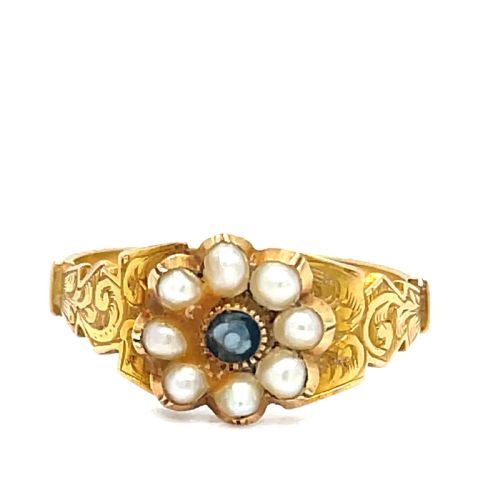


Gold Seed Pearl Cluster
Gold seed pearl cluster pieces bring together delicate marine spheres and bright gold in compact floral or target formations from the Georgian, Victorian, and Edwardian eras.
Gold Seed Pearl Cluster
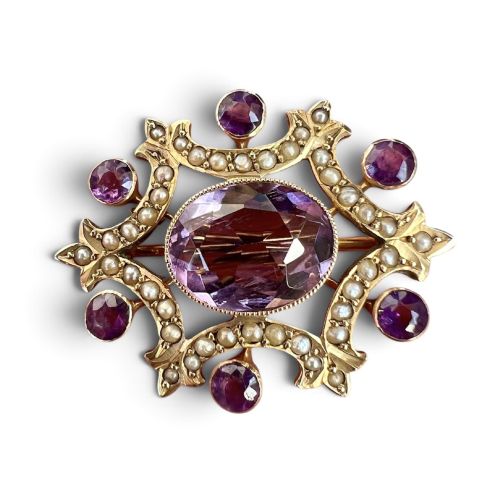
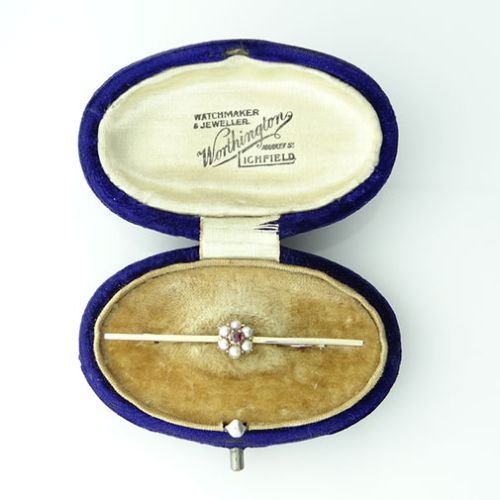
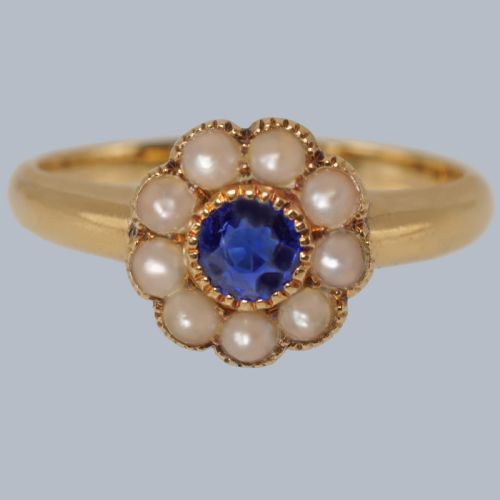
A gold seed pearl cluster centres on tiny, uniform marine pearls arranged tightly in geometric or floral groupings, framed by higher carat yellow or rose gold. These pieces appear across rings, brooches, pendants, earrings, and bangles spanning the Georgian, Victorian, and Edwardian periods.
The most frequent examples on this page are Victorian and Edwardian rings and brooches, often pairing the pearls with amethysts, garnets, peridots, or turquoise. Target designs and flower clusters dominate the forms, frequently utilising multi-tiered mountings to create depth.
Materials and Construction
Makers utilised 9ct, 15ct, and 18ct gold, sometimes paired with platinum in later Edwardian examples, casting or hand-fabricating the cluster bases to hold minute pin-pricked pearls. These tiny pearls were typically threaded on fine hair or wire, or secured with tiny peg settings inside closed-back or open collets.
Coloured gemstones such as amethyst, garnet, turquoise, and tourmaline form the central focal points of the clusters, surrounded by concentric circles of seed pearls. Enamel guilloche and rose-cut diamonds also appear in the earlier Georgian pieces, showing careful hand-tooling of the metal surfaces.
Several pieces incorporate hair beneath glass in mourning compartments, holding tiny pearl borders to remember distant relatives.
Distinctions in Quality
Quality rests in the uniformity and survival of the seed pearls themselves, as well as the crispness of the surrounding gold work. Closely matched pearls with a strong orient and minimal discoloration elevate a piece significantly above those with dull or mismatched spheres.
The weight and purity of the gold mount also set pieces apart, moving from lighter 9ct settings to substantial 15ct and 18ct gold structures. Superior examples maintain intact prong or peg settings without evidence of modern solder repairs interrupting the historic design.
The Gold Seed Pearl Cluster Glossary
- Seed pearl
- A very small, naturally occurring marine pearl, typically under two grains, prized for delicate historic cluster arrangements.
- Target design
- A concentric circular pattern resembling a target, where coloured stones or central pearls sit surrounded by multiple rings of seed pearls.
- Guilloche
- An ornamental engraving technique executed with a mechanical engine turning machine, frequently seen beneath translucent blue enamel in Georgian pieces.
- Collet
- A raised metal collar or band that surrounds and secures a gemstone or pearl within a piece of jewellery.
- Split pearl
- A half-pearl sliced or worked to sit flat against a metal backing plate, commonly utilised in Victorian cluster jewellery.
Gold Seed Pearl Cluster: Frequently Asked Questions
Are these pearls natural or cultured?
The pearls found in these Georgian, Victorian, and Edwardian pieces are natural saltwater pearls, formed organically before the advent of commercial cultured pearl production.
This gives each tiny sphere an individual orient and lustre that differs from modern mass-produced equivalents.
How can I tell a Victorian cluster from an Edwardian one?
Victorian pieces often utilise rose gold, deeper coloured garnets or amethysts, and closed-back settings, reflecting a heavier and more romantic aesthetic.
Edwardian examples shift towards lighter yellow gold and platinum, featuring brighter peridots and openwork filigree that create a lighter, airier visual weight.
Can I wear a cluster ring every day?
Daily wear is possible with careful habits, but the delicate nature of seed pearls requires removing rings before heavy manual work, swimming, or hand washing.
Storing them separately from harder gemstones prevents the pearls from becoming scratched or abraded over time.