
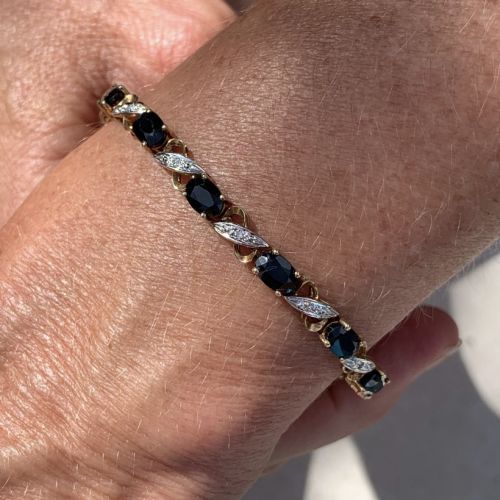


Gold Sapphire Bracelet
A gold sapphire bracelet brings together deep blue corundum and precious metal in forms spanning from Victorian worker to mid-century modernist design.
Gold Sapphire Bracelet
A gold sapphire bracelet is an arm ornament set with corundum stones, appearing frequently across this selection in Victorian, Edwardian, and mid-century forms. Buyers examine pieces ranging from delicate Edwardian mounts to substantial 1960s diamond-set link designs.
The materials span 9ct and 18ct gold housings paired with sapphires from origins such as Ceylon and Burma. Alongside pure sapphire clusters, these pieces often incorporate diamonds, rubies, pearls, or opals.
Structural types on this page include flexible line bracelets, heavy bangles, and triple-strand pearl creations with sapphire clasps. Each era brings distinct setting styles, moving from organic nineteenth-century motifs to geometric Art Deco lines.
Materials and construction
Goldsmiths utilised 9ct, 15ct, and 18ct yellow, white, and rose gold to construct secure settings for precious stones. Metal purity and colour shifted according to period preferences, moving from deep yellow hues in Victorian works to bright white gold frames in later twentieth-century items.
Craftsmen mounted natural sapphires alongside old cut, rose cut, and modern brilliant diamonds using claw, bezel, or star settings. Multi-stone configurations required precise metalwork to balance heavy gemstones within flexible links or rigid bangle hoops.
One persistent Victorian maker squeezed a star motif, a ruby, a diamond, and a sapphire all onto a single matt yellow gold bangle.
Factors separating grades
Quality rests on the origin and optical clarity of the sapphires, alongside the weight and purity of the gold mount. Natural unheated stones from sources like Ceylon command greater attention than treated alternatives.
The standard of associated diamonds, where present, and the intricacy of the metalwork dictate the upper tier of these pieces. Articulation in flexible tennis lines and the preservation of original clasps indicate superior manufacturing standards.
The Gold Sapphire Bracelet Glossary
- Ceylon sapphire
- A corundum gemstone originating from Sri Lanka, noted for a bright and lively cornflower blue shade. These stones appear frequently in antique British and continental settings.
- Rose cut
- A diamond cutting style featuring a flat base and a faceted dome that resembles an opening rosebud. This technique predominates in older Georgian and Victorian jewellery.
- Bangle
- A rigid circular bracelet that slips over the hand or opens on a hinge with a clasp. They appear in gold set with sapphires across the Victorian and Edwardian periods.
- Art Deco
- A design style spanning the 1920s and 1930s characterised by geometric symmetry and clean lines. Pieces from this era often pair calibre-cut sapphires with sparkling diamonds in white gold.
Gold Sapphire Bracelet: Frequently Asked Questions
How do I care for a gold sapphire bracelet?
Clean your gold sapphire bracelet using warm soapy water and a soft brush to remove dust from behind the stone settings. Avoid harsh ultrasonic cleaners, particularly if the piece incorporates pearls, opals, or foiled backs.
Store the item separately in a lined box to prevent the harder sapphire stones from scratching neighbouring gold links or softer gems.
How can I tell a Victorian sapphire bracelet from a 1960s piece?
Victorian pieces often employ lower-profile collet settings, 15ct gold, or rose gold hues paired with natural pearls and old cut diamonds. The overall construction tends to feel heavier and more hand-finished.
Mid-century and 1960s examples showcase brighter 18ct white or yellow gold, cleaner brilliant cut diamonds, and structured geometric or abstract link patterns.
Were these bracelets worn daily or for evening wear?
Many Edwardian and Victorian bangles were created for daytime wear as part of formal attire, while diamond-heavy Art Deco and 1960s tennis lines served primarily as evening ornaments.
Sturdy 9ct gold versions with secure box clasps handled frequent use, whereas delicate triple-strand pearl designs required careful handling.
What is the difference between a line bracelet and a bangle?
A line bracelet is flexible, constructed from a continuous chain of individual stone-set links that drape smoothly around the wrist. They fasten securely with a hidden box clasp and safety chain.
A bangle is a rigid solid hoop that maintains its circular shape whether worn or stored, sometimes featuring a hinged opening mechanism for easier placement.