

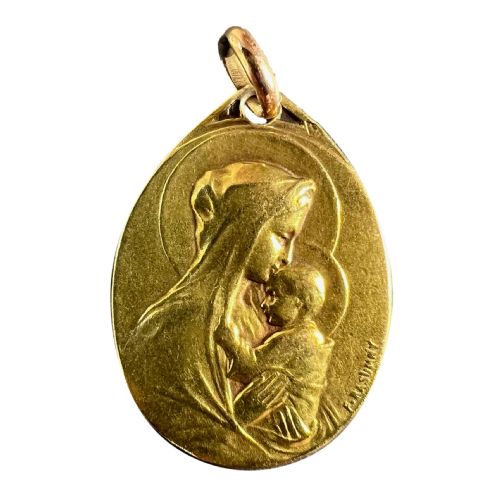
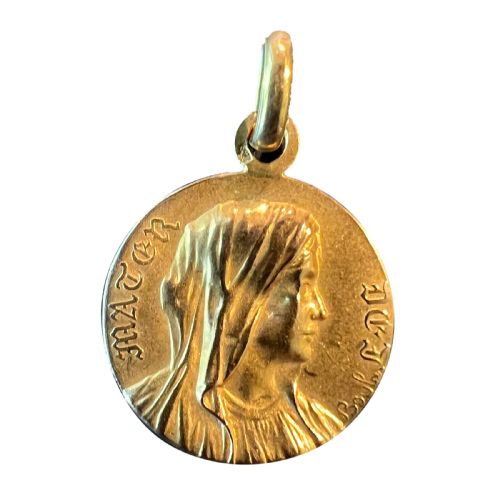
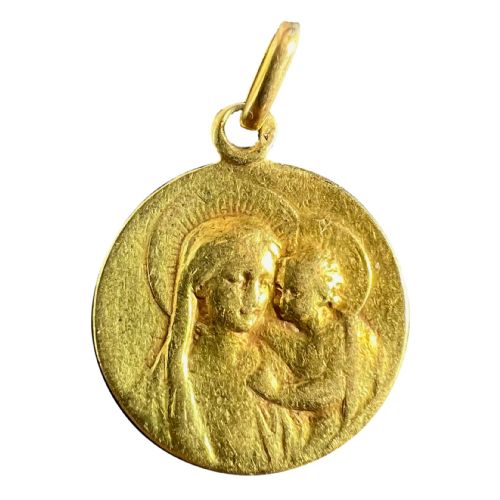


Gold Saint Medallion
These gold saint medallion pieces are French religious pendants and charms issued across the late nineteenth and mid twentieth centuries.
Gold Saint Medallion
A gold saint medallion takes the form of a small devotional pendant or charm intended to be worn close to the body. When collectors search for a gold saint medallion, they encounter French religious jewellery minted in precious metals.
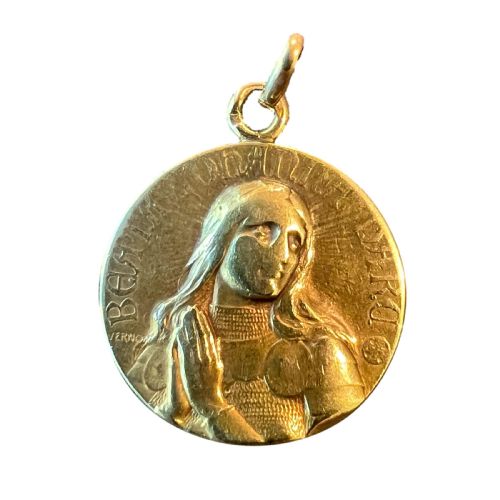
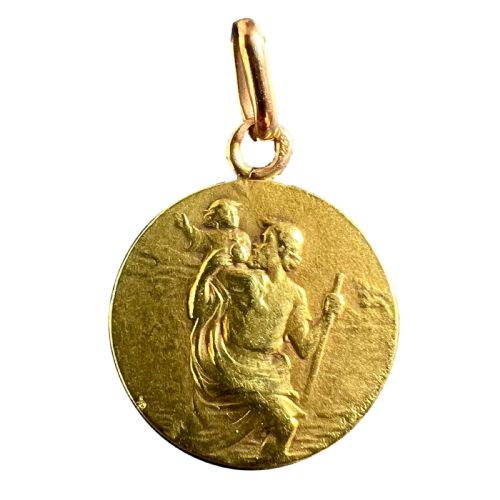
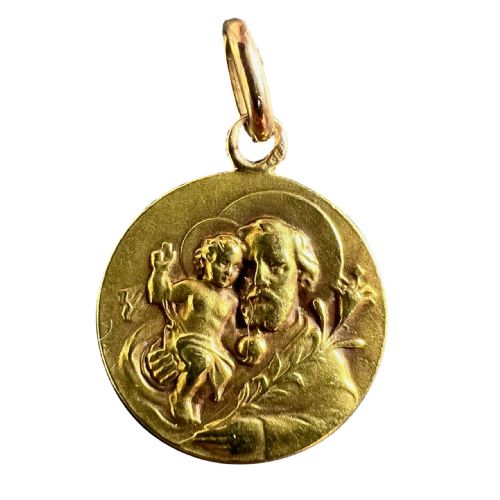
The pieces on this page originate predominantly from the early twentieth century, spanning decades such as nineteen ten and nineteen hundred. Most examples depict figures like the Virgin Mary, Saint Christopher, or Saint Joseph.
These items function as both personal amulets and miniature works of medallic art. Makers fashioned them as oval or round charms designed for suspension from a chain or ribbon.
Materials and construction
Makers utilised eighteen carat yellow gold, alongside variations in white and rose gold, to strike these devotional charms. Certain pieces incorporate mother-of-pearl as a contrasting background material for the carved relief.
Medals were produced through metal stamping and die-striking techniques, allowing prominent artists to achieve fine detail in the depiction of saints and sacred scenes. Engravers then finished the surfaces by hand to sharpen the contours of the figures.
Gold Saint Medallion Retail Price Guide 2026
Typical asking prices for gold saint medallion among the pieces listed under this phrase on Sellingantiques today, from the lower quarter to the upper quarter. They describe what is for sale here now, not the wider market.
Art Nouveau and Art Deco design motifs appear alongside French religious subjects, occasionally incorporating mother-of-pearl elements.
Distinctions in craftsmanship
Quality rests upon the crispness of the relief work and the reputation of the medallist who signed the metal. Medals bearing the names of recognised sculptors display superior depth and facial expression compared to anonymous mass-produced equivalents.
The preservation of delicate engraved lettering and the retention of original surface finish dictate the desirability of an example. Pieces that retain their sharp high points and crisp background textures represent the finest standards of the period.
Rasumny·Vernon·Emile Monier·Mazzoni·Guilbert·Sellier·Dropsy·Tairac·Perriat·Becker·Charl·Ruffony
The Gold Saint Medallion Glossary
- Medallion
- A large metal disc struck or cast to commemorate a person or event. In this context, it refers to wearable devotional pendants.
- Hallmark
- An official stamp applied to precious metals to indicate purity and origin. French pieces often bear tiny marks denoting eighteen carat gold content.
- Pendant
- An ornament that hangs from a necklace, chain, or cord. These items typically feature an integrated loop for suspension.
Gold Saint Medallion: Frequently Asked Questions
How do I wear a gold saint medallion?
These pieces function as pendants or charms suitable for daily wear on a fine gold chain or charm bracelet. Their compact size allows them to sit comfortably against the skin.
Ensure the suspension loop remains secure before adding the charm to a frequently worn chain. Many owners prefer pairing them with period appropriate gold chains.
What periods do these medallions date from?
The selection spans from the late nineteenth century through the mid twentieth century, with a heavy concentration in the nineteen tens. Art Nouveau and Art Deco stylistic influences appear across the chronological range.
Dates are often established through maker signatures and traditional French assay marks stamped directly onto the metal surface.
Which saints appear on these medals?
Common subjects include the Virgin Mary, Saint Christopher, Saint Joseph, and Saint Therese. Depictions of Jesus Christ and various regional or patron saints also feature prominently.
Specific iconography often relates to protection during travel, comfort in illness, or devotion to the Sacred Heart.
Are these items signed by artists?
Many examples display the miniature signature of the artist or engraver along the lower edge of the metal relief. Renowned medallists signed their work to denote authorized studio production.
A signature adds notable context to the history of the piece and assists in identifying the workshop of origin.