



Gold Ruby Carved Band
A gold ruby carved band brings together rich red stones and polished precious metal in settings spanning the Victorian, Edwardian and Art Deco eras.
Gold Ruby Carved Band
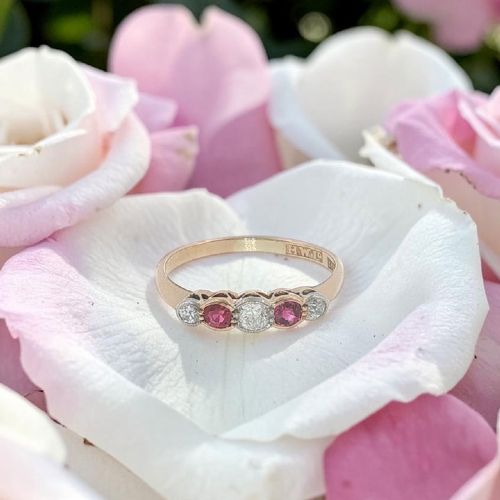
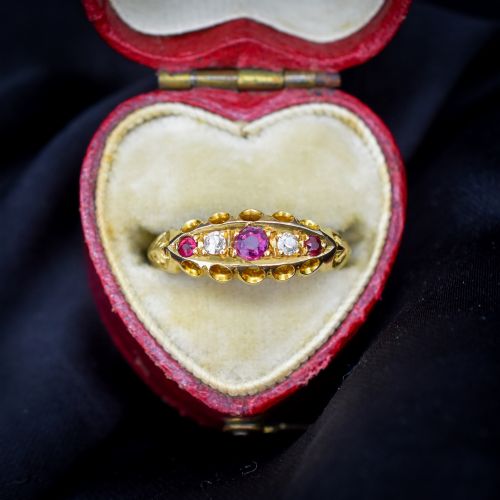
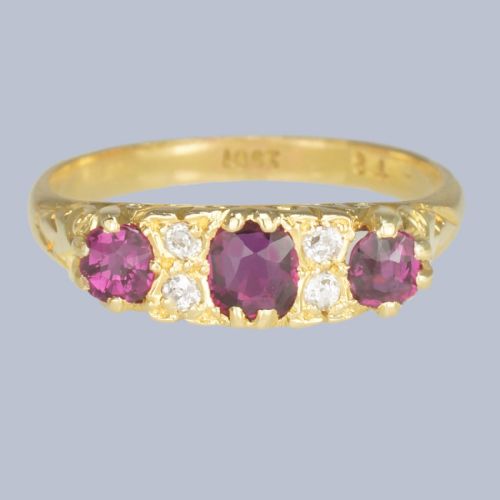
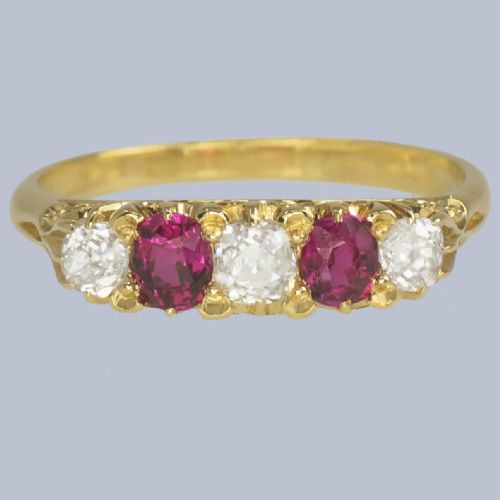
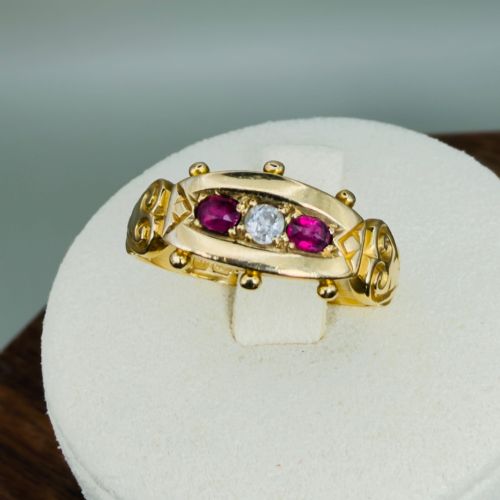
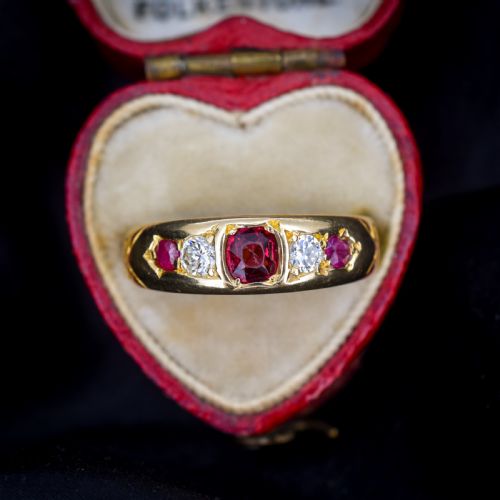
A gold ruby carved band presents ruby gemstones set alongside diamonds within gold rings originating from the Victorian, Edwardian and Art Deco periods. These pieces appear in forms such as five stone rings, boat rings, trilogy settings and patterned band rings.
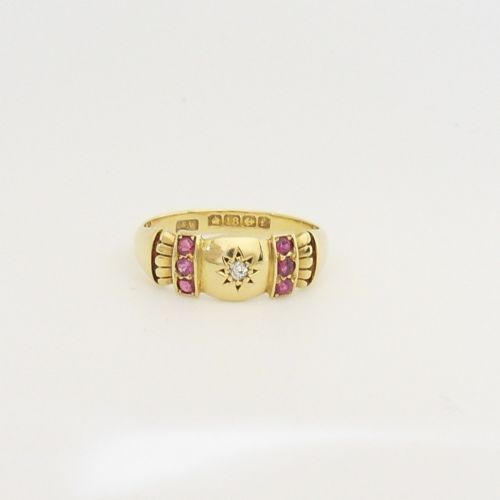
The materials recorded in these listings centre on 18ct gold, 15ct gold and 9ct gold, paired with ruby, diamond, garnet and red gemstone. Hallmarks frequently trace origins to regional assay offices including Chester and Birmingham.
Buyers encounter styles ranging from late Victorian work to Edwardian boat settings and geometric Art Deco layouts. The stones are often combined in starburst clusters or linear arrangements across the finger.
How they were made
Goldsmiths worked primarily in 18ct yellow gold, 15ct gold and 9ct gold to construct these bands, shaping the metal to house rubies and old cut diamonds. Stones were secured using claw settings, flush settings or detailed boat mountings characteristic of the early twentieth century.
Craftsmen applied surface decoration such as patterned engraving along the gold bands, visible in nineteenth century and Edwardian examples. Hallmark stamps were struck directly into the metal to record the purity and assay town.
Past owners clearly loved a boat ring, as Edwardian makers kept sending fleets of them to Chester and Birmingham.
What varies in quality
The distinction across these rings rests on the depth of the gold work, the crispness of the hallmarking and the visual presence of the rubies and diamonds. Heavier gauge 18ct gold mounts and well-matched old mine cut diamonds elevate an example above standard production.
Proportion and stone saturation determine the visual weight of the piece, where deeply coloured rubies interact with clear diamond accents. The precision of the carved band details and the clarity of Chester or Birmingham assay stamps further define the standard.
The Gold Ruby Carved Band Glossary
- Boat ring
- A ring featuring a curved, boat-shaped setting that lifts the central stones slightly above the finger. This silhouette was particularly favoured during the Edwardian era.
- Navette ring
- A ring shape resembling a small boat or eye, featuring an elongated pointed oval face. This format accommodates multiple stones in a slender horizontal line.
- Old cut diamond
- A diamond cut by hand before modern machinery, typically possessing a smaller table, higher crown and larger culet. These stones display a softer candlelit sparkle.
- Trilogy ring
- A ring set with three stones, traditionally representing the past, present and future. In these listings, rubies and diamonds are often alternated in this formation.
- Assay office
- An official body that tests the purity of precious metals and stamps them with hallmarks. Chester and Birmingham offices appear frequently on these rings.
Gold Ruby Carved Band: Frequently Asked Questions
How do I care for a gold ruby carved band?
Rubies possess good hardness, but cleaning should remain gentle with warm soapy water and a soft brush.
Harsh chemical dips risk damaging the gold and softer surrounding gemstones over time.
Can these rings be resized easily?
Most solid gold bands can be adjusted by a skilled jeweller working with the appropriate metal purity.
Intricate carved patterns or stones set all the way around require careful handling to preserve the design.
What is an old mine cut diamond?
An old mine cut diamond is an antique stone shape with a distinctive cushion outline and deep pavilion.
These diamonds were cut by hand to maximise brilliance under candlelight.
How do I identify an Edwardian ring?
Edwardian rings often feature lighter platinum or yellow gold settings with delicate openwork and boat shapes.
Assay marks and date letters stamped inside the band provide precise verification of the manufacturing year.