


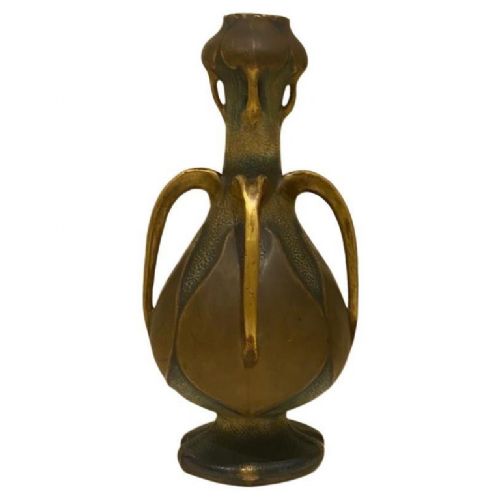


Gold Relief Vases
Gold relief vases bring sculptural depth and metallic warmth to a room, uniting the skilled hands of nineteenth and early twentieth-century makers.
Gold Relief Vases
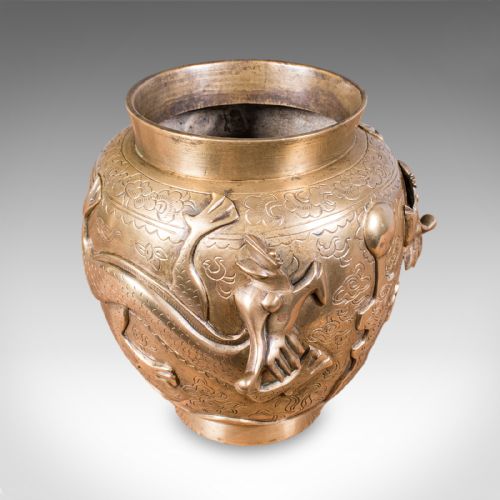
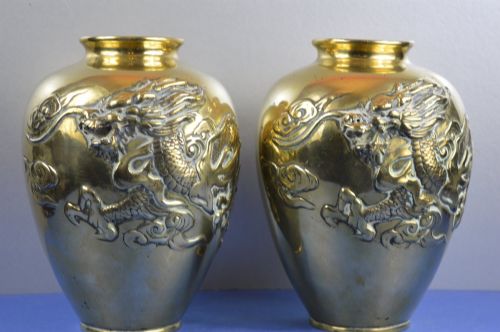
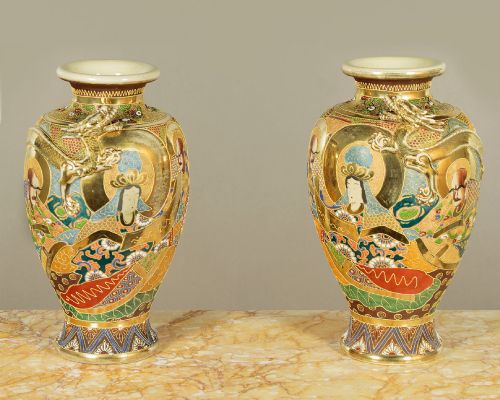
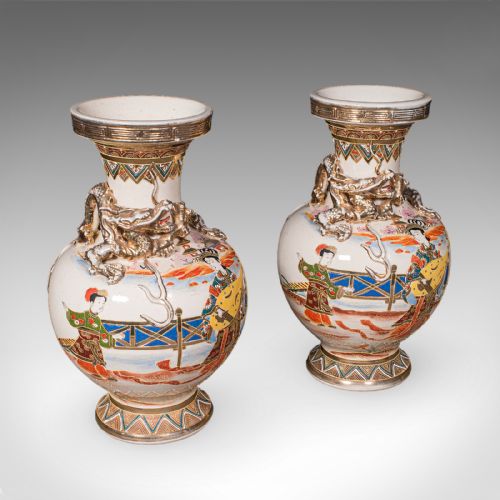
Gold relief vases encompass a striking mix of nineteenth-century European and Asian decorative arts, spanning Victorian urns, French Grand Tour bronzes, and Japanese Meiji ceramics. When you search for gold relief vases, you encounter pieces defined by raised metallic ornamentation, classical motifs, and intricate dragon designs cast or applied upon bronze, earthenware, and porcelain.
The selections available here lean heavily toward substantial paired urns and baluster forms from the Victorian era and the early decades of the twentieth century. Japanese Satsuma ceramics and Chinese bronze vessels feature prominently alongside French classical designs, offering collectors a rich variety of international aesthetics from the 1900s to the 1930s.
Materials and construction
These vessels rely on durable foundational mediums such as heavy bronze, brass, earthenware, and porcelain, often paired with green marble bases or finished with enamel and glaze. Artisans applied gold leaf and gilding to accentuate raised motifs, creating dramatic contrasts against patinated bronze surfaces and ceramic bodies.
Casting techniques dominated metal production, particularly for the Chinese dragon vessels and French classical urns, whilst ceramic pieces integrated hand-painted details with raised gilt elements. The physical weight of these pieces reflects solid bronze construction and thick ceramic walls designed to support elaborate sculptural relief.
Gold Relief Vases Retail Price Guide 2026
Typical asking prices for gold relief vases among the pieces listed under this phrase on Sellingantiques today, from the lower quarter to the upper quarter. They describe what is for sale here now, not the wider market.
Object types span decorative urns and baluster vases, incorporating Art Nouveau, Orientalism, and Japanese Meiji styles.
Distinctions in craftsmanship
Quality reveals itself in the crispness of the chased or cast relief work and the depth of the patination, distinguishing sharp, deliberate detailing from softened, mass-produced tooling. Superior examples display balanced proportions, secure mounts, and harmonious integration between the metallic gilding and the underlying bronze or ceramic body.
The finesse of hand-painted enamels and the precision of applied dragon motifs separate exceptional decorative urns from standard production pieces. Makers who maintained rigorous standards achieved a tactile richness where every gilded element interacts naturally with light and shadow.
Mougin·Royal Dux·Paul Dachsel
The Gold Relief Vases Glossary
- Baluster
- A vase form characterised by a rounded body that tapers toward a narrow neck and a flared rim. This graceful silhouette provides ample surface area for raised relief decoration and figural scenes.
- Grand Tour
- A nineteenth-century cultural tradition where affluent travellers acquired classical antiquities and reproduction bronzes in Europe. These decorative urns often emulate ancient Greek and Roman architectural forms.
- Meiji
- A period in Japanese history spanning from 1868 to 1912 noted for the opening of trade with the West. Japanese bronzes and ceramics from this era frequently combine traditional iconography with refined metallic finishes.
- Satsuma
- A type of Japanese earthenware featuring a crackle-glaze ivory body decorated with polychrome enamels and raised gold. These ceramics gained immense popularity in the West during the late Victorian period.
Gold Relief Vases: Frequently Asked Questions
What defines gold relief vases?
These decorative vessels feature raised metallic ornamentation, gilding, or gold leaf applied to surfaces of bronze, brass, earthenware, or porcelain. They range from nineteenth-century French classical urns to Japanese Meiji bronzes and Art Nouveau ceramics.
The defining characteristic is the tactile, three-dimensional quality of the surface design, which catches the light and emphasises motifs such as dragons, water lilies, and classical figures.
How were these vases used historically?
Most of these pieces served as decorative showpieces for drawing rooms, parlours, and grand hallways rather than functional vessels for fresh flowers. Large paired urns were frequently positioned on mantelpieces, pedestals, or side tables to demonstrate taste and refinement.
Heavier bronze and brass examples also functioned as architectural ornaments during the Victorian era and the French Grand Tour period, while smaller ceramic pieces held ceremonial posies.
How do I style gold relief vases at home?
Place these substantial vessels where natural light can strike the gilded surfaces and raised metallic relief, bringing out the intricate details of the bronze or ceramic body. Paired urns look striking when balanced symmetrically on sideboards, mantels, or dedicated display stands.
Allow the piece to anchor a space without overcrowding it, as the strong sculptural forms of Art Nouveau and Meiji designs command visual attention on their own.
How can I tell different periods apart?
Nineteenth-century and Victorian pieces often lean toward heavy bronze casting, classical French motifs, or intricate Chinese dragon iconography with deep patination. Early twentieth-century pieces, including Art Nouveau and Art Deco designs from makers like Mougin and Paul Dachsel, introduce more stylized organic forms and fluid lines.
Examining the base material, weight, and stylistic signatures provides clear clues to whether a piece originates from the Meiji era, the turn of the century, or the 1930s.