



Gold Opal Engagement Ring
A gold opal engagement ring combines shifting play-of-colour with diamond accents, spanning Victorian, Edwardian, and mid-century periods.
Gold Opal Engagement Ring
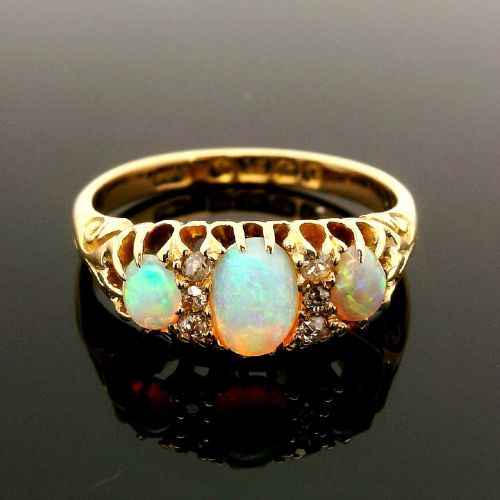
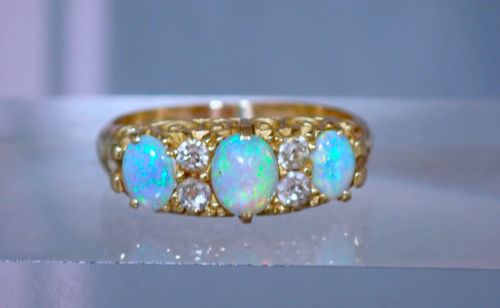
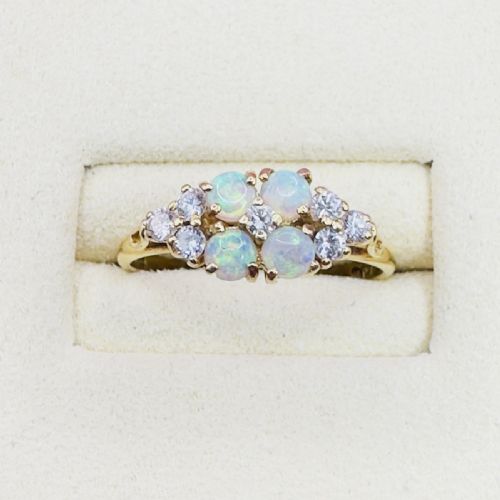
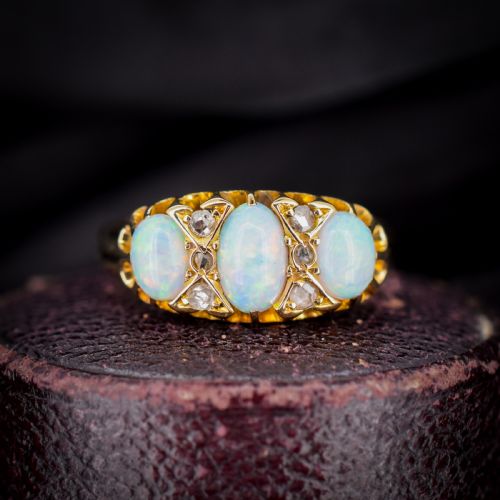
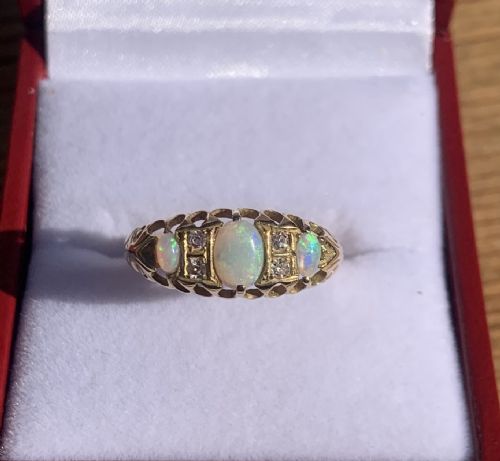
A gold opal engagement ring brings together fiery opals and supporting diamonds set in yellow gold, white gold, platinum, or silver. Buyers searching for a gold opal engagement ring encounter everything from nineteenth-century boat and trilogy designs to mid-century cluster forms.
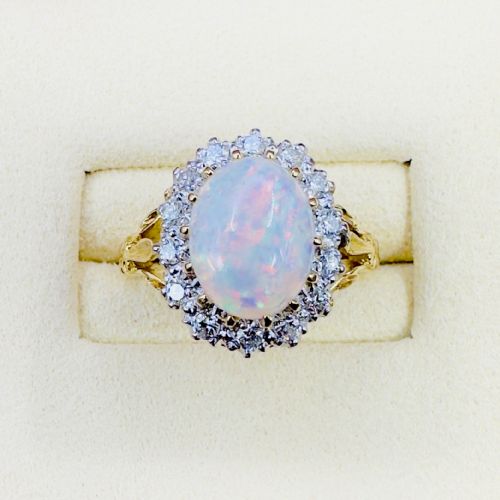
The selections span Victorian, Edwardian, Art Deco, and later twentieth-century periods. Common configurations include five-stone settings, crossover bands, and oval or round cabochon clusters.
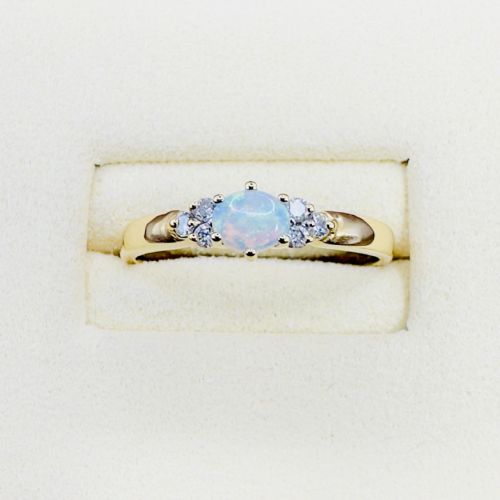
Earlier examples frequently pair natural opals with rose-cut diamonds in robust eighteen-carat yellow gold mounts. Later twentieth-century pieces often utilise nine-carat gold or cleaner contemporary classic lines alongside brilliant-cut diamonds.
Materials and construction
Goldsmiths constructed these rings using eighteen-carat yellow gold, eighteen-carat white gold, nine-carat gold, platinum, and occasionally silver settings. Opals are typically cut as cabochons to display their play-of-colour, secured with traditional claw or bezel settings.
Diamonds accompany the central stones either as single accents, trilogy sides, or surrounding cluster halos. Metalwork techniques range from hand-carved Victorian shoulders to platinum-topped Edwardian scrollwork and cast mid-century basket mounts.
Glasgow band markers and Chester assay stamps occasionally hide inside these antique hoops, whispering secrets of Victorian trade routes.
Judging quality in these rings
Quality rests primarily on the optical performance and stability of the opal itself, specifically the strength and distribution of its internal spectral colours. Stones with vibrant flashes across the entire cabochon face outrank duller specimens with muted play.
The proportion and matching of the accompanying diamonds also separate standard examples from finer ones. Well-preserved original claw work, crisp hallmark stamps, and substantial gold shank weight indicate superior original workshop standards.
The Gold Opal Engagement Ring Glossary
- Cabochon
- A gemstone shaped and polished with a smooth, rounded domed surface rather than faceted edges. This cut is essential for displaying the shifting internal flashes of natural opals.
- Play-of-colour
- The optical phenomenon where spectral colours flash across an opal as the viewing angle shifts under light. This visual property dictates the primary appeal of each stone.
- Trilogy ring
- A ring design featuring three principal gemstones set in a row across the finger, commonly representing past, present, and future. In these listings, opals usually form the centre stone flanked by diamonds.
- Boat ring
- A boat-shaped ring mounting featuring a curved, elongated setting that tapers toward the shoulders. This distinctive silhouette appears frequently in Victorian and Edwardian examples.
Gold Opal Engagement Ring: Frequently Asked Questions
Are opals durable enough for daily engagement wear?
Opals possess a lower hardness than diamonds, meaning they require a degree of mindfulness during everyday activities. Protective settings like bezels help shield the stone from knocks.
Regular care ensures these rings survive generations of daily use while maintaining their characteristic optical display.
How do I identify a Victorian opal ring?
Victorian examples often feature handcrafted eighteen-carat yellow gold shanks, natural cabochon opals, and hand-cut rose diamonds. Hallmarks stamped inside the band can pinpoint the exact assay office and year of creation.
Stylistic cues include boat settings, trilogy layouts, and heavy claw fastenings typical of nineteenth-century workshops.
What is the difference between an Edwardian and a mid-century cluster ring?
Edwardian cluster rings frequently combine platinum-topped gold work with delicate open-work galleries and millegrain detailing around the stones. Mid-century clusters tend to feature simpler basket settings in eighteen-carat or nine-carat gold.
Earlier pieces prioritise intricate wirework, whereas later decades favour cleaner, uniform profiles.