

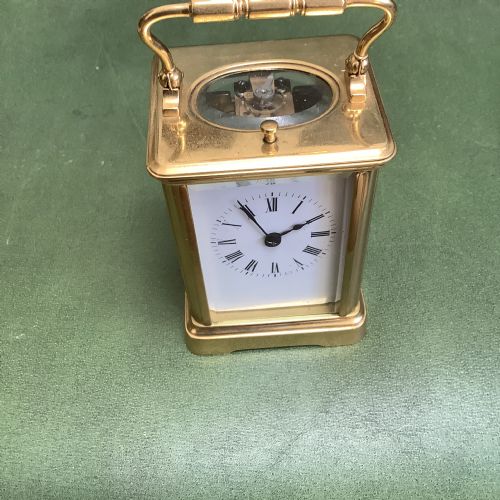

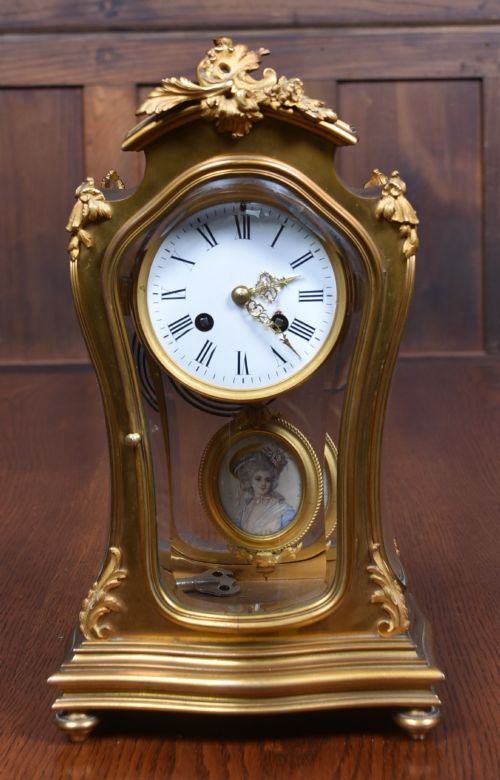
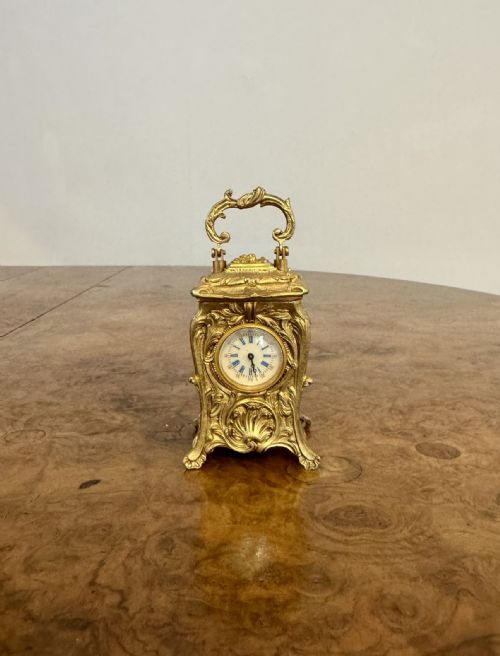


Gold Miniature Clock
A gold miniature clock brings precision timekeeping to a desk or mantel in a compact frame.
Gold Miniature Clock
A gold miniature clock represents a concentrated form of horology, usually taking the shape of a small carriage clock, strut easel clock, or bedside timepiece. Buyers seeking a gold miniature clock will encounter pieces primarily from the nineteenth century, the Victorian era, the Edwardian period, and the Art Deco years up to nineteen thirty.
Most examples originate from French workshops or British retailers, often constructed as carriage clocks with gilt brass, gilt bronze, or ormolu mounts that provide the golden finish alongside genuine gold mountings. These portable timepieces served travellers, boudoir settings, and formal desks, frequently featuring eight-day movements, alarms, or fitted travelling cases.
Materials and construction
Maker workshops utilised brass, gilt bronze, and ormolu as the foundation for cases, applying heavy gilding to achieve a rich golden lustre. Glass panels enclose the dial and movement, allowing visibility of the escapement and gear trains.
Surface decoration frequently incorporated vitreous enamel, champlevé enamel, porcelain mounts, and hand engraving. Components included chain fusee movements, rodier miniatures, and signed mechanisms produced by specialised horologists.
Gold Miniature Clock Retail Price Guide 2026
Typical asking prices for gold miniature clock among the pieces listed under this phrase on Sellingantiques today, from the lower quarter to the upper quarter. They describe what is for sale here now, not the wider market.
The listings span the nineteenth century through the Edwardian era and the nineteen thirties, encompassing brass, porcelain, leather, and vitreous enamel.
Evaluating quality and craftsmanship
The standard of a gold miniature clock rests upon the crispness of the hand engraving across the brass or gilt bronze case and the integration of enamel or porcelain panels. Superior pieces display fully engraved surfaces, multi-train movements with alarm or striking complications, and original leather travelling cases.
Lesser examples rely on plain, unadorned casework with standard time-only movements and mass-produced dial plates. The presence of maker signatures on the dial or movement substantially elevates the horological standing of the piece.
J C Vickery·Perigal & Duterrau·Rodier·Jaz
The Gold Miniature Clock Glossary
- Carriage clock
- A portable spring-driven timepiece designed for travel, typically featuring a glazed brass case and a swinging handle. These clocks became popular during the nineteenth century for their convenience and mechanical reliability.
- Champlevé enamel
- A technique where troughs are hollowed out in the metal surface and filled with vitreous enamel before firing. This process creates colourful decorative patterns across the gilt frame.
- Chain fusee
- A conical pulley and chain mechanism that equalises the declining power of the mainspring as it unwinds. This system ensures even tension and improves timekeeping accuracy.
- Strut clock
- A timekeeper supported by a hinged prop or easel on the back, allowing it to stand upright on a desk or dressing table. They frequently incorporate precious metal mounts and enamel decoration.
Gold Miniature Clock: Frequently Asked Questions
How do I wind a mechanical carriage clock?
Insert the appropriate winding key into the arbour on the backplate and turn it gently clockwise until you feel resistance. Do not overwind, as this can damage the mainspring.
Ensure you handle the glass panels with care while moving the clock to access the back door.
Did these clocks travel easily in the past?
Many nineteenth-century examples were supplied with bespoke leather travelling cases lined with velvet or silk. These cases protected the gilt brass exterior and the delicate glass windows during journeys.
Owners placed the clock inside the case and secured the lid before transport.
What is the difference between a timepiece and a clock?
In horological terms, a timepiece indicates hours and minutes without any striking or chiming mechanism. A clock includes additional gear trains that ring bells or gongs on the hour and half-hour.
Many miniature examples function solely as timepieces due to space constraints.
How do I distinguish Victorian from Edwardian pieces?
Victorian examples often display ornate Rococo Revival styling, heavy gilding, and elaborate hand engraving across the brass frame. Edwardian pieces tend to lean towards lighter neoclassical proportions or refined gilt cases.
Examining the casework style alongside hallmarks or retailer signatures helps determine the exact period.