

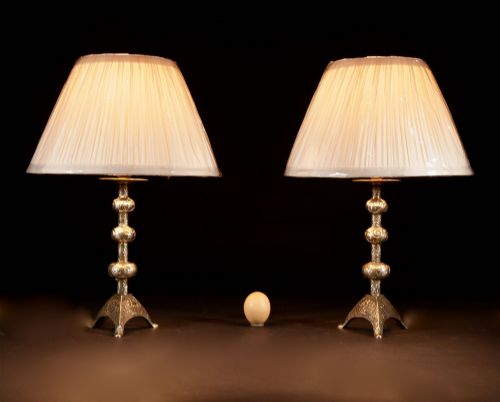


Gold Metal Reading Lamp
These gold metal reading lamps bring functional illumination and period character to a room, offering adjustable lighting and classical forms.
Gold Metal Reading Lamp
When you search for a gold metal reading lamp, you encounter table lamps and floor lamps that span the Victorian era, the nineteenth century, and the early twentieth century. These pieces draw on French Empire, Louis XVI, Art Nouveau, and Romanesque Revival styles to provide focused illumination.
You are most likely to meet brass, gilt metal, gilt bronze, or ormolu versions on this page, often paired with toleware or fabric elements. They appear as single table lamps, pairs, candle lamps, and adjustable standard floor lamps.
How they were made
These lamps utilise metals such as brass, gilt bronze, ormolu, and pressed brass, which are often cast or shaped into classical and revival forms. Some examples combine these metallic structures with black or green toleware and onyx components.
Makers incorporated adjustable mechanisms and twin branch configurations to meet functional needs, while surface gilding provided a polished or patinated gold finish.
Gold Metal Reading Lamp Retail Price Guide 2026
Typical asking prices for gold metal reading lamp among the pieces listed under this phrase on Sellingantiques today, from the lower quarter to the upper quarter. They describe what is for sale here now, not the wider market.
Materials recorded across the selection include solid brass, gilt bronze, ormolu, toleware, onyx, and fabric.
What varies in quality
Quality rests upon the weight of the metal and the precision of the casting, moving from standard pressed brass forms to heavy, finely chased gilt bronze or solid brass. Finer examples display crisp detail in their revival ornamentation and robust construction.
The sophistication of the stylistic execution also separates the range, with some pieces offering simple utility while others exhibit elaborate French Empire or Art Nouveau detailing.
The Gold Metal Reading Lamp Glossary
- Ormolu
- A gilded bronze technique used extensively for decorative mounts on nineteenth-century light fittings. It gives a rich, metallic gold appearance.
- Toleware
- Painted or lacquered sheet metal, frequently utilised in green or black for lamp bodies and shades. It provides a durable contrast to polished brass.
- Standard Lamp
- A tall floor-standing lamp designed to sit beside a chair or desk for reading. Adjustable versions allow the height or angle of the light to be altered.
- Gilt Metal
- Base metal treated with a gold-coloured surface coating or leaf. This provides the visual appeal of solid gold without the weight.
Gold Metal Reading Lamp: Frequently Asked Questions
Where should I place a floor reading lamp?
These tall standard lamps work well beside armchairs or desks where focused illumination is required for reading. Their adjustable designs let you direct the light downward as needed.
Ensure the height complements your seating and that the metal finish coordinates with other hardware in the room.
How do I identify a French Empire style lamp?
French Empire style lamps typically feature classical architectural motifs, heavy gilt bronze or brass construction, and formal symmetry inspired by antiquity. They often incorporate dark toleware bodies to contrast with the bright metal work.
These pieces date largely from the nineteenth and early twentieth centuries.
Are these lamps suitable for modern interiors?
The metallic finishes and clean classical lines of these pieces integrate smoothly into contemporary spaces. They add a layer of historic character and warm illumination to minimalist or eclectic rooms.
Pairing them with simple fabric shades helps bridge the gap between antique forms and modern living.
What is the difference between brass and ormolu?
Brass is an alloy of copper and zinc used for the structural bodies of many period lamps, offering a warm golden hue when polished. Ormolu specifically refers to gilded bronze, which involves applying gold to a bronze base for a richer finish.
Ormolu is typically found on finer French decorative pieces.