


Gold Leaf Coastal Artwork
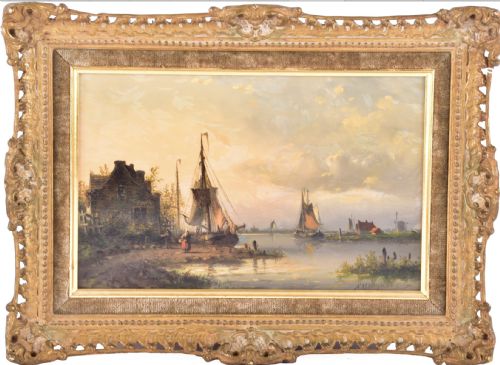
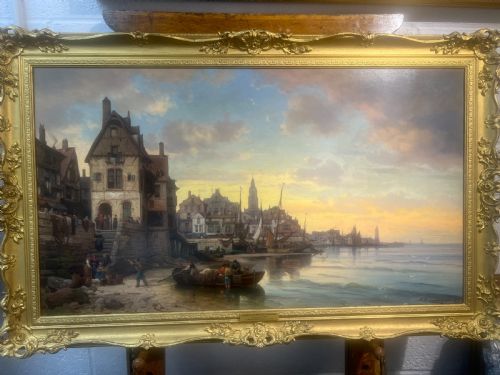
Gold leaf coastal artwork brings together maritime scenes and luminous frames, offering a glimpse of historic seas, shipping lanes, and stormy waters.
Gold Leaf Coastal Artwork
When you search for gold leaf coastal artwork, you find a distinct gathering of marine oil paintings, watercolours, and framed works capturing coastal views, harbour scenes, and stormy waters. These pieces typically date from the seventeenth century through to the early twentieth century, taking in Victorian marine art, Dutch Golden Age influences, and Scottish School paintings.
The works on this page lean heavily into nineteenth-century and Victorian depictions of shipping, fishing boats, and coastal towns. You encounter oil on canvas, paper, and gesso compositions that place maritime activity at the centre of the frame, paired with period giltwood frames that amplify the nautical light.
Makers and painters represented include figures such as Bonaventura Peeters, Charles Euphraisie Kuasseg, Pieter Cornelis Dommersen, George Henry Knight, Thomas Bush Hardy, G B Cullen, Hubert Thornley, and John Mc Ghie. Their subjects range from Dutch boats in a gale and South Coast fishing vessels to Neapolitan views and shipping on the Medway.
Materials and construction
The physical build of these pieces relies on oil paint applied to canvas or paper supports, often secured within wood frames prepared with gesso and finished in gold leaf. Artists utilised oil on canvas to build rich coastal atmospheres, while watercolour on paper captured lighter marine expanses.
Giltwood frames form an essential component of the material record, using layers of gesso beneath gold leaf to catch and reflect light around the painted maritime scene. Wood and glass additionally protect and structure the watercolours and oil paintings from the period.
The listings combine oil paintings, watercolours, and framed works across nineteenth-century, Victorian, and seventeenth-century periods.
Judging quality in marine works
Quality rests upon the handling of light and water by the artist, distinguishing a hurried harbour sketch from a masterly oil painting of Dutch boats in a gale. The depth of the oil on canvas and the precision in depicting rigging, hulls, and coastal architecture signal the maker's hand.
The state of the original giltwood and gesso frames carries considerable weight, as period frames finished in gold leaf complement the artwork. Cohesion between the painting and its framing defines the upper tier of these historical coastal pieces.
Bonaventura Peeters·Charles Euphraisie Kuasseg·Pieter Cornelis Dommersen·George Henry Knight·Thomas Bush Hardy·G B Cullen·Hubert Thornley·John Mc Ghie
The Gold Leaf Coastal Artwork Glossary
- Gesso
- A plaster-like mixture applied to wood frames before the application of gold leaf. It provides a smooth base that can be moulded and burnished.
- Giltwood
- Timber that has been decorated with gold leaf or gold paint. It frames many historical oil paintings to enhance their visual warmth.
- Marine art
- Artwork that depicts or draws its main inspiration from the sea. This genre encompasses shipping scenes, coastal views, and naval battles.
- Oil on canvas
- A painting medium where pigments are suspended in drying oils and applied to stretched fabric. It dominates historical coastal artwork for its durability and depth of colour.
Gold Leaf Coastal Artwork: Frequently Asked Questions
What periods do these coastal artworks cover?
The selection spans from seventeenth-century Dutch marine works up to early twentieth-century pieces from nineteen-ten. Victorian and nineteenth-century examples form the core of the current records.
You also find specific dates recorded on individual pieces, such as eighteen-sixty-one or eighteen-eighty, linking the maritime scenes directly to their Victorian contexts.
How should I care for a giltwood frame?
Giltwood frames finished with gold leaf require gentle dust management with a soft brush rather than liquid cleaners. Keeping them away from direct sunlight and damp conditions preserves the gesso and metallic leaf.
Allowing the wood to acclimatise to a stable indoor environment prevents the gesso from cracking or separating from the underlying timber base.
What subjects appear most often in these paintings?
Shipping vessels, harbour scenes, and fishing boats dominate the compositions. Works frequently capture specific locations like Hastings, Rochester on the Medway, or Neapolitan coastal views.
Artists also depicted dramatic weather, from Dutch boats caught in a gale to calmer seas along the South Coast and Scottish shores.
Are these works usually sold as pairs?
Several listings feature pairs of oil paintings or watercolours by the same artist, often created around the same year. These matched pairs provide a balanced display of coastal or shipping views.
Single oil paintings of harbours or marine scenes also appear frequently alongside the paired works.