

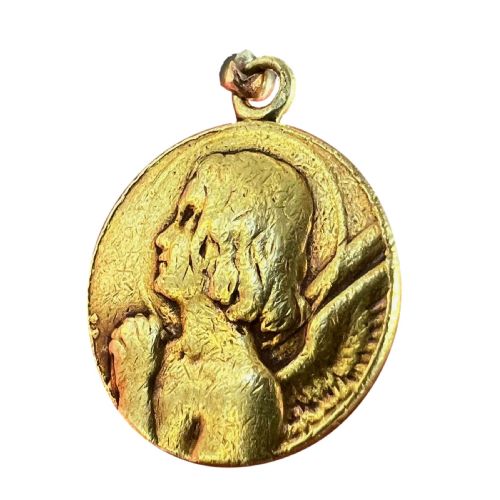
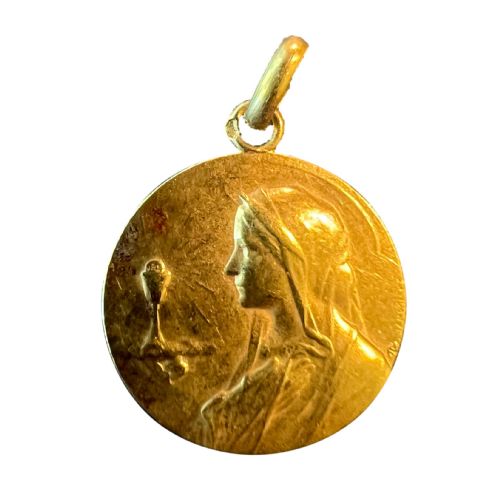


Gold Holy Pendant
These gold holy pendant pieces combine sacred imagery with fine metalwork, offering a tangible connection to early twentieth-century devotion.
Gold Holy Pendant
A gold holy pendant is a piece of devotional jewellery worn close to the heart, featuring sacred figures such as the Virgin Mary, Jesus Christ, and various saints. When searching for a gold holy pendant, buyers encounter devotional medals and charms originating mainly from France across the late nineteenth and early twentieth centuries.
The pieces listed on this page span the Art Nouveau, Art Deco, and French Religious styles, capturing a period of meticulous miniature craftsmanship. Most examples take the form of round or oval medals that combine religious iconography with ornamental borders typical of French workshop production.
Materials and construction
These items are fashioned primarily from 18ct yellow gold and rose gold, providing a warm, enduring foundation for intricate religious relief work. The metal is stamped or cast to form distinct devotional scenes, often enhanced with delicate detailing on the figures and surrounding frames.
Selected pieces incorporate natural materials such as pearl and mother-of-pearl as backing plates or decorative accents, contrasting softly with the polished gold. Workshops utilised these varied components to give depth and texture to miniature representations of holy subjects.
Gold Holy Pendant Retail Price Guide 2026
Typical asking prices for gold holy pendant among the pieces listed under this phrase on Sellingantiques today, from the lower quarter to the upper quarter. They describe what is for sale here now, not the wider market.
Periods represented span from 1890 through the 1930s, encompassing Art Nouveau and Art Deco styles.
Distinctions in quality
Quality in these devotional items rests upon the crispness of the relief work and the depth of the engraving on the gold surface. Superior examples display sharply defined facial expressions and garments on figures like the Madonna or Jesus Christ, whereas lesser pieces show softer, worn contours.
The articulation of secondary elements, such as the crown of thorns, floral borders, or integrated pearl settings, further separates standard production from finer workshop output. The weight and purity of the gold, alongside the clarity of maker marks and stamps, complete the distinction between ordinary charms and exceptional medals.
Sellier·Dropsy·Grün·Lasserre·Vernon·Jules Holy
The Gold Holy Pendant Glossary
- Medal
- A small metal disc bearing a sacred image or inscription intended for devotional wear. These items often commemorate significant religious milestones or holy figures.
- Charm
- A small decorative trinket suspended from a loop or bail on a chain. In this context, charms share the devotional focus of larger medals.
- Art Nouveau
- A design style characterised by flowing, organic lines and natural motifs. This aesthetic heavily influenced French religious jewellery around the turn of the twentieth century.
- Art Deco
- A later style defined by geometric precision and stylised symmetry. Pieces from this era reflect a shift towards cleaner architectural borders.
Gold Holy Pendant: Frequently Asked Questions
How were these pendants used?
These items were suspended from chains and worn close to the body as protective amulets or reminders of personal devotion. They often marked significant spiritual events such as holy communion or baptism.
Owners frequently kept them for a lifetime, passing them down through families as cherished heirlooms with deep sentimental value.
How do I date a gold holy pendant?
Dating relies heavily on stylistic markers, such as the flowing organic curves typical of Art Nouveau pieces versus the geometric borders of Art Deco designs. Maker marks and assay stamps on the gold bail or rim also help establish the decade of production.
The periods represented in these items span from the late Victorian era through the interwar years of the twentieth century.
What materials are used in these pendants?
The primary material is 18ct yellow or rose gold, providing a durable and luminous setting for the sacred imagery. Some designs incorporate organic elements like pearl and mother-of-pearl to add subtle contrast.
These materials were chosen for their longevity and ability to hold fine detail during the stamping and engraving processes.