



Gold Gilt Inkstand
A gold gilt inkstand brings absolute presence to a desk, offering a glittering centrepiece that turns everyday correspondence into an opulent ritual.
Gold Gilt Inkstand
A gold gilt inkstand unites a polished writing surface with integrated holders for ink and sand, establishing order and splendour on a private desk. These pieces emerge from the nineteenth century in varied guises, ranging from compact Regency and Victorian designs to elaborate French Empire and Art Nouveau creations.
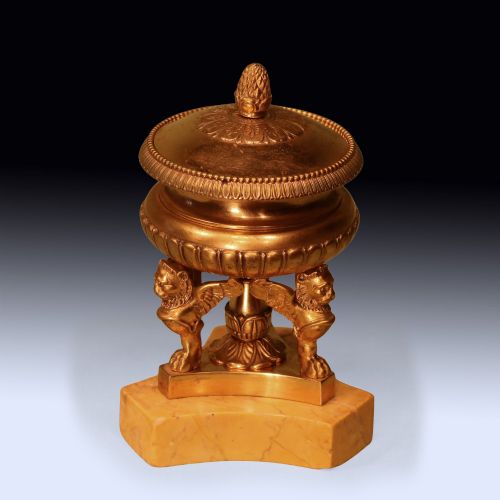
The version most commonly met on this page is the nineteenth-century ormolu or gilded bronze desk set, frequently mounted upon a contrasting marble base. Such objects combine heavy cast metalwork with functional glass or porcelain wells, serving both decorative and practical domestic roles.
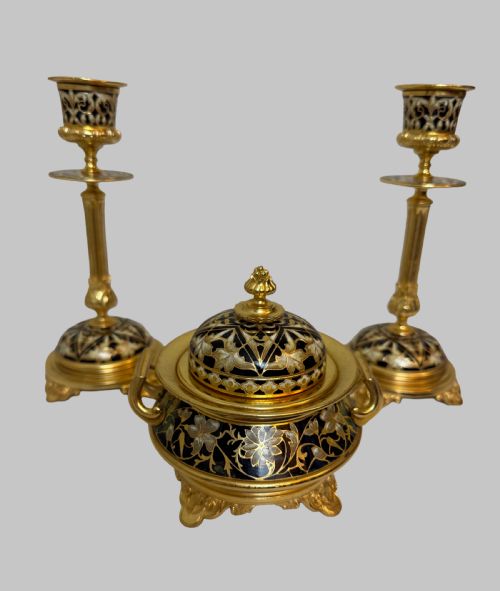
Beyond standard double or single inkwells, the selection encompasses figural subjects involving animals, alongside matching desk accessories like candlestands and letter holders. They reflect a period when writing materials received the highest levels of decorative metal craftsmanship.
Materials and methods of construction
The foundation of these objects relies on cast bronze, brass, or ormolu, shaped through detailed metalworking and finished with a layer of gold gilding. Many incorporate heavy mineral elements such as Sienna marble to anchor the composition and provide a stable platform for the metal fittings.
Internal ink reservoirs utilise blown glass inserts alongside fitted porcelain components, such as Minton porcelain or Worcester ceramic bodies. Specific examples integrate specialised decorative techniques, including champlevé enamelling and applied silver gilt elements.
Artisans employed precise casting and mercury or electro-gilding processes to achieve a lasting metallic sheen across figurative and architectural motifs. Organic details, such as glass eyes in figural pieces, demonstrate the careful assembly of mixed media by period craftsmen.
One stag desk accessory retains its original glass eyes, watching over the inkwell with unblinking Victorian intensity.
Measures of quality and distinction
The upper tier of these pieces displays crispness in the metal chasing, where fur, foliage, and architectural moulding retain sharp definition without softening. Lesser examples show blurred casting details and thin surface applications that fail to capture the depth of the original model.
Integration of materials dictates the standing of a desk set, distinguishing standard production items from bespoke artistic works. Pieces featuring matched marble bases, intact original glass inserts, and named foundry or maker attribution consistently command greater attention.
The balance of proportion and the structural integrity of hinged lids and removable liners separate routine desk accessories from superior examples of nineteenth-century metalwork.
Albert Marionnet·Flight Barr And Barr·Marson And Jones·Minton·Robert Hennell
The Gold Gilt Inkstand Glossary
- Ormolu
- Gilt bronze produced by applying a finely ground mercury and gold amalgam to a bronze object, then heating to drive off the mercury. This technique creates a durable, luminous golden finish characteristic of French decorative arts.
- Champlevé
- An enamelling technique where troughs or cells are hollowed out of a metal surface and filled with vitreous enamel powder before firing. The resulting coloured patterns sit flush with the surrounding metal borders.
- Silver Gilt
- Solid silver that has been coated with a thin layer of gold, combining the weight and hallmarks of silver with a golden appearance. It is frequently termed vermeil in continental contexts.
- Desk Set
- A coordinated assembly of writing accessories, which commonly includes an inkwell, a sander, a pen tray, and sometimes matching candlesticks or letter holders.
- Figural
- Describing an object that incorporates human, animal, or mythical forms into its design rather than relying purely on abstract or geometric ornamentation.
Gold Gilt Inkstand: Frequently Asked Questions
What was the purpose of a gold gilt inkstand?
These objects served as the primary station for ink, pens, and blotting sand on a nineteenth-century writing desk. They kept essential correspondence tools organised while projecting status and refinement in a study or parlour.
As domestic writing shifted from a private chore to a social ritual, elaborate desk sets became prominent decorative furnishings in wealthy households.
How do I identify a French Empire ormolu inkstand?
French Empire pieces rely on classical architectural motifs, symmetry, and heavy, fire-gilded bronze mounts. They often feature clean geometric lines inspired by antiquity rather than the asymmetrical curves of later revivals.
Look for deep ormolu chasing and materials like marble bases that anchor the formal, monumental character typical of the early nineteenth century.
What should I look for in a Victorian animalier desk set?
Victorian animalier pieces focus on naturalistic animal figures, such as lions, stags, or domestic cats, cast in bronze or gilded metal. The quality depends on the anatomical precision of the modelling and the expressiveness of the subject.
Check whether details like original glass inserts or glass eyes remain intact, as these components complete the narrative of the figural scene.
How do I care for a gilded bronze desk accessory?
Gilded bronze requires gentle dusting with a soft, dry cloth to prevent accumulation of debris in the recessed chasing. Avoid liquid cleaners, chemical polishes, or abrasive cloths, which can strip the thin gold layer from the bronze substrate.
Keep glass and porcelain liners clean by washing them separately with mild soapy water, ensuring they are completely dry before returning them to the metal housing.