
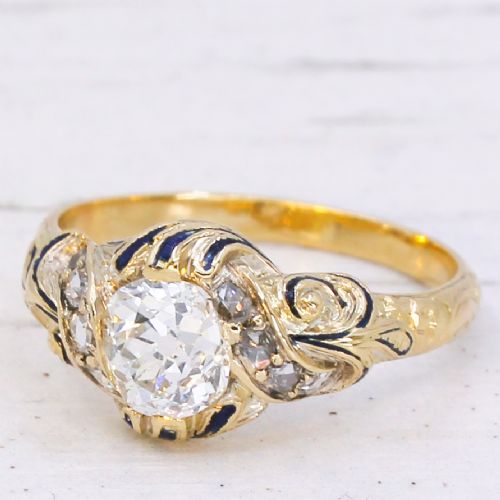


Gold Enamel Ring
A gold enamel ring brings together the rich glow of precious metal and the permanent colour of fused glass, offering a miniature canvas worn upon the hand.
Gold Enamel Ring
A gold enamel ring spans centuries of design, with Victorian and Georgian examples appearing most frequently alongside Art Deco and mid-century variations. These pieces often incorporate personal sentiment, mourning tributes or decorative motifs set into yellow gold, white gold or silver-gilt.
The forms range from cluster rings and star-set diamond designs to mourning bands featuring black or blue enamel work. Alongside finger rings, the broader selection occasionally includes related items sharing similar materials and decorative techniques.
Mourning jewellery forms a distinct category within this group, often displaying hairwork, pearls or white paste alongside dark enamel inscriptions. These survivor pieces record personal history directly through their enclosed locks of hair or memorial dates.
Materials and construction
Metals such as 18ct gold, 14K gold and silver provide the foundational structure for these jewels, sometimes paired with platinum or white gold in later Art Deco creations. Goldsmiths fused powdered glass to these metal bases at high temperatures to create smooth, durable coats of blue, black, white or green enamel.
Gemstones including old cut diamonds, seed pearls, garnets and paste stones are frequently flush-set, claw-set or foiled within the metalwork. Hand-painted miniature portraits and guilloche patterns beneath translucent enamel further demonstrate the specialised hand skills of period jewellers.
Listings feature yellow gold, white gold, and silver paired with diamond, pearl, garnet, and enamel across Georgian, Victorian, and Art Deco periods.
Evaluating quality and condition
The preservation of the glass surface dictates much of the value, as chips, hairline cracks or modern re-enamelling alter the integrity of the piece. Crispness in the hand-painted details and secure setting of small rose-cut or old cut diamonds separate masterwork pieces from standard production.
The weight and purity of the gold mount, alongside the complexity of decorative borders such as scrollwork or Greek key motifs, indicate the original workshop investment. Intact memorial inscriptions and undisturbed hair compartments under glass retain a higher degree of historical completeness.
Richard Hudnut·Roberto Coin·Kutchinsky
The Gold Enamel Ring Glossary
- Guilloche
- An intricate mechanical engraving technique that produces precise geometric patterns beneath translucent enamel. This method was widely favoured in Georgian and Victorian decorative arts.
- Mourning ring
- A commemorative piece of jewellery commissioned to remember a deceased person, usually featuring dark enamel, inscriptions, or hair compartments. These objects served as tangible links to lost family members.
- Rose cut
- A vintage diamond cut featuring a flat base and a domed crown consisting of triangular facets arranged in a star shape. This cut predates the modern brilliant cut.
- Paste
- Hand-cut lead glass used historically as a gemstone substitute in fine antique jewellery. It is often foiled at the back to enhance its internal reflection and colour.
- Old cut
- A term for hand-faceted diamonds shaped before the standardisation of modern cutting techniques, typically displaying smaller tables and higher culets.
Gold Enamel Ring: Frequently Asked Questions
How do I date an antique ring?
Dating relies on a combination of stylistic clues, gemstone cuts, and metal purity hallmarks stamped inside the band. Georgian and Victorian pieces often feature closed-back settings and specific hand-carved motifs that correspond to particular decades.
Changes in gold standards and popular design movements, such as the geometric lines of Art Deco, further narrow down the exact period of manufacture.
Can I wear a mourning ring daily?
Wearing antique memorial jewellery every day requires caution because enamel can chip and glass covers over hair compartments are fragile. Gentle care ensures the delicate goldwork and miniature details survive intact.
It is best to remove such rings during physical labour, swimming, or housework to protect the historical materials from unnecessary impact.
What does blue enamel signify?
Blue enamel frequently represented loyalty, remembrance, and mourning in Georgian and Victorian jewellery design. Lighter shades often appeared in sentimental pieces, while deep dark blues were typical of commemorative or bereavement rings.
The colour was achieved by adding cobalt or other metal oxides to the glass paste before firing it onto the gold base.
Are these rings sized easily?
Resizing depends entirely on the amount of enamel coverage around the band, as heating the metal during adjustment can crack the glass surface. Rings with complete hoop enamel generally cannot be altered without damaging the historic decoration.
Pieces with open shoulders or minimal enamel near the bottom of the shank are much safer candidates for a skilled jeweller to resize.