


Gold Earthenware Bowls
Gold earthenware bowls bring intricate Japanese Satsuma craftsmanship into the home through finely painted scenes and rich gilding.
Gold Earthenware Bowls
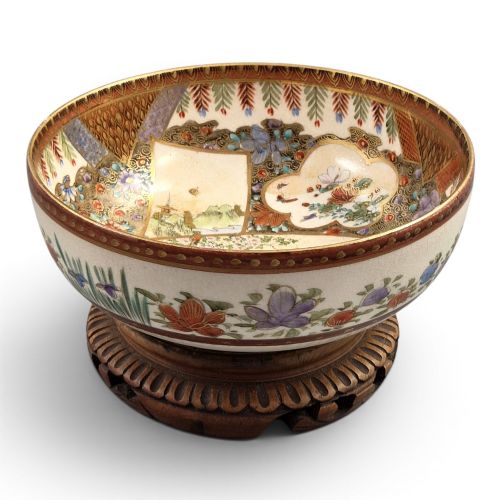
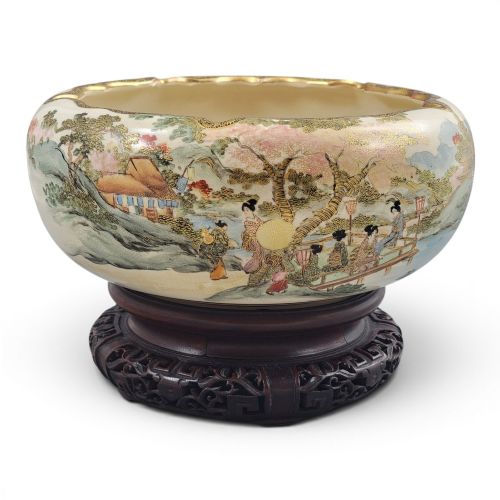
Gold earthenware bowls encompass Satsuma ware ceramics originating from Japan during the Meiji and Taisho periods, alongside Edwardian and Victorian eras. These decorative vessels range from large ceremonial pieces to intimate bowls and saucers, as well as footed burner forms. Buyers encounter elaborate hand-painted designs depicting historical battles, serene figures under camellia trees, and dense thousand flower motifs.
The majority of these pieces originate from Kyoto studios and Yokohama workshops, carrying signatures from renowned masters such as Kozan, Shizan, Nikko, Hododa, Kinkozan, and Shozan. Many feature the Shimazu crest alongside meticulous gilt enamel work that defines the aesthetic of the era. The forms serve primarily as decorative ceramics and incense burners rather than functional tableware.
Materials and methods
Potters built these vessels using earthenware clay, applying a distinctive cream-coloured crackle glaze that formed the base for subsequent artistic decoration. Artisans then hand-painted complex pictorial scenes utilising enamel colours and gold leaf or gold gilt to highlight specific details.
The decorative process often incorporated dense millefleur patterns, known as thousand flowers, alongside pictorial narratives and heraldic crests. Workshops in Kyoto and Yokohama refined these glazing and gilding techniques throughout the nineteenth and early twentieth centuries.
Moonlit samurai battles wage eternal war across the surface of a monumental Kyoto bowl, while nearby sugar bowls remain quietly civil.
Factors of distinction
Execution of the painted detail separates standard production from masterwork output, particularly in the precision of figural work and battle scenes. The clarity of the crackle glaze and the richness of the gold leaf application further distinguish individual pieces.
Signatures from celebrated makers like Kinkozan or Kozan indicate a higher level of studio craftsmanship. Scale also plays a role, with monumental bowls displaying greater ambition in composition than smaller sugar bowls and saucers.
Kozan·Shizan·Nikko·Hododa·Kinkozan·Shozan
The Gold Earthenware Bowls Glossary
- Satsuma
- A type of Japanese earthenware featuring an ivory-coloured, crackled glaze that originated in Satsuma Province and was later produced extensively in Kyoto and Yokohama. It serves as the primary ceramic body for these decorated vessels.
- Meiji Period
- The era of Japanese history spanning from 1868 to 1912, characterised by extensive artistic output directed toward Western export markets. This period accounts for the majority of the finely signed bowls seen here.
- Millefleur
- A decorative style translating to thousand flowers, where the surface is densely packed with minute floral patterns. This technique requires exceptional patience and brushwork from the ceramic artist.
- Shimazu Mon
- The heraldic crest of the Shimazu clan, featuring a cross within a circle. It frequently appears on Satsuma ware to denote patronage or connection to the ruling lords of the Satsuma domain.
- Gilt Enamel
- A combination of raised enamel pigments and gold leaf or gold paint applied over the glaze. This technique adds tactile relief and opulent contrast to the painted surfaces.
Gold Earthenware Bowls: Frequently Asked Questions
What is Satsuma ware?
Satsuma ware is a distinct style of Japanese earthenware identifiable by its warm, ivory-coloured glaze covered in a fine network of crackles. Artisans painted these ceramics with elaborate enamel scenes and heavy gilding for both domestic use and export.
Production centered around Kyoto and Yokohama during the late nineteenth and early twentieth centuries, involving master studios that signed their finished vessels.
How do I identify a Meiji period bowl?
Meiji period pieces date between 1868 and 1912, often bearing artist signatures or workshop marks on the base. They frequently display intricate pictorial themes such as samurai battles or detailed floral arrangements.
The presence of the Shimazu crest and dense millefleur patterns also points toward this specific era of Japanese ceramic manufacturing.
Are these bowls waterproof?
The porous nature of earthenware combined with the decorative crackle glaze means these vessels are primarily intended for display. They function as decorative ceramics, footed burners, and decorative bowls rather than functional kitchenware.
Water and heavy moisture can seep into the unglazed or crackled areas, making dry display the safest method for preservation.
What do the artist signatures mean?
Signatures on these bowls typically name the master artist or the studio responsible for the painted decoration. Names like Kinkozan or Hododa indicate specific workshops renowned for high-grade export ceramics.
Finding a clear signature helps attribute the piece to a particular maker active during the late nineteenth or early twentieth centuries.