

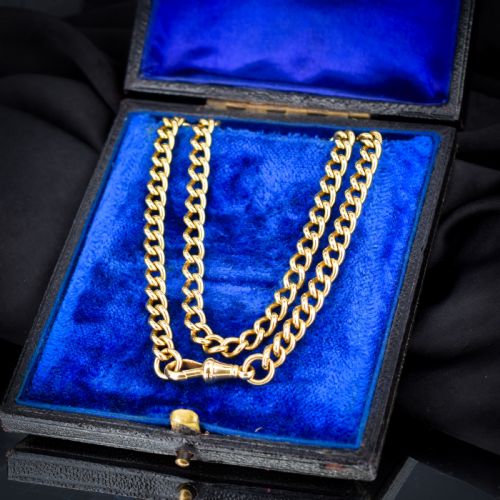


Gold Curb Link Necklace
A gold curb link necklace offers tactile presence and structural grace, carrying the enduring weight of period workmanship.
Gold Curb Link Necklace
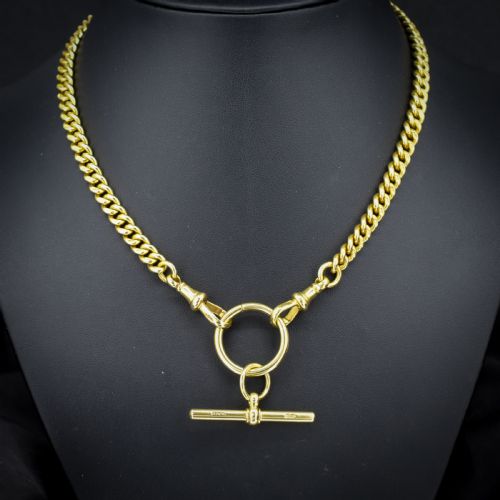
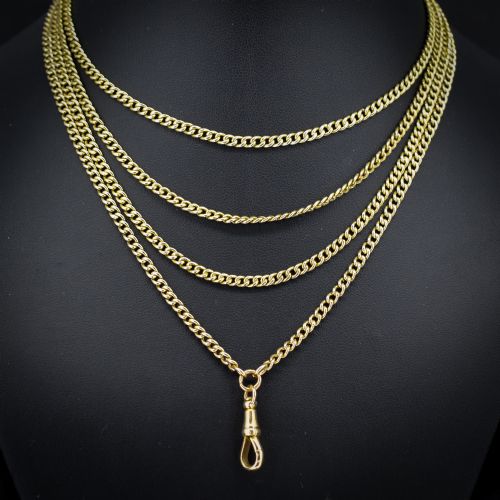
A gold curb link necklace is a heavy, interlinked chain originally engineered to secure pocket watches and now worn around the neck. The pieces listed across this page span the late nineteenth century into the twentieth century, taking the form of traditional Albert watch chains, long guard chains, and dedicated necklaces.
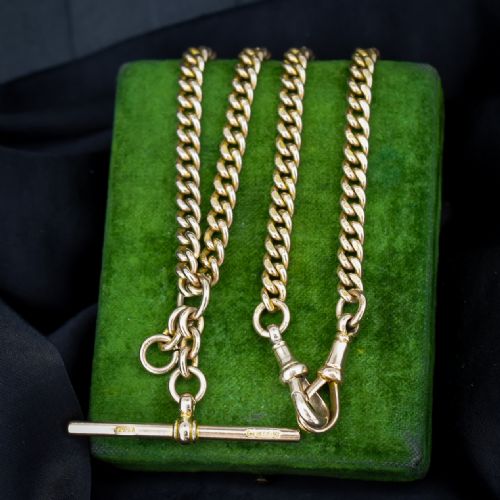
The most common form met here is the Albert chain, distinguished by its dog clips and central T-bar fittings. These items arrive in graduated configurations where links taper from centre to clasp, or in uniform widths designed for symmetrical wear.
Originating largely from British workshops and French ateliers, these chains carry hallmarks indicating regional offices, purity grades, and specific decades from the Victorian and Edwardian eras. Buyers seek them for their mechanical ingenuity and substantial historical character.
Materials and construction
Goldsmiths constructed these chains predominantly from yellow gold and rose gold, ranging in purity from nine-carat and fifteen-carat standards up to eighteen-carat and eighteen-karat yellow gold. Rolled gold and gold plate also appear in the record, offering alternative weights and surfaces.
Individual links were stamped, drawn, or twisted into flattened curb profiles before being joined, soldered, and finished by hand. Many examples feature every single link hallmarked, demonstrating rigorous assay standards applied to watch chains and guard chains alike.
Some nineteenth-century chains required every single link to be individually stamped with a hallmark, turning the entire necklace into a ledger of official assay inspections.
Distinctions in quality
The standard of a gold curb link necklace rests on the integrity of its links and the crispness of its original mechanical components. Chains where every link bears a clear hallmark demonstrate superior provenance and manufacturing oversight compared to unmarked pieces.
Graduation balance and hardware condition separate fine examples from standard items. Original dog clips, swivel hooks, and T-bars that retain crisp spring tension and clean articulation elevate the piece significantly.
The Gold Curb Link Necklace Glossary
- Dog clip
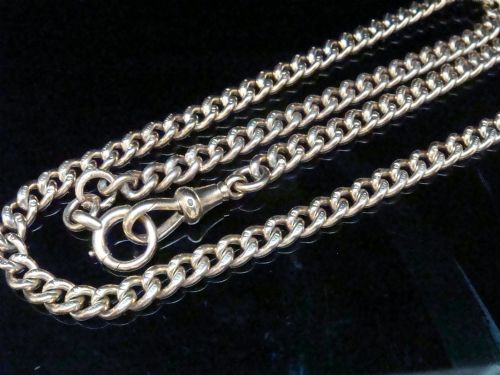
- A spring-loaded swivel fastening used to attach pocket watches, charms, or pendants. This mechanism allows the chain to secure onto itself or a garment.
- T-bar
- A transverse bar attached to the centre of an Albert chain, originally slid through a buttonhole to anchor the watch. It remains a decorative and structural feature on converted necklaces.
- Graduated
- Describing a chain whose links decrease in size progressively from the middle section towards the clasp. This technique enhances drape and visual balance.
- Hallmark
- An official stamp struck into precious metal indicating its purity, place of assay, and often the year of manufacture. British pieces frequently display these marks on individual links.
Gold Curb Link Necklace: Frequently Asked Questions
Can I wear an antique pocket watch chain as a necklace?
Many surviving watch chains function exceptionally well as necklaces due to their length and secure dog clip fastenings. They sit comfortably around the neck, often retaining their original T-bar as a pendant drop.
Shorter Albert chains may require small extenders depending on the desired drape, while longer guard chains slip easily over the head without opening the clasp.
What is the difference between solid gold and rolled gold chains?
Solid gold chains consist entirely of precious metal throughout the structure, typically marked with purity numbers like 375 or 750. These pieces maintain their material value and can be repaired or polished over generations.
Rolled gold items feature a layer of gold mechanically bonded to a base metal core, providing the visual appearance of solid metal at a different scale of construction.
How do I identify the period of my chain?
Dating relies heavily on hallmarks, maker's marks, and structural style conventions. Victorian and Edwardian pieces often display specific assay office symbols and date letters alongside purity stamps.
The presence of certain clasps, hollow versus solid link construction, and design motifs such as fancy faceted links further narrow down the decade of production.
What does graduated mean on a watch chain?
Graduation refers to a design where the links at the centre of the chain are noticeably larger than the links tapering towards the ends. This traditional layout distributed weight evenly for pocket watches and creates a tapered silhouette when worn around the neck.
Uniform chains maintain the exact same link size from end to end.