

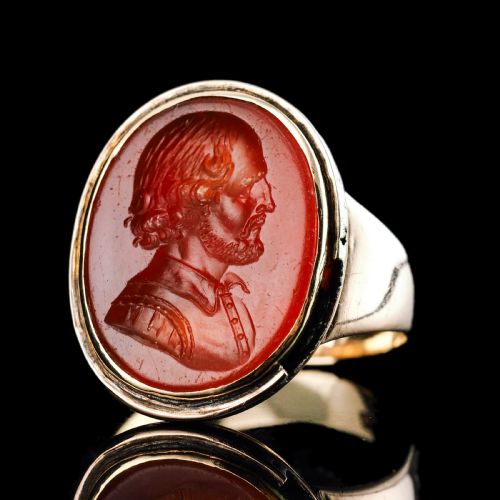


Gold Carved Portrait Ring
A gold carved portrait ring brings miniature classical carving directly to the hand, offering miniature profiles of gentlemen, ladies and historical figures set in precious metal.
Gold Carved Portrait Ring
A gold carved portrait ring is a wearable piece of miniature sculpture that places a carved hardstone cameo or intaglio directly onto the finger. When you search for a gold carved portrait ring, you encounter pieces spanning the Georgian, Victorian, and Edwardian periods, as well as Classical Revival styles.
The forms on this page include both rings and fob seals adapted as rings, featuring subjects ranging from Classical female portraits and Zeus to side-profile gentlemen and William Shakespeare. Materials span 9ct and 18ct yellow and rose gold, alongside rich hardstones like carnelian, agate, rock crystal, black opal, and coral.
How they were made
Makers shaped these jewels using precious metals such as 9ct gold, 18ct yellow gold, and 18ct rose gold to form the settings and bands. The structural metalwork securely houses the carved components while providing durable daily wear.
Portraits were formed from hardstones including carnelian, agate, rock crystal, black opal, and coral, utilising abrasive cutting and polishing techniques. Artisans carved either relief cameos that project from the stone or intaglio designs that sink beneath the surface to create a seal impression.
Gold Carved Portrait Ring Retail Price Guide 2026
Typical asking prices for gold carved portrait ring among the pieces listed under this phrase on Sellingantiques today, from the lower quarter to the upper quarter. They describe what is for sale here now, not the wider market.
William Shakespeare makes a cameo appearance here alongside Zeus, proving that historical playwrights and classical gods share remarkably similar tastes in ring settings.
What varies in quality
The choice and execution of the mounting also separate standard pieces from finer work, seen in the weight and purity of the 18ct gold settings versus simpler 9ct constructions. The natural grain and colour consistency of the underlying hardstone, such as layered agate or deep carnelian, further define the upper tier of the range.
The Gold Carved Portrait Ring Glossary
- Cameo
- A method of carving where the design is raised in relief against a contrasting background layer of stone or shell. This technique highlights the profile of the portrait by utilising natural colour variations in the material.
- Intaglio
- A design carved incuse or sunken beneath the surface of a gemstone so that it leaves a raised impression when pressed into wax. These motifs often depict classical figures, deities, or historical portraits.
- Hardstone
- A semi-precious stone of durable mineral composition, such as carnelian, agate, or rock crystal, chosen for detailed glyptic carving. These materials resist scratching and hold fine microscopic lines over centuries.
- Fob seal
- A small engraved stone matrix originally used for stamping wax seals on correspondence, frequently mounted onto a ring shank for modern wear. These pieces combine utilitarian sealing functions with portraiture.
- Classical Revival
- An artistic movement drawing inspiration from the art, architecture, and portraiture of ancient Greece and Rome. This aesthetic heavily influences Georgian and Victorian intaglios and cameos.
Gold Carved Portrait Ring: Frequently Asked Questions
How do I date a gold carved portrait ring?
Dating relies on stylistic clues, the type of gold alloy used, and the mounting construction. Georgian pieces often display specific foiled or closed-back settings with classical subjects, while Victorian and Edwardian examples show shifts in gold standards and bezel shapes.
Examining the depth of the carving and the specific portrait subject helps place the piece within its historical period, ranging from 18th century work through to the early 20th century.
Can I wear my antique portrait ring daily?
These historical rings require mindful care due to their age and delicate carved stones. While hardstones like agate and carnelian are reasonably durable, softer materials like coral or certain gems need protection from knocks and harsh chemicals.
Removing the ring during heavy manual tasks preserves the integrity of the gold setting and the fine details of the portrait carving.
What stones were used for these portrait rings?
Carvers utilised a variety of natural materials, most notably hardstones such as carnelian and agate. These stones offered attractive layered colours that contrasted sharply when carved.
Other materials found in these pieces include rock crystal, coral, and black opal, each providing a unique texture and optical depth to the miniature portrait.