




Gold Bronze Clock Set
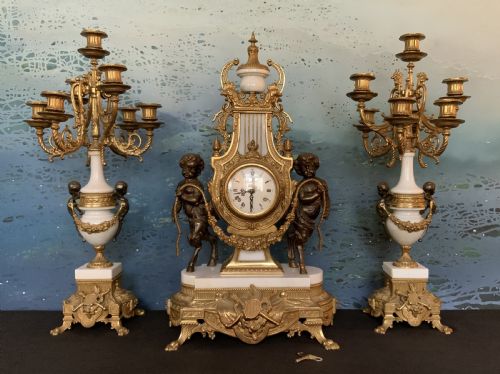
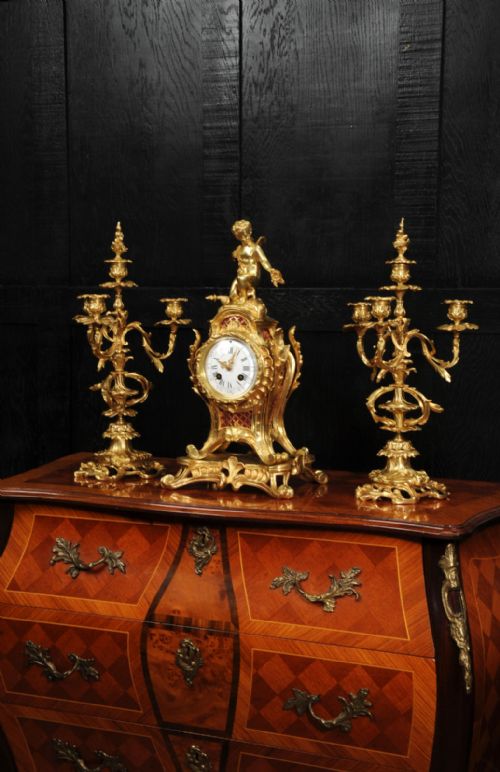
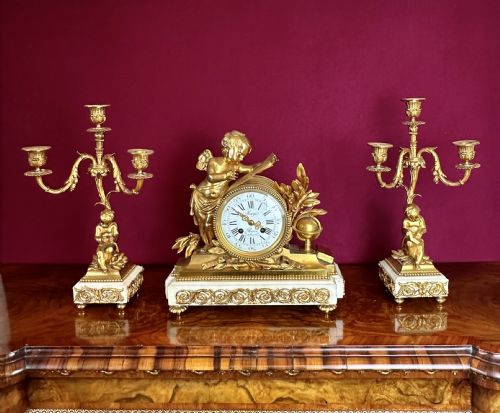
These gold bronze clock set pieces bring heavy French ormolu and marble mantel displays into the room.
Materials and construction
Foundries cast bronze and brass before applying mercury gilding or modern electroplating to create the characteristic ormolu surface. Enamel dials, often painted with numerals, sit behind glazed bezels within heavy cast housings.
Marble plinths and columns provide structural weight and contrast to the metallic mounts. Cabinetmakers and bronze-founders combined these dense stones with cast figures depicting cherubs, classical motifs and Rococo scrolls.
Judging quality in sets
The integration of the garniture components dictates the overall presence of the ensemble. Matching marble veining, uniform gilding wear across all three pieces, and signed movement plates elevate a set above anonymous workshop assembly.
Keep an eye out for cherubs caught mid-mischief hauling heavy bronze clock cases across your mantelpiece.
Henry Dasson·Raingo Fres Paris·Deniere Paris·Vincenti·Japy Freres·A.D Mougin
The Gold Bronze Clock Set Glossary
- Ormolu
- Gilded bronze produced by applying an amalgam of gold and mercury to a bronze base and heating it. This historic technique creates a warm, durable finish seen on nineteenth-century French pieces.
- Garniture
- A set of decorative objects designed to match and display together on a mantelpiece or sideboard. They typically include a central clock flanked by two matching candelabra, urns or vases.
- Candelabra
- Branching candlesticks designed to hold multiple tapers. In these sets, they share the exact stylistic vocabulary and metalwork of the central clock.
- Patinated bronze
- Bronze that has been chemically treated to darken the surface rather than leaving it bright or gilded. This technique creates contrast against the surrounding ormolu mounts.
- Movement
- The mechanical clockwork housed inside the metal case. Nineteenth-century French sets often utilise brass eight-day movements produced by established regional makers.
Gold Bronze Clock Set: Frequently Asked Questions
What is a clock garniture?
A clock garniture is a matched three-piece set consisting of a central mantel clock and two flanking ornaments such as candelabra or urns. These displays were designed to sit harmoniously upon a fireplace mantel or sideboard.
The matching elements share identical casting styles, metals, and decorative motifs to create a unified visual statement across the room.
How do I identify a French nineteenth-century set?
Nineteenth-century French sets typically display Louis XVI, Napoleon III or Rococo Revival styling executed in heavy cast bronze, ormolu, and marble. Examining the movement backplate often reveals maker stamps and serial numbers characteristic of the period.
The quality of the chasing on the bronze figures and the presence of enamel dials further confirm the nineteenth-century manufacturing origin.
How do I care for gilt bronze and ormolu?
Gilt bronze and ormolu require gentle dusting with a soft, dry brush to prevent the accumulation of dirt in the chased recesses. Avoid chemical polishes, abrasive cloths, and moisture, which can strip or damage the historic gold surface.
Keeping the metal away from direct heat sources and sunlight protects both the gilding and the underlying marble or enamel components.