



Gold and Diamond Cluster Pin
A gold and diamond cluster pin brings together brilliant stones and precious metal in a compact, wearable format.
Gold and Diamond Cluster Pin
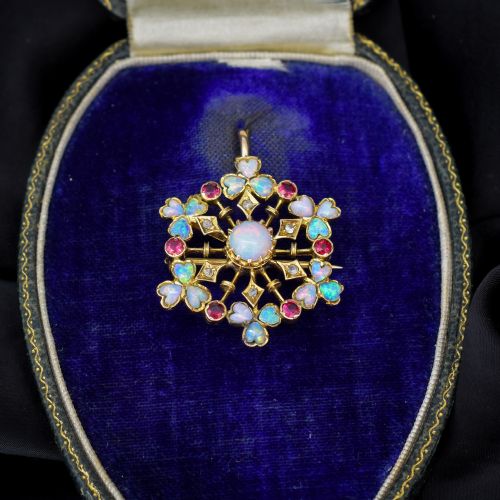
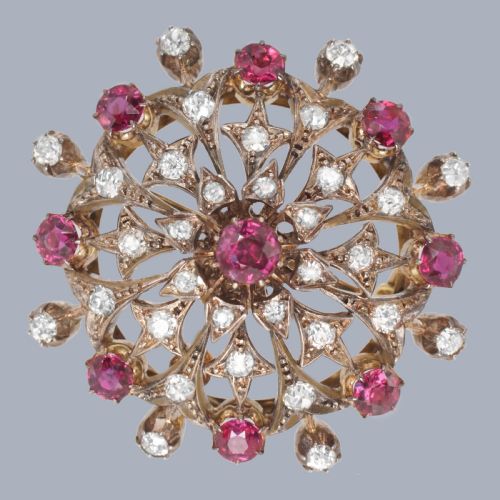
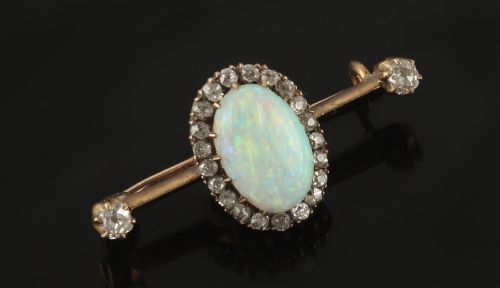
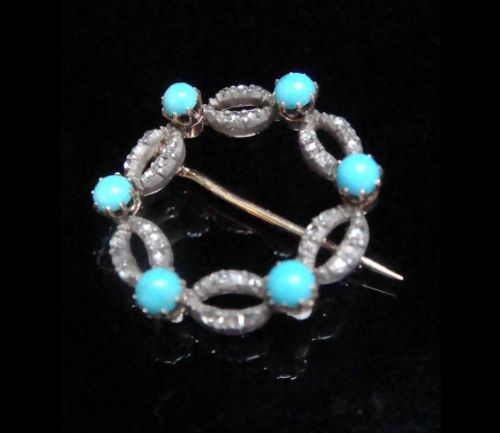
A gold and diamond cluster pin encompasses brooches, pendants, and bar pins designed with a central focal arrangement of stones. These pieces span Victorian, Edwardian, and Art Deco periods, alongside Georgian and Imperial Russian examples. Buyers will frequently encounter Victorian and Edwardian iterations featuring intricate floral, starburst, and geometric motifs.
The objects serve primarily as garment fastenings or decorative adornments, often equipped with convertible fittings to double as pendants. Surviving examples demonstrate diverse configurations, from delicate 9ct and 15ct yellow gold bars to substantial 18ct white gold and silver-topped creations. The selection captures centuries of shifting lapidary fashions while maintaining the core cluster composition.
Materials and Construction
Craftsmen utilised combinations of yellow gold, rose gold, white gold, and silver, frequently backing silver onto gold settings to enhance the brilliance of diamonds. Stones such as rubies, sapphires, opals, peridots, and pearls were integrated alongside central diamond clusters using traditional claw, collet, and pavé techniques. Metal purities varied widely across the eras, ranging from lower-carat yellow gold to higher 18ct alloys and unmarked precious metals.
Makers constructed these jewels by hand, employing rose-cut and old European cut diamonds that catch candlelight and daylight differently than modern cuts. Complex configurations like trellis work, foliate motifs, and multi-layered starbursts required precise solder joints and secure prong placements to hold diverse gemstones safely within the cluster frame.
Surviving gemstone combinations pair diamonds with rubies, sapphires, opals, peridots, and natural pearls.
Evaluating Quality
Quality rests upon the harmony of the design and the integrity of the original settings, where superior pieces exhibit balanced proportions and clean gem integration. The choice and matching of secondary stones, such as natural untreated rubies or clean sapphires paired with diamonds, elevate a piece above standard workshop output.
Execution of delicate details, such as hand-carved foliate motifs or complex multi-tiered starbursts, distinguishes master craftsmanship from simpler production. The survival of original presentation cases, maker marks, or accompanying gem reports adds considerable historical weight to an individual jewel.
G. Colani
The Gold and Diamond Cluster Pin Glossary
- Cluster
- A jewellery design arrangement featuring a central stone surrounded by a border of smaller gems. This configuration maximises visual impact and light reflection.
- Rose-cut
- An antique diamond cut featuring a flat base and a domed crown with triangular facets. It produces a soft, translucent glow rather than modern brilliance.
- Bar brooch
- A slender horizontal metal pin decorated with gemstones or central motifs. This style gained immense popularity during the late nineteenth and early twentieth centuries.
- Collet
- A band of metal that holds a gemstone in place by folding over the girdle. This traditional setting method secures stones without modern prong fittings.
Gold and Diamond Cluster Pin: Frequently Asked Questions
How were these pins worn historically?
Owners fastened these pieces securely onto the lapels of coats, the fronts of bodices, or high collars of Victorian and Edwardian garments. Many incorporated hidden loops to suspend from chains as pendants.
This dual functionality allowed wearers to transition a single jewel between day wear and evening attire with minimal effort.
What metals are most common?
Yellow gold in various purities forms the structural backbone of the majority of these antique jewels. Silver-topped gold represents another frequent combination, particularly in older pieces where silver enhanced the whiteness of diamond settings.
Later Edwardian and Art Deco examples shift toward white gold and platinum-like finishes to suit contemporary tastes.
How do I date a cluster pin?
Dating relies heavily on the metal combinations, stone cuts, and overall stylistic motifs present in the construction. Georgian and early Victorian pieces often feature closed-back settings and rose-cut stones, while Edwardian examples favour airy platinum or silver-topped gold filigree.
Art Deco creations introduce rigid geometric symmetry and crisp white gold framework.
Can I wear an antique pin daily?
These delicate historic jewels require thoughtful care and gentle handling if worn on regular occasions. Securing the pin properly to sturdy fabrics prevents accidental loss or strain on the original clasp mechanisms.
Owners should store them individually to protect fragile stones like opals and pearls from abrasion.