

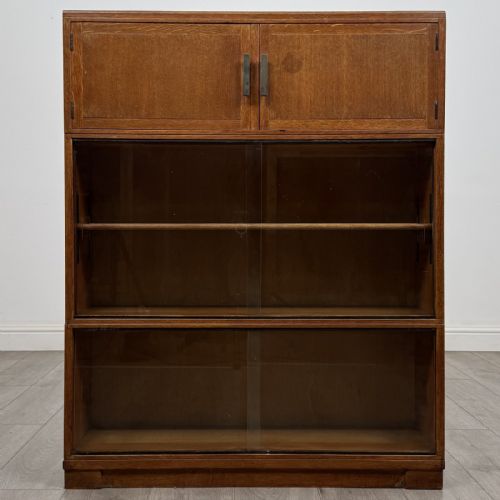
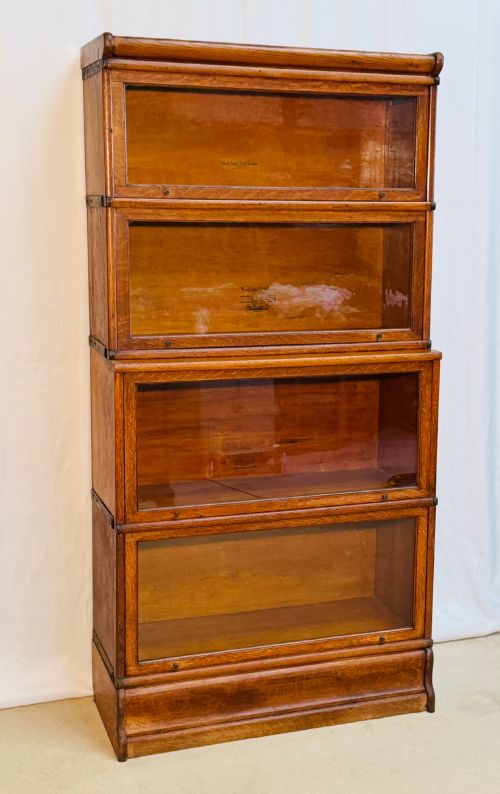
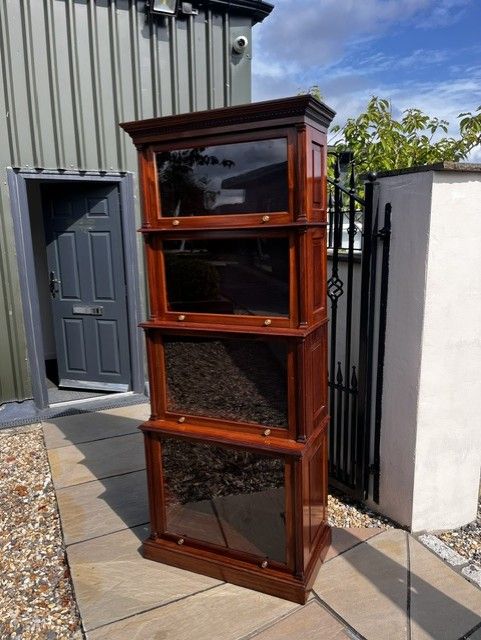


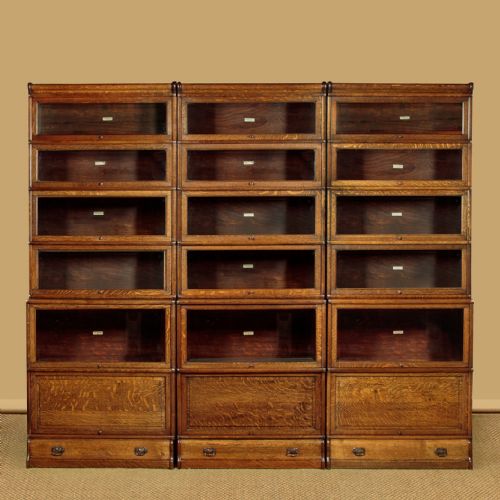


Globe Wernicke Stacking Shelves
Globe wernicke stacking shelves are modular bookcases designed to protect individual rows of books behind glazed doors.
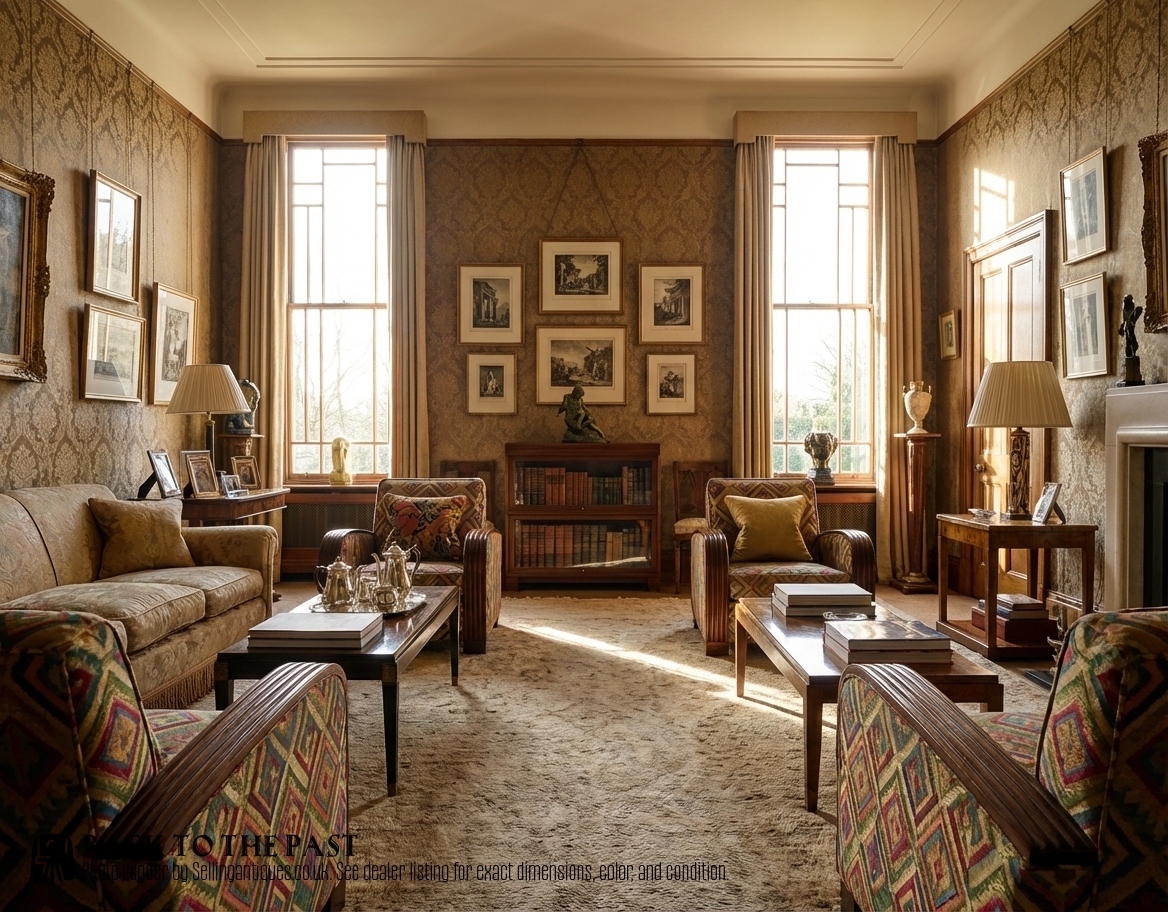
Globe Wernicke Stacking Shelves
Globe wernicke stacking shelves comprise modular units that stack vertically to form tall bookcases with glass doors. Each tier operates independently, allowing individual sections to lift and slide inward above the books.
The pieces appearing on this page span the Edwardian period through the 1920s and 1930s. Oak and mahogany serve as the primary woods, housing collections within sectional office or domestic layouts.
How they were made
Makers constructed these bookcases using solid oak and mahogany timbers for the carcases, combined with glazed panels for the doors. Brass and metal fittings facilitate the lifting and sliding mechanisms of each tier.
Lead also appears as a material component within the construction details of the glazing and framework. Individual sections remain detachable to allow flexible configuration during assembly.
Globe Wernicke Stacking Shelves Retail Price Guide 2026
Typical asking prices for globe wernicke stacking shelves among the pieces listed under this phrase on Sellingantiques today, from the lower quarter to the upper quarter. They describe what is for sale here now, not the wider market.
Listings feature oak and mahogany woods across Edwardian, nineteen-ten, nineteen-twenty, and Art Deco nineteen-thirty periods.
What varies in quality
Distinctions in quality rest upon the selection of timber, such as solid mahogany versus standard oak, alongside the integration of original brass hardware. The precision of the sectional fit dictates the overall refinement.
Makers such as Heal's and Lebus introduce specific regional variations in design and construction. The presence of original glazed doors and uniform colour across multiple tiers defines the finer examples.
Heal's·Lebus
The Globe Wernicke Stacking Shelves Glossary
- Sectional
- A piece built from separate tiers that stack one upon another without permanent fixings. This modular construction permits easy transport and rearrangement.
- Barrister
- A term commonly applied to stacking bookcases with glazed lifting doors designed to keep law books clean. The style originates from professional office interiors.
- Glazed
- Fitted with glass panels within the doors to protect contents from dust while maintaining visibility. The glass is often held securely by traditional lead or wood framing.
- Edwardian
- A stylistic period spanning the reign of King Edward VII, noted for lighter furniture forms than the preceding Victorian era. Pieces from this time often utilise figured mahogany and oak.
Globe Wernicke Stacking Shelves: Frequently Asked Questions
How do stacking shelves work?
Each tier functions as a separate box with a glass door that lifts and slides back into the unit above the books. This mechanism allows access to one shelf at a time without disturbing the others.
The individual sections rest on top of each other using tongue-and-groove or pin joints rather than permanent glue. A separate base and top cornice complete the vertical stack.
Are the sections fixed together?
The sections are entirely modular and simply stack vertically under their own weight. This design enabled offices and homes to add extra tiers as libraries grew.
Because they are unattached, the entire bookcase disassembles easily into individual shelves, a base, and a top for moving. Metal side clips sometimes secure the units externally.
What wood types should I expect?
Oak and mahogany dominate the construction of these sectional bookcases. Solid mahogany and figured oak appear frequently across Edwardian and 1920s examples.
Interior components and backing boards may utilise secondary timbers while the primary exterior surfaces showcase the chosen hardwood grain.
How do I date a stacking bookcase?
Stylistic cues such as Art Deco geometric lines point toward the 1930s, while Edwardian pieces display lighter proportions and traditional bracket feet. Maker stamps or labels, when present, provide specific manufacturer dates.
Hardware details like brass knobs and patent mechanisms also help narrow down the decade of production between nineteen-ten and nineteen-thirty.