


Glazed Pottery Spaniels
Glazed pottery spaniels bring nineteenth-century hearthsides to life with their familiar painted faces and characteristic earthenware stances.
Glazed Pottery Spaniels
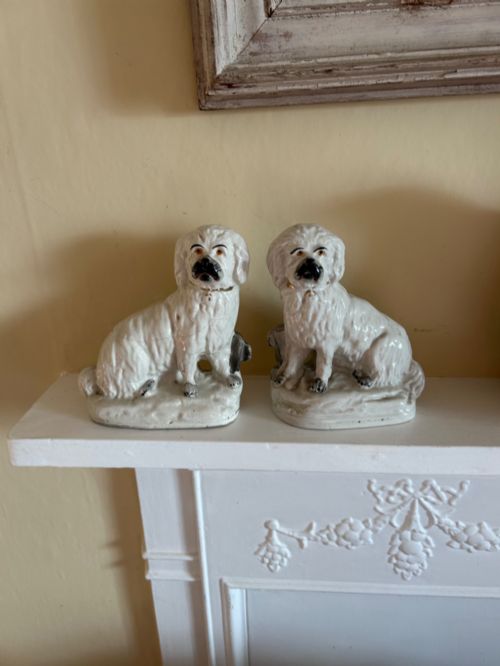
Glazed pottery spaniels are traditional nineteenth-century ceramic figures modelled as seated dogs, often encountered as pairs flanking a mantelpiece or shelf. These Victorian ornaments take the form of Staffordshire spaniels, alongside related terriers, poodles, and complex groups such as clock cases and quill holders.
The pieces appearing on this page date principally from the Victorian era, spanning the nineteenth century with specific examples from eighteen-sixty and eighteen-eighty. Buyers meet both standard pairs and larger collections, finished with hand-painted details and distinctive lustre or enamel markings.
How they were made
Makers formed the figures as decorative objects, finishing them by hand painting the surface details directly onto the fired clay. This technique resulted in varied coat markings, from solid black and white patterns to rich copper tones.
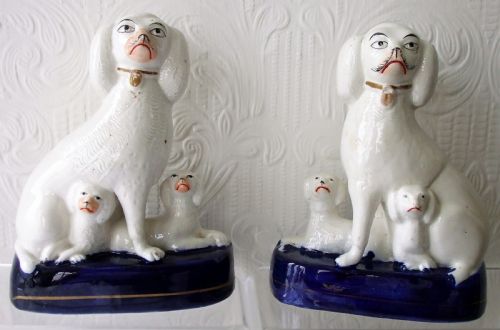
Several Victorian spaniels keep watch alongside unexpected companions, including diminutive pups tucked firmly beside their parents.
What varies in quality
Quality in these figures rests on the crispness of the modelling and the precision of the hand-painted enamel work. Finer examples display expressive facial details and careful application of copper lustre or gilt highlights rather than hurried factory decoration.
The distinction between standard decorative items and superior pieces also depends on the complexity of the form, such as multi-dog collections, clock groups, or functional quill holders rather than simple seated pairs.
The Glazed Pottery Spaniels Glossary
- Earthenware
- Porous pottery fired at lower temperatures, serving as the standard body material for nineteenth-century Staffordshire figures. It requires a protective glaze to hold liquids and achieve a smooth finish.
- Lead glaze
- A glossy coating containing lead compounds applied to pottery before firing to give a vitreous, reflective shine. This finish protects the underlying painted earthenware body.
- Copper lustre
- A metallic glaze technique producing a coppery, reflective sheen on the ceramic surface. Potters used this effect to create gleaming coats and collars on Victorian figures.
- Quill holder
- A ceramic desk accessory featuring an integrated inkwell or pen stand beside the main figure. These functional pieces combined ornament with utility on nineteenth-century writing desks.
- Staffordshire
- A generic term for pottery manufactured in the English county of Staffordshire, renowned for domestic animal figures and Victorian mantelpiece ornaments.
Glazed Pottery Spaniels: Frequently Asked Questions
What are glazed pottery spaniels?
These pieces are nineteenth-century ceramic figures modelled as dogs, traditionally displayed in pairs on mantelpieces.
They reflect Victorian domestic tastes, featuring painted markings and glossy lead glazes that mimic real canine coats.
How were Staffordshire dogs used?
Victorian households placed them on mantelpieces, often facing inward toward each other from opposite ends of the hearth.
Some specialised variants doubled as functional items, such as clock groups or quill holders for the desk.
How do I date an antique spaniel?
Dating relies on observing the ceramic body, glaze characteristics, and the style of the hand-painted enamels.
Most traditional figures originate from the nineteenth century, with specific stylistic shifts occurring between eighteen-sixty and eighteen-eighty.
Are all Staffordshire dog figures spaniels?
While spaniels dominate the category, potters also modelled poodles, Maltese terriers, and King Charles spaniels.
Makers occasionally paired these dogs with pups or incorporated them into larger decorative groupings.