

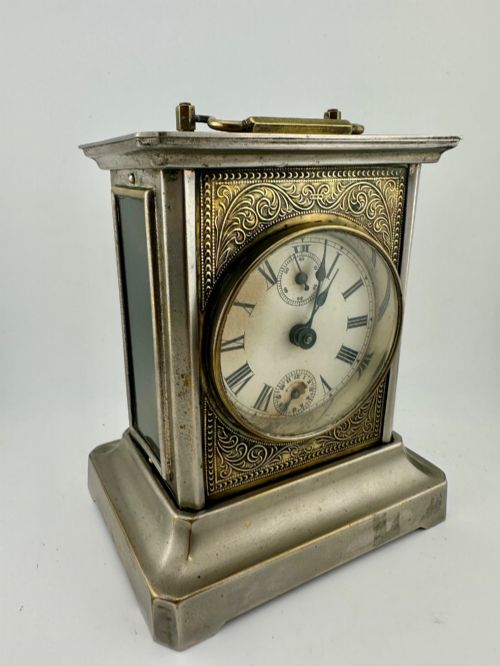


Gilt Silver Table Clock
These gilt silver table clock examples combine precision timekeeping with decorative bronze, brass, and enamel craftsmanship across centuries of European design.
Gilt Silver Table Clock
A gilt silver table clock brings together functional horology and sculptural ornament, designed to sit prominently on a desk, mantel, or bracket. When exploring this selection, buyers encounter everything from seventeenth-century English basket top clocks to nineteenth-century French carriage clocks and Art Deco miniatures.
The objects span diverse formats, including portico clocks, strut clocks, and repeating carriage pieces. Makers utilise materials such as ebony, mahogany, glass, and ormolu alongside gilt and silvered finishes to achieve visual depth.
Victorian and nineteenth-century French examples dominate the selection, often incorporating intricate dials and specialised movements. Earlier seventeenth-century pieces reflect traditional English craftsmanship with ebony cases and brass accents.
Materials and construction
The construction relies on metals such as bronze, brass, and steel, finished with gilt and silver plating to create striking surface contrasts. Cases frequently incorporate structural hardwoods like ebony and mahogany, providing a dark, stable backdrop for metallic dials and ornaments.
Enamel work appears on dials and miniature timepieces, often utilising blue guilloche patterns for added texture beneath glass panels. Movements combine brass gear trains with escapements and striking mechanisms housed securely within decorated metal and wooden housings.
Gilt Silver Table Clock Retail Price Guide 2026
Typical asking prices for gilt silver table clock among the pieces listed under this phrase on Sellingantiques today, from the lower quarter to the upper quarter. They describe what is for sale here now, not the wider market.
Listings feature periods spanning from the seventeenth century through to the Art Deco era, encompassing wood, glass, and metal materials.
Quality factors in horology
Quality rests in the precision of the movement and the crispness of the cast bronze, gilt, and silvered components. Finer examples exhibit meticulous hand-finishing on dial engravings, casework, and mechanical parts rather than mass-produced uniformity.
The integration of secondary functions, such as date work, repeating strikes, or integrated thermometers, distinguishes more ambitious horological pieces from standard timepieces. The cohesion between the decorative housing and the mechanical interior dictates the overall standing of an individual clock.
Jonathon Lowndes·William Speakman·Howell And James·Thomas Cole·James Cole·Hunt And Roskell·Le Roy Et Fils·Paul Garnier
The Gilt Silver Table Clock Glossary
- Carriage clock
- A portable timekeeper originally designed for travel, featuring a protective glass case and a folding handle. These pieces often include striking or alarm complications.
- Fusee
- A conical pulley used in mechanical clocks to maintain even power delivery as the mainspring unwinds. This mechanism improves timekeeping accuracy across the power reserve.
- Guilloche
- An intricate decorative pattern engraved mechanically into metal surfaces using a lathe. Enamel is frequently applied over this texture to create translucent depth.
- Portico clock
- A monumental clock style shaped like a classical temple with supporting columns. These tall mantel pieces gained popularity during the nineteenth century.
- Strut clock
- A timepiece supported by a hinged prop or stand at the back, designed to rest at an angle on a desk or table. They frequently incorporate gilt or silvered bronze frames.
Gilt Silver Table Clock: Frequently Asked Questions
Where should I place a table clock?
Select a stable, level surface away from direct sunlight, extreme temperature fluctuations, and high moisture areas like kitchens or bathrooms. Mantelpieces, sturdy desks, and dedicated display brackets provide ideal support.
Placing the clock on a level plane ensures the escapement beats evenly, which keeps the timekeeping accurate. Avoid locations where vibrations from doors or heavy foot traffic might disturb the movement.
How do I date an antique clock?
Examine the stylistic cues of the case, such as the architectural columns of a portico clock or the ebony basket top typical of seventeenth-century English work. Maker signatures, hallmarks, and engraving styles on the backplate offer further chronological clues.
Movements also evolved over time, shifting from verge escapements to later platform escapements in nineteenth-century carriage pieces. Comparing these mechanical details with documented maker timelines clarifies the period of manufacture.
What is a single fusee movement?
A single fusee movement uses a conical pulley and a chain or cord to transmit power from the mainspring to the gear train. This clever device compensates for the dropping torque of the unwinding spring.
Clocks featuring this mechanism generally offer superior timekeeping consistency compared to uncompensated spring-driven alternatives. You will often spot the fusee chain or cord visible within the movement plates.