


Gilt Bronze Girandole
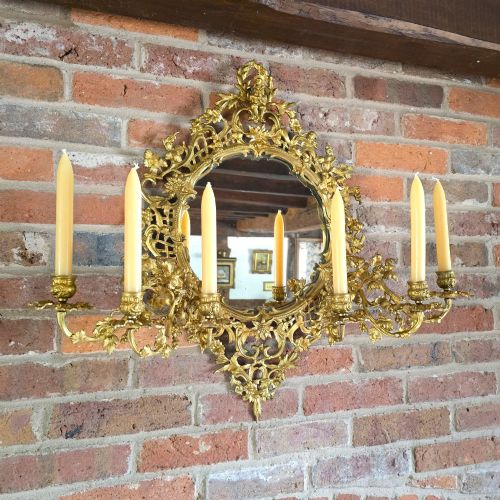
These gilt bronze girandole pieces combine reflective glass with candle branches, offering both functional illumination and decorative grandeur for the wall.
Gilt Bronze Girandole
A gilt bronze girandole is a decorative wall-mounted lighting fixture incorporating a mirror to multiply the candlelight within a room. Most examples found here originate from the nineteenth century, reflecting French Rococo Revival, Second Empire, and Empire aesthetics alongside Victorian British designs.
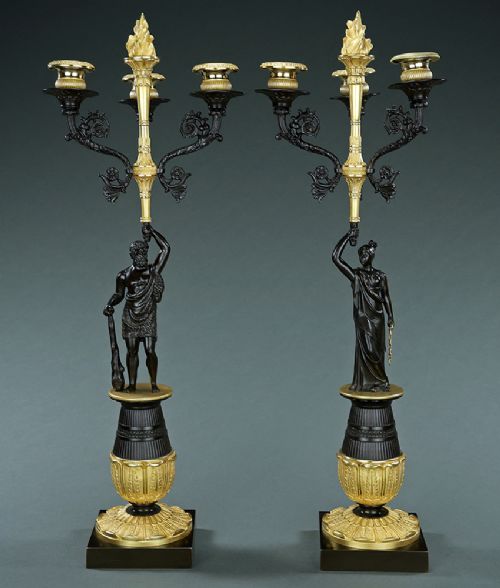
The objects take several forms, including mirrored wall sconces, candelabras with central reflective plates, and table mirrors flanked by candle branches. They combine metalwork with glass or crystal elements, often featuring multiple candle arms designed to project light across an interior space.
Materials and construction
The primary structure relies on cast bronze, brass, or gilded brass, finished with fire gilding or ormolu to achieve a bright, reflective metallic surface. Makers integrated crystal pendants and bevelled glass mirror plates to enhance the play of light from the candles.
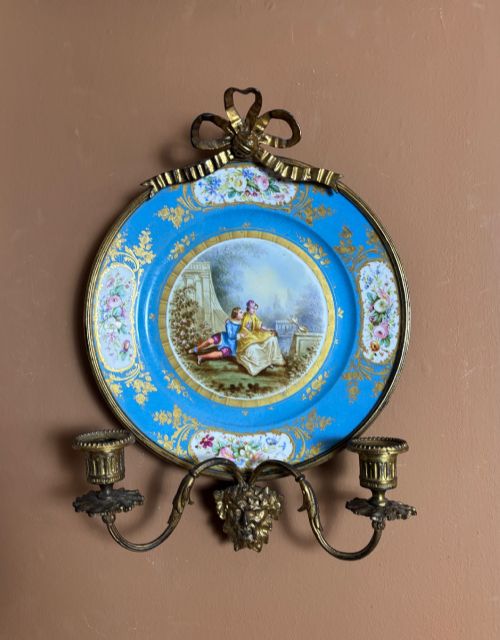
Many pieces incorporate additional decorative media, such as Sevres porcelain plaques or marble bases, assembled with mechanical fasteners rather than modern adhesives. The metal components are chased and finished by hand to sharpen the cast details of foliage, cherubs, or classical figures.
Listings feature items spanning the 1850s to the 1920s, dominated by French Rococo Revival styles and Victorian gilded brass forms.
Judging quality and craftsmanship
Quality rests primarily in the crispness of the bronze chasing and the depth of the gilding, where finer pieces retain sharp undercuts and varied surface textures. Heavier casting and thicker bronze plates indicate a more substantial object built to support multiple heavy candle branches without distortion.
The integration of the mirror plate within the metal frame also distinguishes better examples, particularly where bevelled glass and original crystal drops remain intact. Superior pieces demonstrate balance in design, where the proportion of the mirror matches the reach of the candelabra arms.
Thiebaut Freres
The Gilt Bronze Girandole Glossary
- Ormolu
- A technique of applying finely ground high-carat gold to a bronze object, creating a durable golden finish. This term appears frequently in French nineteenth-century metalwork.
- Girandole
- A branched wall light or candelabra featuring a mirrored backplate to reflect and amplify illumination. The glass centre is integral to the definition of the piece.
- Rococo Revival
- A nineteenth-century design style drawing on eighteenth-century French motifs, characterised by asymmetrical curves, scrollwork, and naturalistic plant forms. It dominates many of the sconces and mirrors here.
- Candelabra
- A multi-branched candlestick holder designed to support several candles simultaneously. In this context, they are often paired with wall mirrors.
- Second Empire
- A mid to late nineteenth-century French architectural and decorative style associated with Napoleon III, combining eclectic historical elements with lavish ornamentation.
Gilt Bronze Girandole: Frequently Asked Questions
How do I hang a heavy girandole securely?
These fixtures require direct attachment to wall studs or the use of heavy-duty toggle bolts due to the substantial weight of the cast bronze and glass. Professional installation is recommended to support the outward leverage of the candle branches.
Ensure the mounting bracket engages the primary metal frame rather than decorative trim or removable mirror plates to prevent structural strain.
Can these wall sconces be wired for electricity?
Many examples retain their original configuration for wax candles, while others have been adapted for low-voltage electric bulbs over their lifespan. Converting them requires careful concealment of wiring through the existing hollow arms without damaging the bronze or gilding.
Consult a qualified restorer to ensure any electrification preserves the removable components and historical integrity of the metalwork.
How do I clean gilt bronze and crystal?
Dusting with a soft, dry brush prevents the accumulation of grime in the intricate recesses of the bronze chasing. Avoid commercial metal polishes, which can strip the thin ormolu or fire gilding from the surface.
Crystal drops and mirror plates can be wiped gently with a damp cloth, taking care not to let moisture seep behind the silver backing of the glass.
How do I identify a nineteenth-century French piece?
Nineteenth-century French pieces typically exhibit heavy bronze casting, distinct chasing marks on the reverse, and characteristic styling such as Rococo scrolls or Empire classical motifs. The presence of mercury gilding or Sevres porcelain inserts often points toward mid-century Parisian workshops.
Examining the construction joints and screw threads will also reveal period-appropriate manufacturing methods distinct from modern reproductions.