


Gilt Blue Accent Chairs
Gilt blue accent chairs bring golden warmth and rich textile colour into a room, offering both decorative presence and comfortable seating.
Gilt Blue Accent Chairs
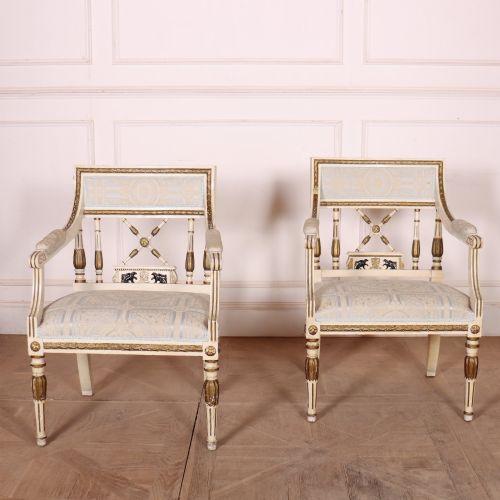
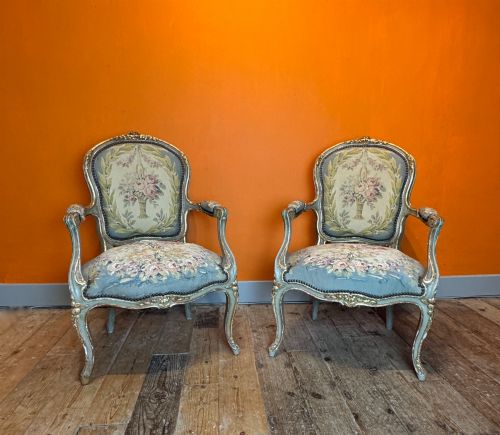
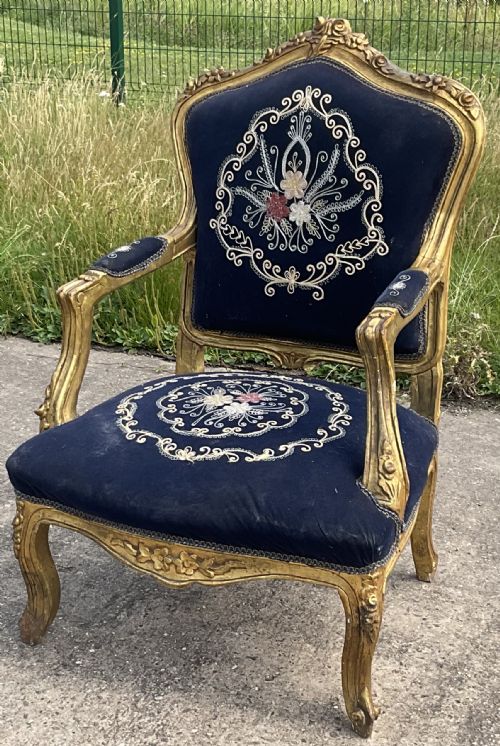
When you search for gilt blue accent chairs, you encounter seating designed to draw the eye through gilded surfaces paired with blue upholstery. The examples found here span armchairs, side chairs, and boudoir chairs from various historical periods.
Most pieces appearing on this page belong to revival styles, notably French Louis XVI and Louis XVI style, alongside Swedish Empire, Italian Neoclassical, and Victorian interpretations. These forms originate from the eighteenth century onwards, with nineteenth-century interpretations predominating.
You will see armchairs featuring scroll arms, wingbacks, and bergere forms upholstered in blue velvet, silk damask, and tapestry. The timber frames carry finishes of giltwood, gesso, painted wood, and parcel gilt applied over mahogany or softer woods.
How they were made
The wooden frames of these chairs rely on carved mahogany or painted wood, prepared with gesso layers to receive gold leaf or parcel gilt highlights. Artisans shaped these components into curved and straight structural members characteristic of revival and neoclassical designs.
Upholstery techniques involved securing fabrics such as velvet, silk damask, and tapestry over padded foundations within the wooden armchairs and side chairs. Ormolu mounts occasionally complemented the gilded woodwork on Empire revival pieces.
Listings here feature items from the eighteenth, nineteenth, and early twentieth centuries, including Swedish Empire, Italian Neoclassical, and French revival styles.
What varies in quality
The standard of carving in the giltwood and gesso dictates the visual crispness of the frame, distinguishing finely detailed floral and linear motifs from softer, broader execution. Superior pieces maintain integrity in the joinery of the armchairs and side chairs across centuries of use.
The application of gold leaf and the choice of textile, whether silk damask or standard velvet, separate standard decorative seating from exceptional examples. Original surface patination on the gilded wood remains a key indicator of authenticity and historical preservation.
The Gilt Blue Accent Chairs Glossary
- Giltwood
- Wood that has been coated with gold leaf or gold powder. This surface treatment provides the bright metallic finish seen on the frames of these chairs.
- Gesso
- A plaster mix applied to wooden frames as a base for gilding. It allows craftsmen to carve sharp details before applying gold leaf.
- Ormolu
- Cast bronze that has been gilded with ground gold amalgamated with mercury. It appears as decorative metal mounts on Empire revival furniture.
- Parcel Gilt
- A finishing technique where only specific raised portions of a painted or stained wooden surface are gilded. This creates a contrast between the wood colour and the gold leaf.
Gilt Blue Accent Chairs: Frequently Asked Questions
What is a gilt blue accent chair?
A gilt blue accent chair is a decorative seating piece featuring a gold-finished wooden frame paired with blue upholstery. These items serve as focal points in interior schemes.
They encompass various historical styles, including French revival and Italian neoclassical designs, functioning primarily as armchairs or occasional seating.
How do I identify a Louis XVI style chair?
Louis XVI style chairs typically display straight, fluted legs and geometric frames, contrasting with the earlier curved rococo forms. Their backs are frequently oval or rectangular.
These pieces often incorporate neoclassical motifs such as ribands, acanthus leaves, and beaded mouldings within the gilded woodwork.
Where should I place an antique armchair?
Antique armchairs fit well in reception rooms, studies, or bedrooms where their visual presence can anchor the space. They provide both a functional seat and a decorative element.
Because of their delicate gilded surfaces and historic textiles, placing them away from direct sunlight preserves the materials.
What distinguishes giltwood from painted gold?
Giltwood utilises thin sheets of gold leaf applied over a gesso and glue preparation on the timber. This method yields a deep, reflective metallic lustre.
Painted gold involves liquid metallic paint applied with a brush, resulting in a more uniform and less reflective surface finish.
How do I care for antique upholstery?
Antique textiles such as silk damask and velvet require gentle maintenance, including careful vacuuming with a soft attachment. Direct sunlight should be avoided to prevent fading.
Professional textile conservators should handle any deep cleaning or structural repairs needed for the fabric.