


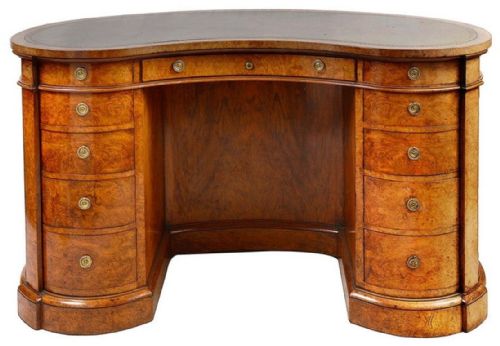


Gillows Partners Desk
A gillows partners desk offers generous workspace on both sides, built by a famous Lancaster firm known for exceptional cabinet work.
Gillows Partners Desk
When you search for a gillows partners desk, you find substantial double-sided writing furniture designed for two people to work opposite one another. These pieces come in Georgian, Regency, Victorian, and Edwardian periods, reflecting long-running production by the Lancaster firm.
The most common forms on this page include mahogany and walnut pedestal desks, along with library tables and specialised sorting desks. Makers and workshops from the late eighteenth century onwards produced these large items for grand libraries and offices.
Makers such as Gillow and Co and Waring and Gillows stamped their work or followed strict design traditions. Pieces range from George III double-sided postmasters sorting desks to later Edwardian writing tables.
Materials and construction
Makers built these desks using dense timbers such as mahogany, oak, burr walnut, and plain walnut. These woods provided the structural strength required for large double-sided pedestals and wide writing surfaces.
Workshops incorporated inset leather writing surfaces and cast brass hardware, including handles and drawer pulls. Skilled cabinet makers joined the pedestals and drawers using traditional dovetail joints and sturdy framing.
Gillows Partners Desk Retail Price Guide 2026
Typical asking prices for gillows partners desk among the pieces listed under this phrase on Sellingantiques today, from the lower quarter to the upper quarter. They describe what is for sale here now, not the wider market.
Listings span the Georgian, Regency, Victorian, and Edwardian periods, utilising mahogany, oak, walnut, burr walnut, leather, and brass.
What separates the best from the rest
The distinction between standard commercial pieces and top-tier examples lies in the selection of timber figures and the crispness of the carving. Finely figured mahogany and burr walnut veneers demonstrate superior material choice by the workshop.
Original maker stamps, authentic brasses, and documented attribution elevate the status of a desk. Superior craftsmanship appears in the smooth action of drawers and the precise integration of double-sided storage compartments.
Gillows Lancaster·Gillow and Co·Waring and Gillows·Thomas Myers of Gillows
The Gillows Partners Desk Glossary
- Partners desk
- A large double-sided writing table fitted with drawers and cupboards facing both directions. This design allowed two people to work opposite each other simultaneously.
- Pedestal desk
- A heavy freestanding desk comprising two supporting columns of drawers beneath a wide top. The central opening provides legroom for the user.
- Breakfront
- A cabinet or desk front where the central section projects forward from the flanking wings. This architectural arrangement adds visual depth to large library furniture.
- Burr walnut
- Wood grain taken from the warted excrescences of a walnut tree, showing intricate swirling patterns. Cabinet makers prized this material for high-status veneered surfaces.
- Dovetail joint
- An interlocking woodworking joint formed by interlocking wedge-shaped fingers. It provides exceptional tensile strength for drawer construction.
Gillows Partners Desk: Frequently Asked Questions
What is a partners desk?
A partners desk is a large double-sided writing table designed with drawers and cupboards on both front and back. This layout enables two people to sit opposite each other and work at the same time.
Historically, these desks served business partners, bankers, or senior officials in large administrative offices and private libraries.
How do I identify a Gillows desk?
You identify a Gillows desk by looking for maker stamps, signature brass pulls, or distinct cabinet-making techniques associated with the Lancaster firm. Many pieces feature secondary signatures or distinct workshop records.
Some desks lack stamps but show the construction methods and proportions characteristic of the maker's documented output.
What woods were used?
Makers constructed these desks primarily in mahogany and walnut, with oak used for secondary drawer linings and internal framing. Burr walnut veneers appear on decorative surfaces to create striking grain patterns.
Timber choice depended on the period of manufacture, ranging from George III mahogany to late Victorian walnut.
How do I care for the leather top?
You care for the inset leather writing surface by keeping it clean and applying appropriate leather balms to prevent drying and cracking. Avoid placing hot cups or moisture directly onto the leather.
Gentle dusting maintains the surface finish without damaging the delicate tooling around the edges.