

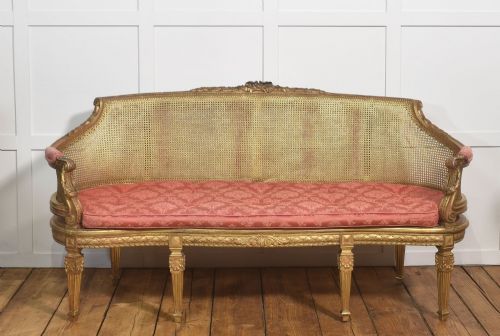


Gilded Wooden Sofa
These gilded wooden sofa examples bring monumental 19th-century and early 20th-century seating into a room with distinct French and Swedish neoclassical presence.
Gilded Wooden Sofa
A gilded wooden sofa search gathers grand French, Swedish, and English settees, canapes, and couches spanning the nineteenth century and the early twentieth century. Buyers encounter large country house frames alongside smaller canework pieces designed for formal reception rooms.
The selections on this page lean heavily toward Louis XVI style, Louis XV, and French Empire designs, alongside Swedish Empire and Edwardian neoclassical revivals. These seating forms range from expansive giltwood sofas to painted and gilt settees and upholstered hall seats.
How they were made
Workshops utilised timber frames finished with giltwood leaf or layered paint to achieve the characteristic metallic sheen demanded by neoclassical taste. Artisans shaped these structural wooden carcasses into sweeping curves and architectural straight lines.
Many frames incorporate cane panels or intricate canework alongside traditional textiles such as silk damask and patterned fabric. Upholstered elements rely on robust internal padding to support the grand proportions of each settee.
Gilded Wooden Sofa Retail Price Guide 2026
Typical asking prices for gilded wooden sofa among the pieces listed under this phrase on Sellingantiques today, from the lower quarter to the upper quarter. They describe what is for sale here now, not the wider market.
One unexpected side table snuck into the seating lineup, proving that gilded wood defies pigeonholing.
What varies in quality
The depth and crispness of the carved wood ornamentation dictate the visual strength of a piece, distinguishing standard joinery from superior artisan output. Finer examples display meticulous attention to proportion across sweeping crest rails and arms.
The integrity of the original gilt surface or early painted finish plays a critical role in establishing the character of the seating. Intact canework and cohesive upholstery choices further separate modest workshop output from high-status furniture.
The Gilded Wooden Sofa Glossary
- Giltwood
- Wood coated with gold leaf or a metallic substitute. This surface treatment defines the bright, reflective aesthetic seen across many European neoclassical seating forms.
- Canework
- Woven rattan or cane applied to seat backs and panels. It provides a lightweight, decorative texture that contrasts with solid timber frames.
- Damask fabric
- A reversible figured textile with patterns woven into the cloth. Silk damask varieties often upholster formal nineteenth-century French and English settees.
- Canape
- A decorative French upholstered sofa with an exposed wooden frame. These pieces typically feature carved details and generous seating proportions.
Gilded Wooden Sofa: Frequently Asked Questions
Where did these sofas sit originally?
These seating pieces belonged in formal drawing rooms, grand salons, and country house reception spaces where hosts entertained guests.
Their ornate gilt surfaces and neoclassical lines were chosen to project status and refined taste in prominent interior settings.
How do I style a giltwood settee today?
A gilded wooden sofa acts as a natural focal point when paired with understated modern or traditional furnishings.
Allowing the carved frame and metallic finish to remain visible ensures the piece commands attention without visual clutter.
What is the difference between a settee and a canape?
A settee is a broad term for a wide seat accommodating multiple people, often featuring upholstered backs and arms.
A canape specifically denotes a French-style sofa with an exposed decorative wooden frame and distinct period proportions.
How do I identify a Regency period piece?
Regency seating incorporates neoclassical motifs inspired by ancient Roman, Greek, and Egyptian design vocabulary.
These items often display clean architectural lines combined with rich giltwood or painted finishes characteristic of the early nineteenth century.