

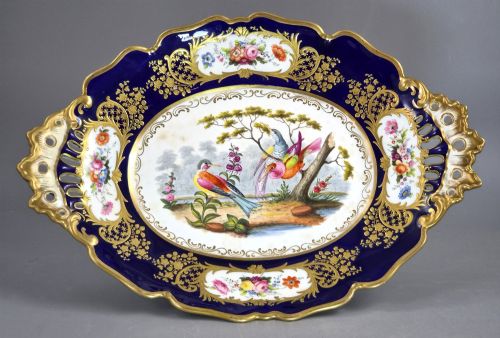


Gilded Porcelain Oval Dish
These gilded porcelain oval dish pieces bring hand-painted birds, fruit, and cobalt blue into service as serving platters and decorative dishes.
Gilded Porcelain Oval Dish
A gilded porcelain oval dish provides an elegant centrepiece for the table or a decorative accent on a cabinet shelf. When you search for a gilded porcelain oval dish, you encounter serving platters and decorative dishes spanning the eighteenth, nineteenth, and early twentieth centuries. The examples on this page encompass English factories, continental works, and Japanese imari output.
The forms range from ribbon trays and fish dishes to large platters and serving dishes. You are most likely to meet Victorian rococo revival and nineteenth-century English pieces decorated with handpainted birds or fruit bouquets. Continental porcelain from French and German factories also appears frequently in the selection.
Makers represented include Herend, H & R Daniel, Coalport, Royal Worcester, Royal Crown Derby, Sevres, and Meissen. These pieces combine utility with decorative ambition, utilising gold leaf and enamel highlights to frame pastoral scenes or floral displays.
How they were made
The production of these wares relies upon hard-paste porcelain or bone china bodies shaped into oval forms. Artisans applied enamel paints by hand to create detailed motifs such as fancy birds, fruit bouquets, and cobalt blue borders.
Gilding was then added using gold leaf or gold gilt, often highlighting the moulded edges, handles, and ribbon details of the dish. Firing fixed the enamels and the metal leaf to the glazed ceramic surface, yielding a durable and lustrous finish.
Gilded Porcelain Oval Dish Retail Price Guide 2026
Typical asking prices for gilded porcelain oval dish among the pieces listed under this phrase on Sellingantiques today, from the lower quarter to the upper quarter. They describe what is for sale here now, not the wider market.
The selection includes pieces spanning the eighteenth, nineteenth, and twentieth centuries, utilising hard-paste porcelain, bone china, enamel, and gold leaf.
What varies in quality
Quality in these dishes rests upon the crispness of the porcelain moulding and the precision of the hand-painting. Superior examples display finely rendered birds and fruit with subtle shading, whereas simpler pieces rely on standard transfer prints or heavier, less refined brushwork.
The application of the gold leaf also marks a distinction between standard production and exceptional output. Rich, hand-tooled gilding that remains bright and intact elevates a piece above those with worn or flat metallic decoration.
Herend·H & R Daniel·Coalport·Royal Worcester·Royal Crown Derby·Sevres·Meissen
The Gilded Porcelain Oval Dish Glossary
- Hard-paste porcelain
- A dense, durable ceramic material fired at high temperatures, composed of kaolin and petuntse. It provides a bright white body that resists scratching.
- Bone china
- An English ceramic body incorporating bone ash, resulting in a slightly warmer tone and high translucency. It allows for thinner vessel walls while maintaining strength.
- Gilding
- The application of gold leaf or gold powder to the surface of the porcelain. This technique emphasises moulded borders and decorative panels.
- Enamel
- Low-melting glass coloured with metal oxides, applied over the glaze to create colourful painted scenes. These details require a secondary, lower-temperature firing to bond with the ceramic.
- Cobalt blue
- A deep blue pigment stable at high temperatures, frequently used for underglaze borders and dramatic contrasts against white porcelain and gold.
Gilded Porcelain Oval Dish: Frequently Asked Questions
Can I use these dishes for serving food?
Many of these pieces were originally created as serving platters, fish dishes, or dessert services, meaning they are structurally suited for table use. However, age, delicate hand-painted enamels, and fragile gilding often encourage owners to keep them for display.
Hand washing in warm soapy water without abrasive sponges helps preserve the historic enamel and gold leaf on older porcelain.
How do I date an antique porcelain dish?
Dating relies on factory marks stamped or painted on the underside, stylistic cues like neo-rococo moulding, and the type of ceramic body used. Eighteenth-century pieces often show different glaze pooling and paste characteristics compared to Victorian or Edwardian output.
Comparing the decorative palette, such as imari patterns versus handpainted fancy birds, also narrows down the period of manufacture.
What is the difference between bone china and hard-paste porcelain?
Hard-paste porcelain uses traditional continental minerals fired at extreme heat, resulting in a vitreous and sturdy body. Bone china includes bone ash in the recipe, giving English wares a softer translucency and a slightly creamier background colour.
Both materials accept gilding and enamel painting well, but their weight and light transmission differ perceptibly.
How should I display an oval decorative dish?
Oval platters and dishes sit securely in wire wall hangers designed for plates or on sturdy plate stands inside cabinets. Ensuring the support distributes weight evenly protects the rim and handles from unnecessary stress.
Keeping the dish away from direct, harsh sunlight prevents any fading of the delicate enamel colours over time.