
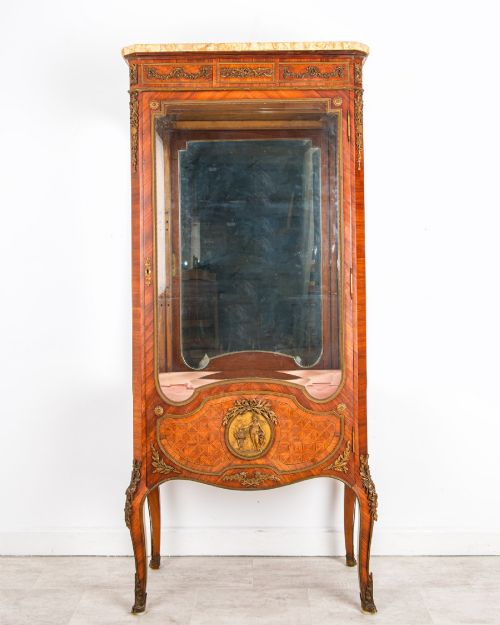


Gilded Glass Display Case
These gilded glass display case pieces combine polished timber and glazed panels with metal mounts to showcase precious objects.
Gilded Glass Display Case
A gilded glass display case takes the form of a vitrine, a side cabinet, or a bijouterie table designed to exhibit small treasures. These items emerge chiefly in nineteenth-century and Edwardian contexts, drawing on Louis XV and Neoclassical revival styles.
The version most commonly encountered on this page is the French nineteenth-century vitrine cabinet, typically constructed with curved or flat glass panels. Such cabinets frequently feature marble tops and decorative metal mounts alongside wood carcases.
Domestic display pieces sit alongside shop display counters and pedestal cabinets in the record. These variations span from grand salon furniture to commercial fittings from the nineteen-tens.
How they were made
Maker workshops shape these cabinets using timbers such as kingwood, mahogany, and rosewood, often applying gilt bronze or ormolu mounts to the exterior angles and feet. Glazed sides and doors permit light to enter the interior chamber from multiple angles.
Surface decoration frequently includes Vernis Martin painted panels or gold leaf application on carved giltwood frames. Marble slabs form heavy, polished tops on many of the nineteenth-century examples.
Listings feature periods spanning the Victorian era, the nineteenth century, and the nineteen-tens, utilising glass, marble, ormolu, and kingwood.
What varies in quality
The refinement of the ormolu mountings and the crispness of the gilt bronze chasing separate standard pieces from superior examples. Better workshops employ heavier bronze casts that fit the contours of the timber with precision.
The choice of underlying veneers, such as figured kingwood or elaborately painted Vernis Martin panels, dictates the visual ambition of the piece. Superior construction shows in the tight joining of glazed frames and the quality of the marble selected for the top.
Maison Krieger·François Linke
The Gilded Glass Display Case Glossary
- Vitrine
- A glass-fronted cabinet designed for displaying fine porcelain, curiosities, or objets d'art. This French term appears frequently in nineteenth-century furniture descriptions.
- Ormolu
- Gilded bronze used for decorative mounts and feet on French revival furniture. The technique involves applying a gold amalgam to a bronze base.
- Vernis Martin
- A simulated Japanese lacquer developed in eighteenth-century France and replicated in later revival pieces. It uses successive coats of varnish to achieve a translucent finish over painted scenes.
- Bijouterie table
- A low display table with a glazed top and compartment designed for holding jewellery and small ornaments. These pieces typically stand on slender cabriole legs.
- Kingwood
- A dense, richly figured timber native to Brazil, prized for its use in veneering fine cabinetwork. It displays dark violet-brown tones with lighter golden streaks.
Gilded Glass Display Case: Frequently Asked Questions
What is a gilded glass display case used for?
These cabinets serve to protect and display collections of small ornaments, porcelain, tea wares, or curiosities within a room. The glass panels and internal light allow objects to be viewed clearly from multiple angles.
Domestic versions typically stand in reception rooms or drawing rooms, while commercial variants serve in shops and tea rooms to present goods to customers.
How do I date a gilded glass display case?
Dating relies on identifying the revival style, timber choices, and construction methods characteristic of the nineteenth century or Edwardian period. Pieces associated with the Victorian era or specific decades like the eighteen-eighties often exhibit distinct revival vocabularies.
Makers' stamps, ormolu casting styles, and the specific type of glass or veneer further narrow the period of manufacture.
Where should I place a gilded glass display case?
Position these cabinets away from direct sunlight to protect interior contents and sensitive wood veneers from fading. Placing them against a stable interior wall ensures the heavy marble tops and glass panels remain properly supported.
Consider room traffic to ensure doors swing open fully without obstruction, particularly with bow-end or cylindrical pedestal designs.
How do I distinguish French styles in these cabinets?
French Louis XV style cabinets feature asymmetrical curves, cabriole legs, and naturalistic ormolu mounts inspired by rococo forms. Neoclassical revival pieces adopt straighter architectural lines, symmetrical proportions, and classical motifs.
Vernis Martin decoration and specific wood veneers like kingwood frequently accompany these distinct decorative schemes.