
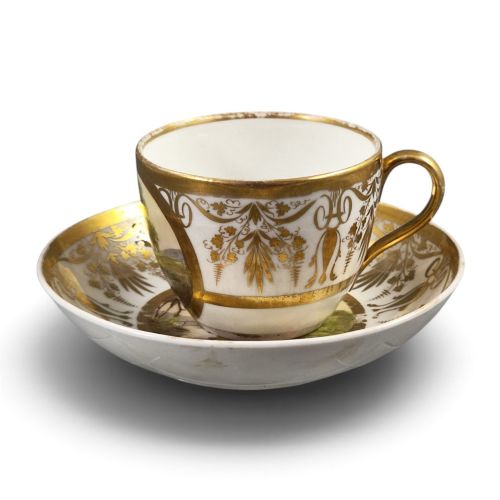
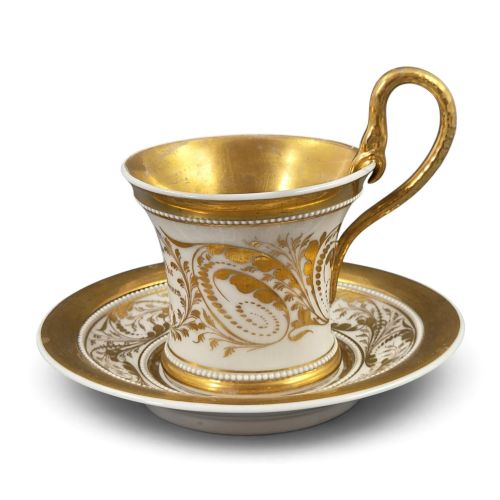


German Porcelain Cup Saucer
A german porcelain cup saucer brings European craftsmanship to the table, offering painted landscapes and gilt details from the nineteenth century.
German Porcelain Cup Saucer
When searching for a german porcelain cup saucer, collectors encounter delicate teacups, demitasse sets, and miniature forms originating from German manufactories. These pieces span the nineteenth century, including specific dates around eighteen hundred, eighteen thirty, eighteen forty, eighteen eighty, and nineteen twenty.
The objects frequently take the form of standard teacups and saucers, alongside specific demitasse and miniature variations. Styles range from Rococo Revival and Biedermeier to Empire and Neoclassical, reflecting changing aesthetic preferences across German ceramic production.
How They Were Made
These items rely on hard-paste porcelain as the primary ceramic body, shaped into cups, pedestals, and matching saucers. Artisans applied glazes to create smooth, durable surfaces suitable for detailed painting.
Decoration involves hand-painted scenes, floral motifs, and birds of paradise, augmented by enamel colours. Gold leaf, gilding, and gold gilt add metallic highlights to rims, handles, and surfaces.
Birds of paradise frequently gaze across porcelain rims, ensuring morning coffee comes with avian company.
What Varies in Quality
The standard of painting distinguishes standard factory output from finer works, particularly where hand-painted landscapes and courting couples appear. Precision in brushwork and the complexity of Dresden flowers indicate the skill of the decorator.
The application of gold leaf and gilding also dictates the grade of a piece. Intricate gilt borders and presentation-grade finishes elevate the visual presence beyond plain glazed surfaces.
KPM Berlin·Meissen·Hutschenreuther·Hirsch Dresden·Helena Wolfsohn
The German Porcelain Cup Saucer Glossary
- Hard-paste porcelain
- A dense ceramic material fired at high temperatures, composed of kaolin and petuntse. It provides a durable base for delicate German tableware.
- Demitasse
- A small cup used for serving espresso or strong black coffee. These often appear alongside matching saucers in nineteenth-century collections.
- Gilding
- The application of gold leaf or gold paint to ceramic surfaces. It highlights rims, handles, and decorative motifs.
- Enamel
- Vitreous coloured glass fused to porcelain during firing. It supplies the vibrant pigments found in floral designs and landscape scenes.
- Trembleuse
- A specialised cup and saucer featuring a raised ring in the saucer to hold the cup securely. This design prevented spills among nobility during the nineteenth century.
German Porcelain Cup Saucer: Frequently Asked Questions
How do I date a German porcelain cup?
Dates are estimated through stylistic indicators, period markers, and factory marks recorded on the underside of the porcelain. Examining the transition from Neoclassical to Rococo Revival styles helps narrow the manufacturing era.
Archival examples and recorded pieces from the nineteenth century provide comparative baselines for dating specific forms like demitasse sets and cabinet cups.
What is the difference between a teacup and a demitasse?
A demitasse is specifically sized for serving strong coffee or espresso, possessing a smaller capacity than a standard teacup. They frequently feature slender handles and matching compact saucers.
Standard teacups offer a larger vessel capacity suited for tea service, often accompanied by broader saucers for resting spoons or small treats.
Are all German porcelain cups marked?
Many pieces feature underglaze blue marks, impressed symbols, or painted factory signatures identifying the maker. However, some early or miniature pieces may bear minimal markings or wear over time.
Absence of a visible mark does not preclude authenticity, as style, paste composition, and painting technique remain primary indicators of origin.