
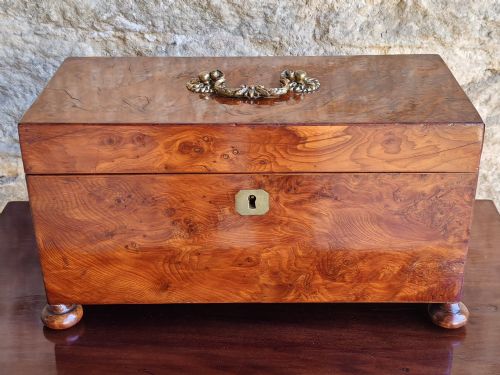
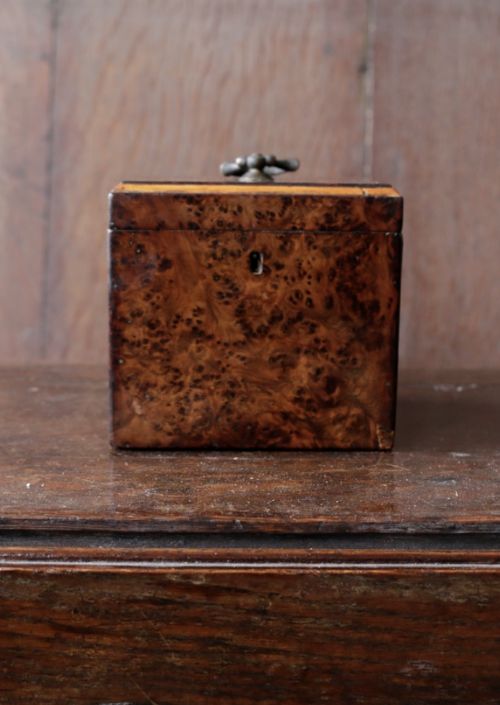


Georgian Yew Wood Box
These georgian yew wood box pieces combine dense timber with subtle grain figures, offering collectors practical storage shaped by eighteenth and nineteenth century cabinetmakers.
Georgian Yew Wood Box
A georgian yew wood box brings together rich timber and compact storage, taking forms such as tea caddies, jewellery boxes, and sewing chests. Buyers examining this page encounter pieces originating from the eighteenth century through to the regency period and the mid-nineteenth century.
Tea caddies and chests dominate the available selection, reflecting the high status of tea in period households. Makers also utilised the timber for small barrels, candle boxes, and octagonal or semi-circular caskets designed to sit on parlour tables.
Materials and construction methods
Cabinetmakers selected yew and burr yew for its complex patterning, often pairing the timber with contrasting stringing made from boxwood and ebony. Surfaces frequently display intricate marquetry work or rely entirely on the natural swirling grain of the burr timber.
Hardware played a functional role in construction, with makers fitting brass hinges, escutcheons, and locks to secure valuable contents. Bone details occasionally appear on interiors, completing boxes built to withstand daily use.
A tiny barrel made of yew proves that some cabinetmakers could not resist turning a tea caddy into a miniature wine cask.
Judging quality and grain
Quality rests primarily on the depth and movement of the burr yew grain across the visible panels. Finer examples display a matched, continuous pattern wrapping around the corners of the box.
The precision of contrasting stringing and the inclusion of original internal compartments separate standard utilitarian items from superior cabinetwork. Integrated brass mounts and stable timber construction also distinguish the upper tier of pieces.
The Georgian Yew Wood Box Glossary
- Burr yew
- A growth on a yew tree that produces highly figured, swirling wood grain prized for decorative veneer.
- Tea caddy
- A small lidded container originally built to store loose tea leaves securely under lock and key.
- Teapoy
- A small stand or large table-top box designed to hold tea canisters and equipment in a drawing room.
- Stringing
- Thin lines of contrasting wood inlay used to outline panels and geometric shapes on box surfaces.
- Escutcheon
- A small protective plate surrounding a keyhole, frequently cast in brass on period boxes.
Georgian Yew Wood Box: Frequently Asked Questions
What were georgian yew wood boxes used for?
These boxes served specific household storage needs, most commonly protecting expensive imported tea leaves from damp and theft in locked caddies.
Other examples functioned as miniature desks, sewing chests, or repositories for candles, snuff, and jewellery within the formal rooms of the house.
How do I date a yew wood box?
Dating relies on observing structural forms, such as the curved geometry of regency pieces or the straight lines associated with eighteenth-century work.
Details like ebony stringing, brass escutcheons, and the style of internal partitions provide further clues to the decade of manufacture.
How do I care for antique yew wood?
Keep timber pieces away from direct sunlight and sudden temperature shifts to prevent the wood from drying out or splitting.
Apply occasional traditional wax polish to nourish the grain and maintain a natural protective sheen on the surface.
Are yew wood boxes rare?
Yew timber is notoriously difficult to work with due to its twisting growth habit, which naturally limited the number of large boxes produced.
While tea caddies survive in moderate numbers, specific forms like barrels or semi-circular caskets appear less frequently in collections.