





Georgian Wood Barometer
A georgian wood barometer measures atmospheric pressure while anchoring a room with rich timber grain and restrained eighteenth or nineteenth century design.
Georgian Wood Barometer
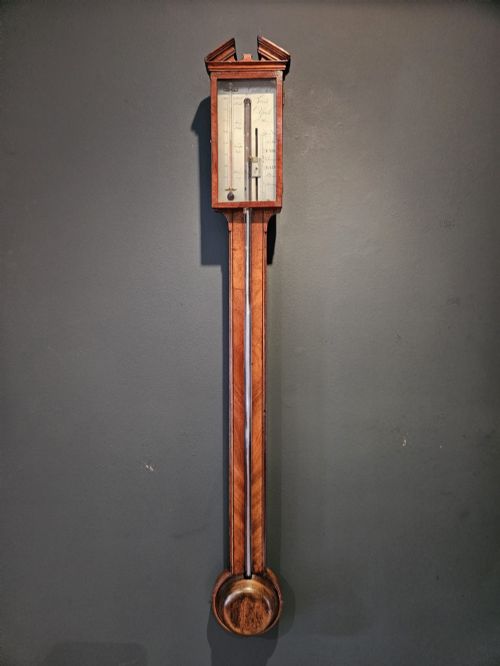
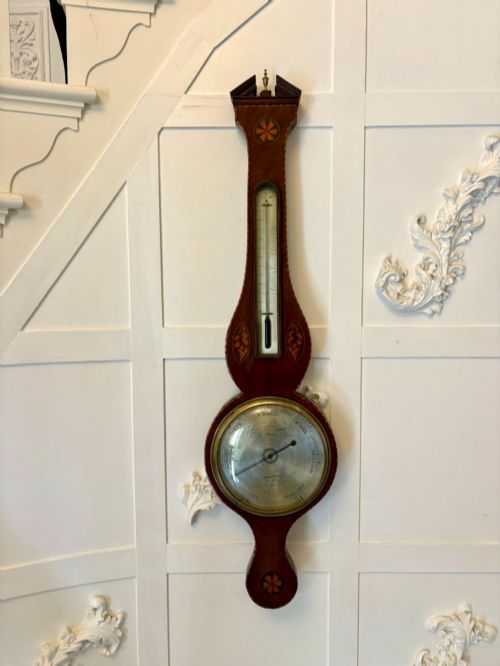
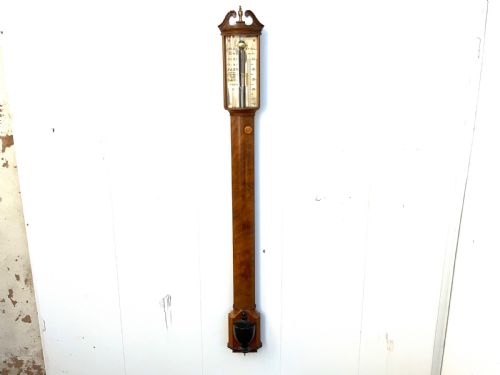
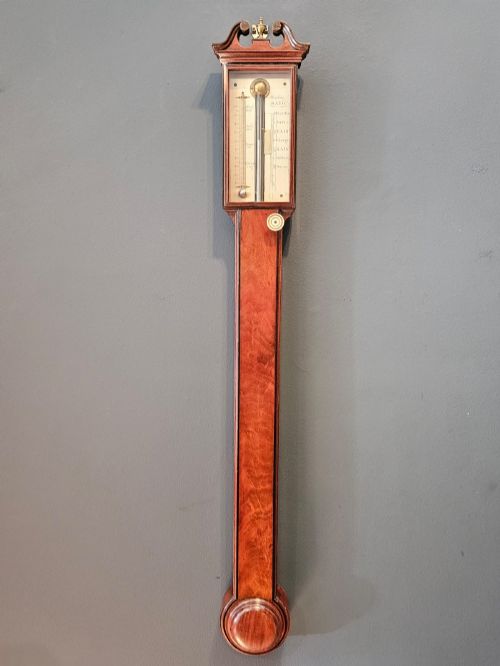
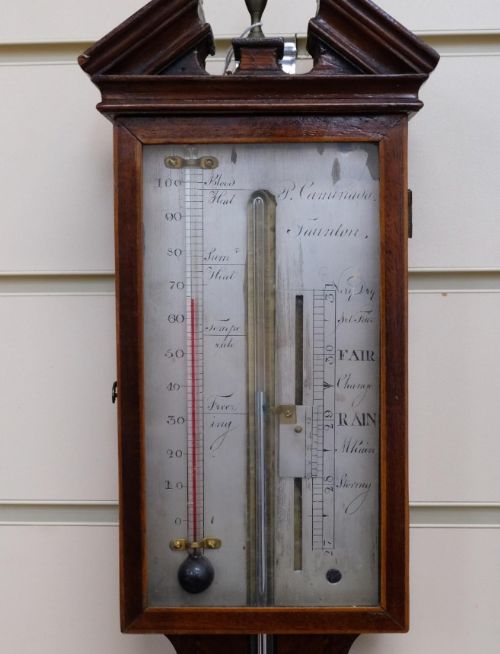
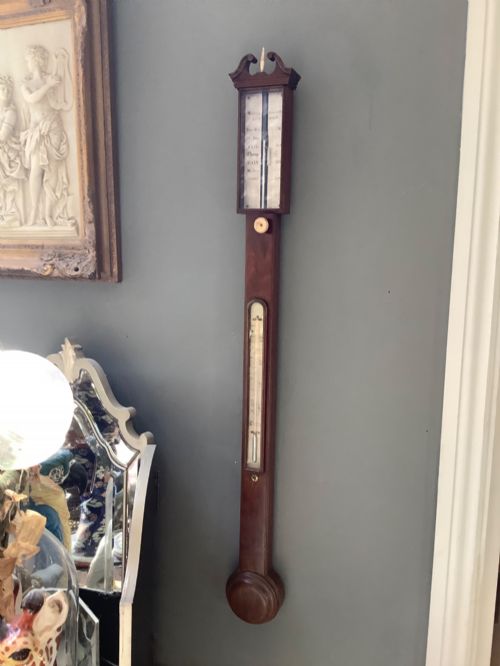
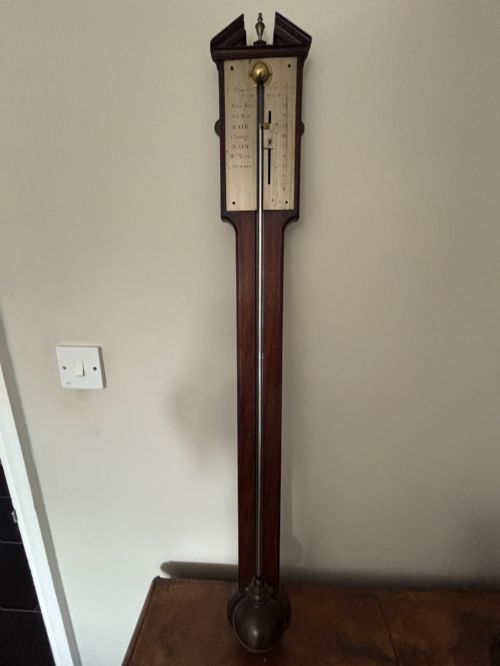
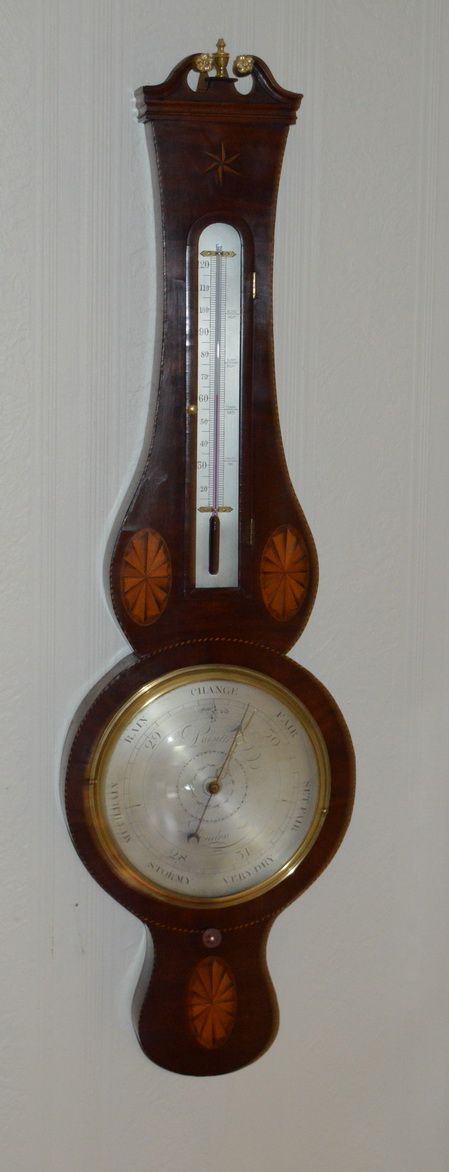
A georgian wood barometer appears in two distinct configurations across these listings: the vertical stick barometer and the wider wheel or banjo barometer. Stick variants dominate the selection, housed in narrow wooden trunks designed to display the mercurial tube alongside a silvered brass scale.
Makers working during the Georgian, Regency and early nineteenth century periods constructed these instruments in mahogany, rosewood, walnut and satinwood, frequently incorporating shell inlay, boxwood stringing or architectural pediments at the crest.
Buyers will encounter provincial English makers as well as London instrument houses, spanning walnut examples from the early eighteenth century through to later nineteenth century interpretations.
Materials and Technique
Cabinetmakers utilised dense timbers such as mahogany, rosewood and walnut, selecting boards with strong grain patterns to shape the long trunks and cases of each georgian wood barometer. Selected pieces feature contrasting stringing in boxwood or marquetry details in satinwood and mother of pearl.
The delicate mechanical components rely on glass tubes containing mercury, paired with engraved silvered brass or silvered metal scales that display the barometric pressure readings. Brass bezels, dampening cistern covers and occasional bone vernier knobs complete the functional assembly.
Georgian Wood Barometer Retail Price Guide 2026
Typical asking prices for georgian wood barometer among the pieces listed under this phrase on Sellingantiques today, from the lower quarter to the upper quarter. They describe what is for sale here now, not the wider market.
Listings feature eighteenth and nineteenth century stick and wheel barometers constructed from mahogany, rosewood, walnut and satinwood.
Craftsmanship and Proportion
Quality in a georgian wood barometer rests upon the crispness of the timber mouldings, the delicacy of any shell or line inlay, and the architectural integrity of the pediment. Finer examples retain their original surface patination and undisturbed mercury tubes.
The legibility and engraving quality of the silvered brass scale set superior instruments apart from utilitarian output, particularly when signed by a known maker working in London or provincial centres.
P Caminada Taunton·George Adams London·Dollond of London·JB Bergna Newcastle·Fagioli of Clerkenwell London·Jenkins Of Old Swindon·Roncoroni·Sandrino of Liverpool·Gilbert London·Luisetti of London·Charles Aiano London·A Pozzoby London·J C Moretti of Kings Lynn·Corti of Exeter
The Georgian Wood Barometer Glossary
- Stick barometer
- A tall, narrow instrument enclosing an exposed or glass-covered mercurial tube against a vertical wooden backboard. This form allows for precise readings of atmospheric pressure changes.
- Banjo barometer
- A domestic weather glass featuring a circular dial at the base attached to a wider trunk, often containing a thermometer and hygrometer. It is also frequently referred to as a wheel barometer.
- Silvered brass
- A copper and zinc alloy treated with a silver solution to create a matte white metallic surface. Engraved scales and maker signatures appear clearly against this contrasting background.
- Pediment
- The triangular or architectural crowning element at the top of a stick barometer case. Makers often shaped these in broken-arch or swanneck designs.
- Vernier
- A small auxiliary sliding scale operated by a knob, allowing the user to read barometric fractions with greater precision.
Georgian Wood Barometer: Frequently Asked Questions
How do I read a stick barometer?
Observe the height of the mercury column inside the glass tube against the graduations marked on the silvered brass scale. Rising mercury generally indicates improving weather conditions.
Utilise the small sliding vernier to take precise measurements by aligning the index marker with the top of the mercury meniscus.
Where should I hang a wooden barometer?
Mount the instrument securely on an interior wall away from direct sunlight, radiators or draughts. Consistent room temperatures prevent thermal shock to the wood and glass components.
Ensure the wall is structurally sound to support the weight of the dense timber case and internal mercury column.
Are these barometers still functional?
Many surviving examples retain their original mercurial tubes and mechanisms, responding accurately to changes in barometric pressure. Professional handling is recommended if the mercury column has separated.
Some historical instruments serve primarily as decorative wall furniture while retaining their intact nineteenth century dials and thermometers.
How do I distinguish a stick barometer from a wheel barometer?
A stick barometer presents a long, narrow vertical profile where the entire height of the mercury tube remains visible along the wooden trunk. This design focuses on direct mercurial measurement.
A wheel barometer widens into a circular dial at the base, translating the vertical movement of the mercury through a mechanical pulley and wheel system to point a hand around a face.