



Georgian Telescopic Candlesticks
Georgian telescopic candlesticks are clever mechanical lighting devices designed to adjust in height, offering both practicality and elegance for the table.
Georgian Telescopic Candlesticks
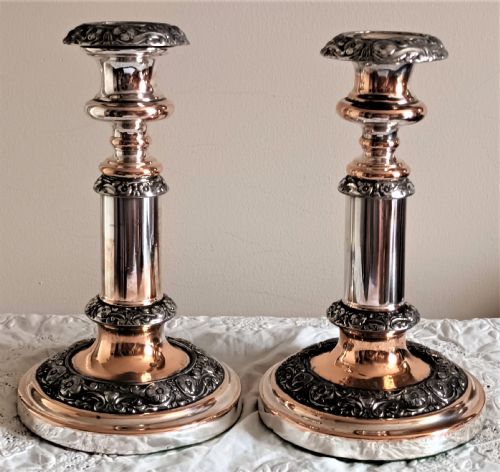
Georgian telescopic candlesticks are extending lighting pieces that rise and fall through a sliding mechanism housed within the shaft. These examples span the 19th century, the Regency era, and the reign of George III, appearing chiefly as pairs or sets.
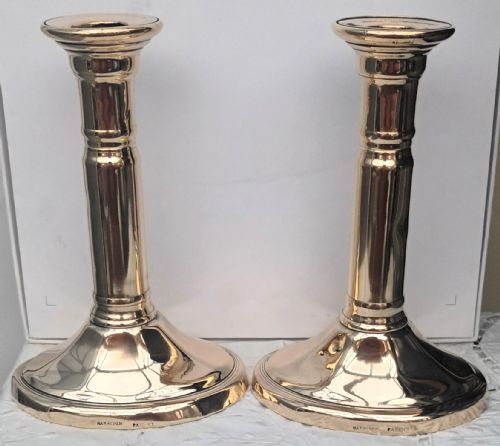
Makers produced these adjustable lights in brass, copper, silver plate, and old Sheffield plate. The forms range from simple utilitarian designs to grand Regency interpretations meant for formal dining settings.
How They Were Made
Artisans constructed these pieces using brass, copper, and silver plating techniques, including old Sheffield plate applied to a base metal. The sliding inner tubes required precise metalwork to ensure the telescoping action remained smooth and secure.
Workshops shaped the components through casting and hammering, assembling weighted bases to support the extended height safely. Patented designs, such as those by Harrison, introduced specialised internal mechanisms to hold the columns firmly at various elevations.
Georgian Telescopic Candlesticks Retail Price Guide 2026
Typical asking prices for georgian telescopic candlesticks among the pieces listed under this phrase on Sellingantiques today, from the lower quarter to the upper quarter. They describe what is for sale here now, not the wider market.
Some inventors were so proud of their sliding tubes they stamped their surnames right into the metal.
What Varies in Quality
The sophistication of the mechanical action dictates the upper tier of these pieces, where inner sleeves glide without binding or looseness. Simpler examples lack the refined engineering found in patented variants.
Surface finish and material choice divide standard production from exceptional work, particularly in the depth of old Sheffield plate and the crispness of cast brass details. Heavier gauge metalwork provides better balance when the stem is fully raised.
Harrison Patent
The Georgian Telescopic Candlesticks Glossary
- Telescopic
- An adjustable design featuring sliding concentric tubes that allow the overall height of the stem to increase or decrease. This mechanical feature permitted varying levels of illumination.
- Old Sheffield Plate
- A fused composite material made by melting a thin sheet of silver onto a thicker copper base. It remains a hallmark of quality Georgian manufacturing.
- Regency
- A style period spanning the early 19th century, known for drawing inspiration from classical antiquity. Pieces from this era often display bolder lines and more pronounced architectural details.
- Harrison Patent
- A specific mechanical design denoted by period makers for extending candlesticks. This designation indicates a recognised innovation in the sliding mechanism.
- George III
- The historical period associated with the reign of the third king of that name, covering the latter half of the 18th century and the early years of the 19th.
Georgian Telescopic Candlesticks: Frequently Asked Questions
How do telescopic candlesticks work?
The inner shaft slides smoothly within the outer column, allowing the user to raise or lower the nozzle to the desired height.
Internal stops or friction fittings hold the extended section securely in place during use.
What metals were used for these?
Craftsmen utilised brass, copper, silver plate, and old Sheffield plate to build these adjustable lighting fixtures.
The choice of material often dictated whether the piece was intended for everyday domestic use or formal entertaining.
How are pairs and sets arranged?
These pieces most frequently survive as matched pairs designed to sit at opposite ends of a dining table or mantlepiece.
Larger configurations, such as sets of four, occasionally appear for more substantial room displays.
How do I identify a Regency example?
Regency pieces typically exhibit heavier classical detailing and bolder proportions compared to earlier Georgian designs.
The styling reflects the architectural tastes of the early 19th century.