
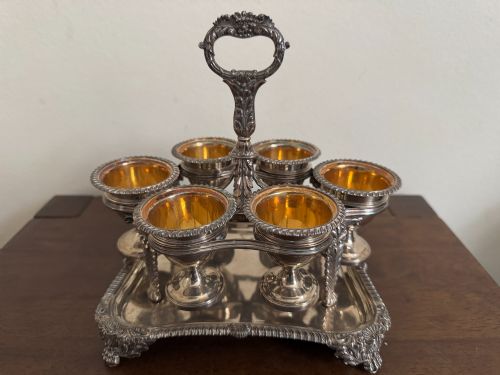


Georgian Silver Cruet Stand
A georgian silver cruet stand is a table centrepiece for condiments that brings period elegance to dining, combining fitted frames with cut glass bottles.
Georgian Silver Cruet Stand
A georgian silver cruet stand is a dining table accessory designed to hold bottles and castors for condiments such as oil, vinegar, salt, and pepper. These pieces date from the eighteenth and nineteenth centuries, reflecting the formal dining habits of the period.
The versions most commonly met on this page include sterling silver frames, Sheffield plate, and ebonised wood designs holding cut glass bottles. Some examples are configured specifically as egg cruets or decanter sets rather than traditional multi-bottle condiment holders.
Makers produced these stands in various sizes, ranging from compact three-bottle frames to substantial seven-bottle sets complete with casters. Each piece demonstrates the functional requirements of elite dining tables during the Georgian and later reigns.
Materials and construction
Silversmiths utilised sterling silver and silver plate, alongside Sheffield plate and ebonised wood, to construct the foundational frames and handles. Metalwork techniques involved casting, piercing, and soldering to create sturdy bottle rings and supporting feet.
Cut glass was shaped and polished to form the accompanying bottles, cruets, and casters that fit securely within the metal framework. Gold gilt and silver gilt finishes were also applied to enhance the interior or decorative elements of select stands.
Listings feature items from the 18th Century, 19th Century, and 1930, showcasing solid sterling silver, Sheffield plate, cut glass, and ebonised wood.
Assessing quality in stands
Quality varies according to the crispness of the silversmith's chasing and the integrity of the fitted frame, where superior examples maintain rigid alignment and balanced weight. The presence of matching, original cut glass bottles significantly elevates a piece above those assembled later from mismatched components.
The distinction between solid sterling silver and plated wares alters the standing of an object, with hallmarked London pieces demonstrating high standards of British craftsmanship. Maker attribution, particularly to renowned silversmiths, marks the upper tier of the range.
William Burwash·Charles Thomas Fox·Hester Bateman·Viners
The Georgian Silver Cruet Stand Glossary
- Cruet stand
- A fitted frame designed to hold multiple condiment bottles or casters on the dining table. These frames often feature a central carrying ring and supporting feet.
- Sheffield plate
- A fused composite material made by melting a sheet of sterling silver onto a thicker copper base. This technique was widely used for tableware before modern electroplating.
- Castor
- A small jar with a perforated top used for sprinkling sugar or dry spices over food. Casters frequently form part of larger condiment sets.
- Bright cut
- An engraving technique utilising faceted cuts to create a sparkling, geometric pattern on silver surfaces. It was popular on silverware during the Georgian period.
- Silver gilt
- Silver that has been coated with a thin layer of gold on its surface. This finish protects the silver from tarnishing and adds a rich two-tone appearance.
Georgian Silver Cruet Stand: Frequently Asked Questions
How were these stands used?
Hosts placed these stands in the centre of the dining table so guests could season their food during a meal. The bottles held liquids like oil and vinegar alongside dry spices.
Handles attached to the frames allowed servants to pass the entire collection easily between diners as courses progressed.
How do I date a cruet stand?
Dating relies heavily on hallmarks stamped into the silver, which record the assay office, date letter, and maker's mark. Stylistic clues such as bright cut engraving also point to specific decades.
Changes in bottle shape and frame architecture help distinguish eighteenth-century examples from later nineteenth-century interpretations.
Are the glass bottles usually original?
Many stands retain their period cut glass bottles, though some have replacements gathered over time to match the original apertures. Close inspection reveals whether the glass wear and style align with the frame's manufacturing period.
Original stoppers and matching cut patterns add to the completeness of the set.
How do I care for silver stands?
Silver frames require gentle cleaning with appropriate polish to maintain their shine without wearing down engraved details. Wooden elements like ebonised bases need dusting with a dry cloth.
Glass bottles can be washed separately in warm soapy water, ensuring all residues are removed before returning them to the stand.