
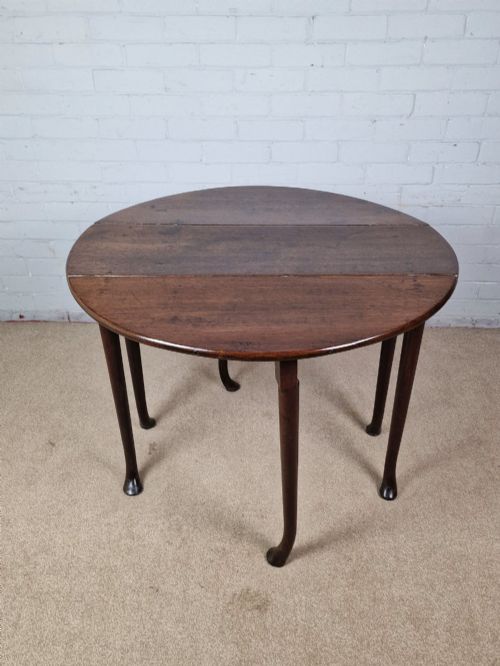


Georgian Round Drop Leaf Table
These georgian round drop leaf table examples offer clever space-saving design and sturdy eighteenth-century craftsmanship for modern dining rooms.
Georgian Round Drop Leaf Table
When searching for a georgian round drop leaf table, you encounter practical oak and mahogany dining pieces designed to fold away when not in use. These versatile tables date from the eighteenth century and the Regency period, providing flexible seating for four to six people.
The selection on this page leans heavily towards oak gateleg tables and George II mahogany versions featuring pad feet and demi-lune ends. Such forms reflect the domestic needs of Georgian households where furniture needed to adapt quickly to changing room layouts.
How They Were Made
Cabinetmakers constructed these tables using solid oak and rich mahogany, relying on traditional framing techniques to support the folding leaves. Gateleg mechanisms and hinged flaps required precise joinery to ensure stability when the leaves were raised.
Metal components such as brass appear in specific hardware applications, while feet are often shaped as pads to distribute weight evenly across wooden floors. The combination of dense hardwoods and robust hinges allowed these folding tables to withstand daily family use.
A sturdy gateleg mechanism hides beneath many an antique top, ready to support a heavy Georgian feast after centuries of loyal service.
What Varies in Quality
Quality in these drop-leaf pieces rests upon the choice of timber and the structural integrity of the folding mechanism. Better examples utilise well-figured mahogany or dense old-growth oak with minimal replacement timber in the framework.
The refinement of the leg turning and the snugness of the joints when the table stands fully open distinguish superior workshops from standard farmhouse production. Tables with well-preserved pad feet and smoothly operating drop leaves command greater attention.
The Georgian Round Drop Leaf Table Glossary
- Gateleg table
- A table with hinged leaves supported by legs that swing outward like gates. This clever design provides rigid support for extended flaps.
- Pad foot
- A flat, rounded foot resting directly on the floor without a separate caster. This feature appears frequently on George II dining furniture.
- Demi-lune
- Half-moon shaped in plan, allowing tables to sit flush against a wall when folded. These ends often join together to form a larger round dining surface.
- Mahogany
- A dense tropical hardwood prized for its rich reddish-brown colour and fine grain. Georgian cabinetmakers utilised it extensively for high-status dining tables.
Georgian Round Drop Leaf Table: Frequently Asked Questions
How do I seat six people?
Raise both drop leaves and pull out the swinging gatelegs to lock the flaps into a stable horizontal position.
Ensure the chairs fit comfortably around the newly formed circular or oval perimeter without knocking against the central frame.
Are these tables solid oak?
Many examples utilise solid native oak throughout the top, frame, and swinging leg assemblies. This dense timber provides the necessary weight to keep the folding structure stable.
Mahogany also appears frequently in finer eighteenth-century dining pieces on this page.
Where did they stand?
Georgian households placed these folding tables against parlour or dining room walls when the leaves dropped down to save floor space. They moved into the centre of the room only when meals required extended surface area.
Smaller variants also served as side tables or supper tables.