


Georgian Rosewood Tea Caddy
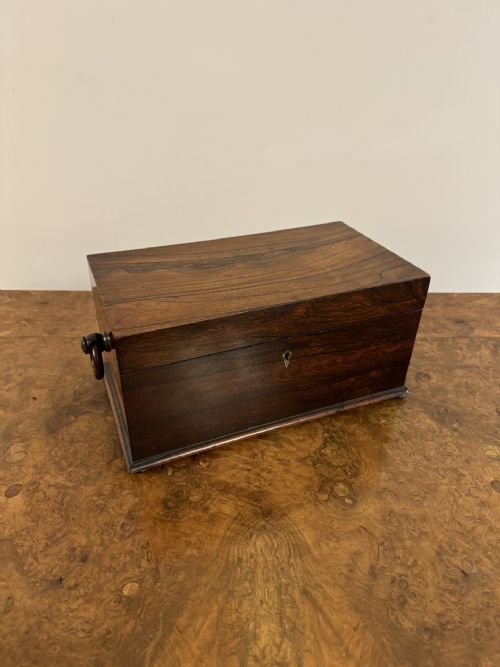
A georgian rosewood tea caddy is a small, heavy timber box designed to store precious tea leaves under lock and key.
Georgian Rosewood Tea Caddy
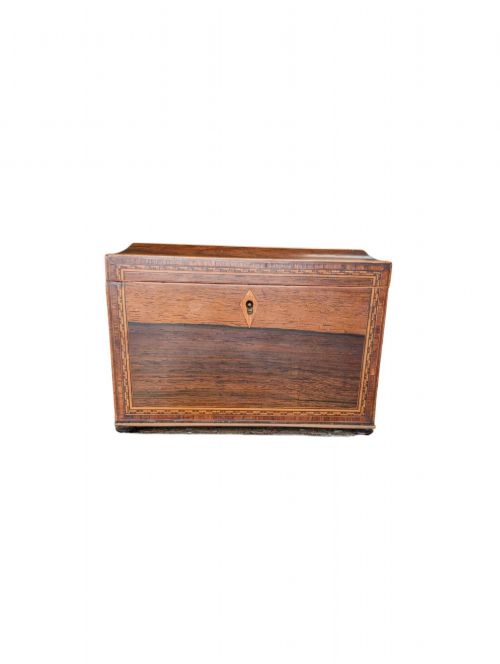
When you search for a georgian rosewood tea caddy, you encounter domestic containers fashioned during the late eighteenth and early nineteenth centuries. These boxes served a practical function in period drawing rooms when tea was an expensive commodity requiring secure storage. The examples on this page predominantly date from the Regency era and the wider Georgian period, appearing in rectangular, tapered, and sarcophagus forms.
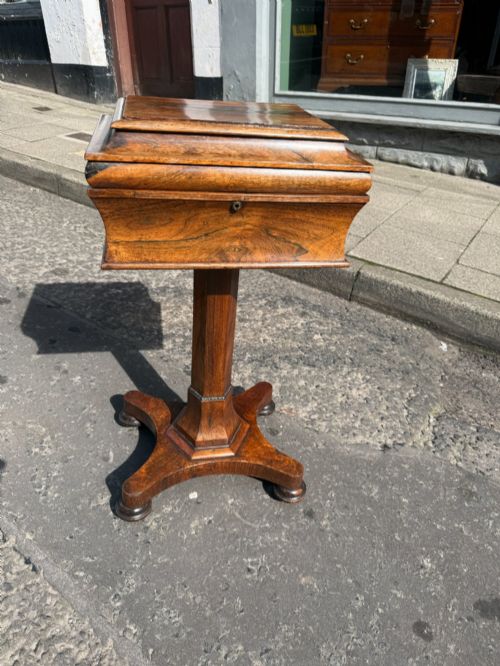
Beyond standard table boxes, the selection includes teapoys, which are larger containers mounted on central pedestals or stands. The primary materials span dark tropical rosewood supplemented by contrasting stringing, banding, and internal compartments. While most survivors retain their fitted wooden tea canisters or glass mixing bowls, many present as empty vessels ready for modern display.
What varies in quality
Quality rests upon the crispness of the brass inlay and the complexity of the timber grain selected for the exterior panels. Superior boxes display continuous grain wrapping around the corners of the carcass, whereas lesser examples use mismatched veneer segments. The intricacy of internal fittings, such as matched mixing bowls and intact inner lids, separates standard containers from high-status drawing room pieces.
Proportion and architectural detail also dictate the standing of a box. Sarcophagus forms with well-defined feet, carved handles, and precise boxwood stringing demonstrate superior workshop output compared to plain, unadorned oblong versions. The survival of original working locks and key escutcheons preserves the integrity of the piece.
Current listings feature rosewood alongside secondary materials including boxwood, mother of pearl, and brass inlay across Regency and Victorian periods.
The Georgian Rosewood Tea Caddy Glossary
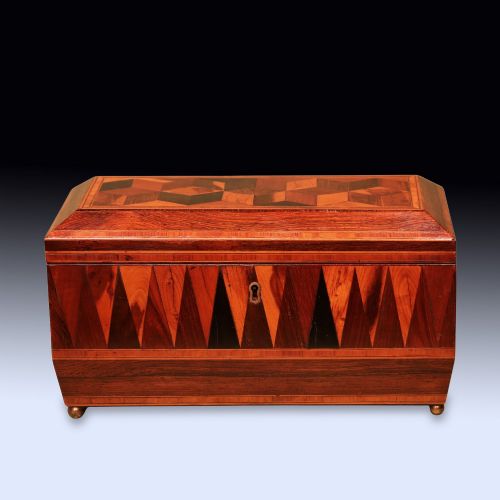
- Sarcophagus form
- A box design featuring a sloping lid and inverted plinth base, reminiscent of classical stone tombs. This silhouette became popular during the Regency period for larger tea receptacles.
- Teapoy
- A tea caddy raised on a pedestal stand or legs rather than resting directly on a table. These freestanding pieces often incorporate interior mixing bowls.
- Tunbridge Ware
- Small mosaic wood-working technique that produces geometric or pictorial patterns from thousands of tiny dyed wood blocks. It appears as decorative banding on specialised caddies.
- Parquetry
- Geometric mosaic woodwork formed by fitting small veneer tiles together to create patterns. Makers utilised this method on box lids to showcase timber contrast.
- Escutcheon
- A flat plate surrounding the keyhole of a box. These protective brass fittings prevent the surrounding wood from splintering during use.
Georgian Rosewood Tea Caddy: Frequently Asked Questions
How were tea caddies used?
Households kept expensive black and green teas locked inside these boxes to control daily consumption. The mistress of the house typically held the key, dispensing leaves into porcelain pots for guests.
Interior compartments kept different tea varieties separated. Central glass bowls accommodated sugar or served as rinsing vessels for the leaves.
What is a teapoy?
A teapoy is a tea caddy supported by a central pillar and a sturdy base with feet. This format allowed the container to stand independently beside a chair in the drawing room.
Some versions feature internal canisters identical to table boxes, while others include washing bowls and compartmentalized storage trays.
How do I date a rosewood tea caddy?
Dating relies on stylistic markers such as brass inlay, boxwood stringing, and box proportions. Pieces with sharp sarcophagus angles and lion mask handles generally point to the Regency era around eighteen twenty.
Earlier eighteenth-century examples tend toward simpler rectangular shapes with delicate shell marquetry. Victorian iterations often introduce heavier mother of pearl foliate motifs.
Do original locks and keys matter?
Original working locks and matching keys add desirability and confirm the piece remains in unalterable condition. Many antique boxes retain functional brass locks despite losing their keys over the decades.
Replacements do not diminish the decorative value of the timber work, though collectors prefer factory-original hardware.
Can I store tea inside them today?
Dry modern tea sealed in foil packets can sit safely inside the internal wooden canisters. However, aged timber linings can transfer old aromas to loose leaves.
Most owners utilise these boxes purely as decorative objects or for storing small modern trinkets rather than dry goods.