



Georgian Revival Nightstand
A georgian revival nightstand brings refined eighteenth-century cabinet-making into the bedroom through early twentieth-century interpretations.
Georgian Revival Nightstand
A georgian revival nightstand takes the form of bedside cabinets, cupboards, and small chests produced during the early twentieth century. These pieces translate earlier cabinet styles into practical bedroom furnishings for Edwardian and interwar homes.
The versions most commonly met on this page belong to the opening decades of the twentieth century, specifically between nineteen hundred and nineteen thirty. Makers drew heavily on Sheraton, Chippendale, and general Georgian vocabularies to shape these compact bedside pieces.
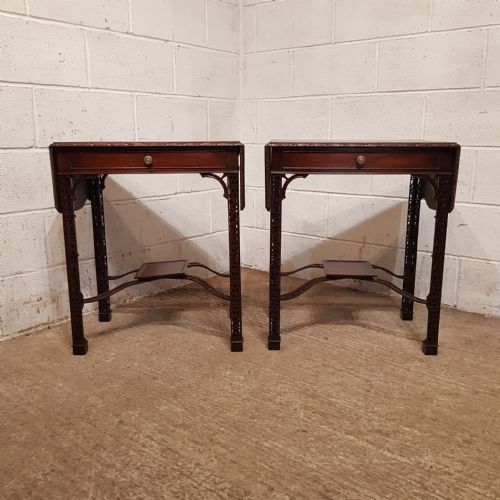
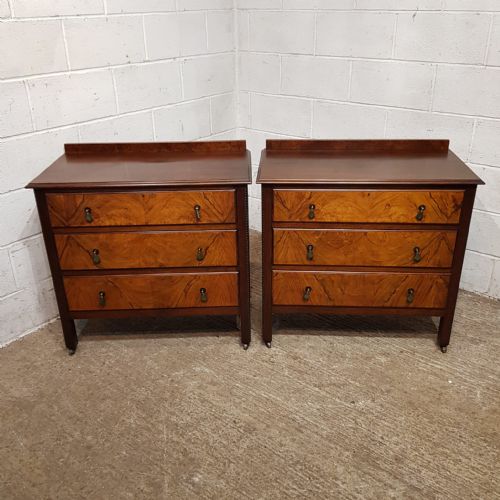
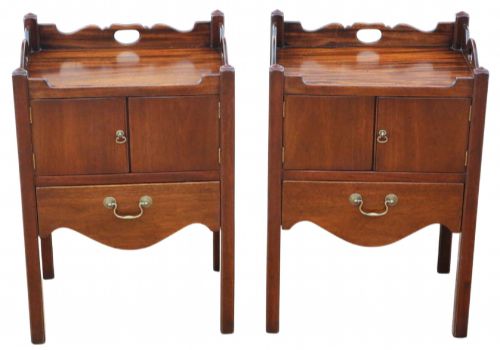
Forms range from enclosed bedside cupboards with panelled doors to small three-drawer chests and occasional drop-leaf tables. Many appear as matched pairs, reflecting the Edwardian and later preference for symmetrical bedroom arrangements.
Construction and Materials
Makers relied on solid mahogany and walnut as primary timbers, frequently selecting flame mahogany and burr walnut veneers for decorative surface movement. Satinwood also appears alongside brass hardware to provide contrast and structural detail.
Techniques combined traditional cabinet-making frames with period-specific decorative flourishes such as hand-painted detailing and inlaid woodwork. Surface finishes were applied to highlight the natural grain patterns of the selected timbers.
Listings span periods from eighteen-twenty through nineteen thirty, with the majority concentrated in the Edwardian era and the nineteen-twenties.
Assessing Quality
Quality rests in the selection of timber and the precision of the veneer work across the top and drawer fronts. Superior pieces employ figured grain thoughtfully, matching patterns symmetrically to create visual depth.
Construction integrity shows in the joinery of the drawer boxes and the crispness of applied mouldings or stringing. The choice of secondary woods and the weight of brass fittings further distinguish standard production from finer workshop output.
The Georgian Revival Nightstand Glossary
- Burr walnut veneer
- A thin slice of wood taken from the deformed growth or burl of a walnut tree. It yields intricate, swirling grain patterns highly prized for decorative furniture surfaces.
- Flame mahogany veneer
- Timber cut from the branch junction of a mahogany tree that creates a distinctive flickering, flame-like pattern. It was widely utilised on cabinet doors and drawer fronts during revival periods.
- Drop-leaf table
- A table with fixed centre section and hinged flaps on either side that can be raised or lowered. This mechanism allows the piece to save space when placed beside a bed.
- Bedside cabinet
- A small enclosed piece of furniture designed to sit beside a bed for storage. These units usually feature a single door concealing a shelf or interior compartment.
Georgian Revival Nightstand: Frequently Asked Questions
Are these nightstands usually sold in pairs?
Many of the bedside cabinets and tables listed appear as matching pairs. This reflects the standard practice of furnishing both sides of a bed symmetrically during the Edwardian and interwar periods.
Single pieces also occur frequently, offering flexible placement options for smaller bedrooms or guest spaces.
Which woods were used for these cabinets?
Mahogany and walnut form the primary structural and decorative timbers for these pieces. Makers frequently applied burr walnut and flame mahogany veneers to enhance the visual texture of the surfaces.
Satinwood and various inlay techniques also appear, providing contrast and detail derived from eighteenth-century design traditions.
How do I identify the period of a piece?
Dating relies on examining construction methods, timber choices, and stylistic markers such as Sheraton or Chippendale revival motifs. Most pieces date from the early decades of the twentieth century, between nineteen hundred and nineteen thirty.
Hardware styles, interior linings, and the nature of the secondary woods further help narrow down the exact decade of manufacture.
How should I care for burr walnut veneer?
Burr walnut veneer requires protection from direct sunlight and excessive moisture to prevent fading and lifting. Regular dusting with a soft, dry cloth helps maintain the finish without damaging the delicate wood.
Occasional application of appropriate furniture wax preserves the moisture and depth of the figured grain.