
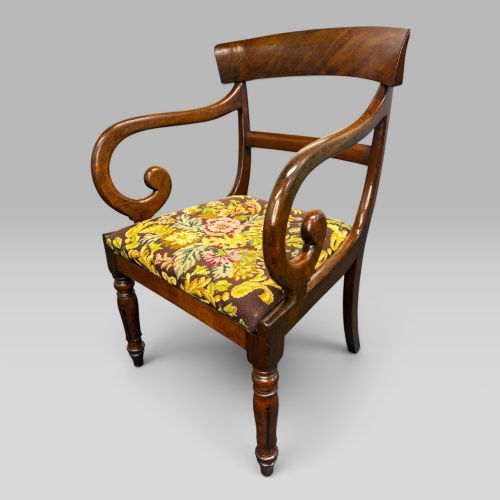
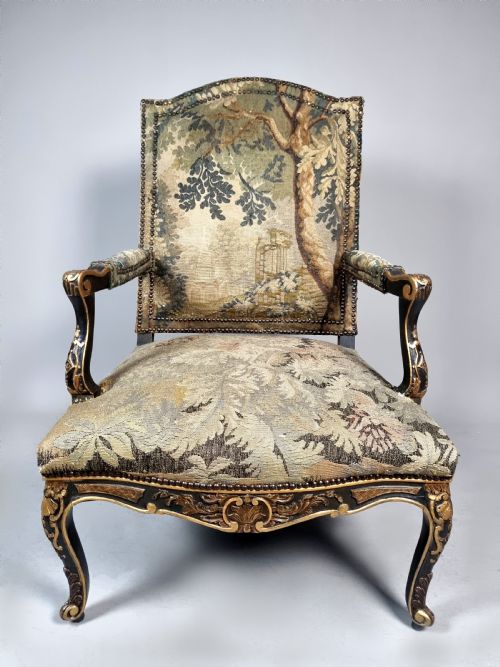
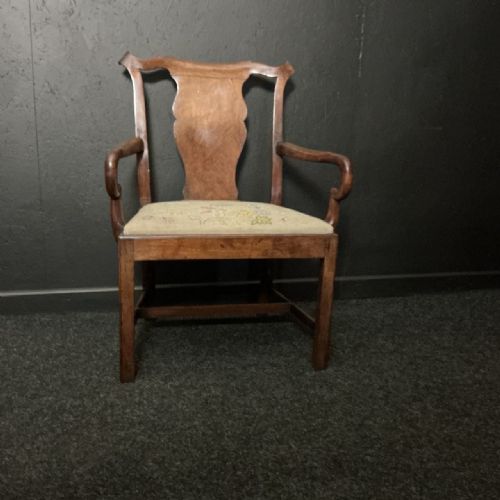


Georgian Needlepoint Armchair
A georgian needlepoint armchair brings tactile historical texture and sturdy timber framing into a room, offering both traditional seating and enduring visual warmth.
Georgian Needlepoint Armchair
A georgian needlepoint armchair spans diverse regional interpretations and formal iterations, most frequently appearing in mahogany or walnut frames paired with textile or tapestry upholstery. Buyers encounter pieces ranging from formal George III library seats to country-made dark elm corner chairs and compact children's seating.
The selection encompasses distinct object types including elbow chairs, carver chairs, dining chairs, and corner chairs. Many examples feature drop-in seats or full upholstered panels worked in wool needlepoint.
Dating ranges from the 18th century through the Regency and William IV periods, alongside later revival pieces produced in the 20th century. These seating forms demonstrate how domestic furniture evolved from robust walnut structures to refined mahogany frames with sabre legs or carved details.
Judging quality and execution
The distinction between tiers of work rests on the crispness of timber carving and the architectural proportion of the frame. Superior examples demonstrate confident handling of mahogany or walnut, where joinery remains tight and structural elements retain their original profile.
Needlepoint upholstery varies from dense, finely worked historical wool threads to simpler later textiles. The harmony between the timber frame and the textile covering dictates the visual cohesion of the seating.
Listings feature woods including mahogany, walnut, and elm, paired with wool needlepoint and tapestry textiles across the Georgian, Regency, and Victorian periods.
Robert Strahan Dublin
The Georgian Needlepoint Armchair Glossary
- Needlepoint
- A type of embroidery stitched on canvas mesh using wool or silk threads. It provides the durable decorative surface seen on many period seat covers.
- Elbow Chair
- A seating form fitted with arms, designed for comfort at a desk or in a parlour. These chairs often feature upholstered drop-in seats.
- Drop-In Seat
- A removable wooden frame holding the upholstered pad that drops into the seat rails of a chair. This construction method allows for straightforward reupholstery.
- Gainsborough Chair
- A wide, open-armed armchair with a low back, padded arms, and an upholstered seat, popular during the 18th century. It offers comfortable seating for reading or writing.
- Sabre Leg
- A concave, outwardly curved leg tapering toward the foot, characteristic of Regency furniture design. This form imparts a lighter visual balance to heavy timber chairs.
Georgian Needlepoint Armchair: Frequently Asked Questions
How do I identify a georgian armchair?
Look for dense timber frames in mahogany or walnut combined with traditional joinery methods. Proportions tend to be robust, reflecting the structural standards of the 18th and early 19th centuries.
Examine the legs and arm supports for period characteristics such as carved details, sabre curves, or simple slat backs. Original upholstery forms, including drop-in seats with needlepoint, further clarify the origin.
Are these chairs comfortable for daily use?
Many of these pieces offer supportive seating thanks to their generous elbow rests and upholstered pads. Their ergonomic design was originally intended for extended periods of reading or dining.
Modern comfort depends on the internal condition of the webbing and padding beneath the needlepoint. Professional reinforcement of the frame ensures stability during everyday seating.
How should I care for needlepoint upholstery?
Protect wool needlepoint from direct sunlight to prevent the natural dyes from fading over time. Gentle vacuuming through a mesh screen helps remove dust without disturbing the stitches.
Avoid placing these chairs in areas of high humidity or fluctuating temperatures. Professional textile conservation maintains the integrity of aged threads.