



Georgian Lap Desk Box
A georgian lap desk box provides a portable writing surface with fitted storage, prized for fine timbers and brass mounts.
Georgian Lap Desk Box
A georgian lap desk box is a portable writing slope or box designed for correspondence while travelling or at home. These pieces typically open to reveal a sloping writing surface lined with leather alongside compartments for inkwells and pens.
The versions most common on this page date from the Georgian, Regency, and Victorian periods, often constructed as campaign items for officers. Common forms include bi-fold slopes and document boxes fitted with secret drawers.
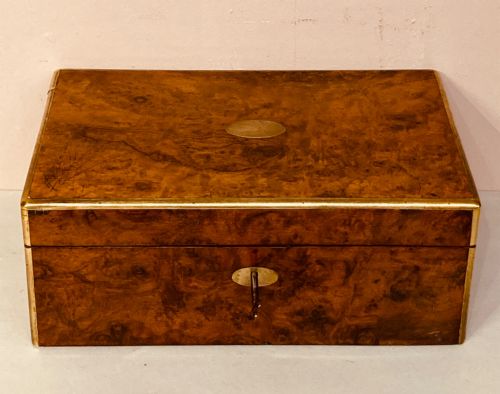
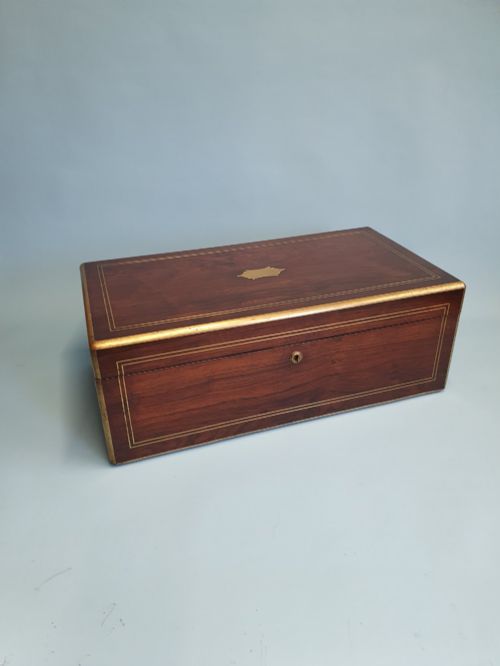
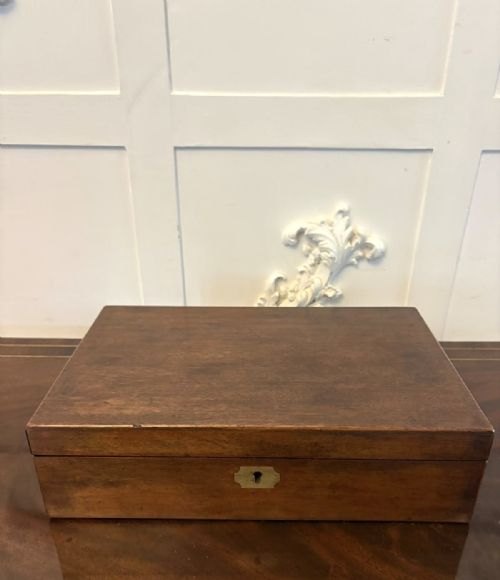
Materials range from figured mahogany and rosewood to walnut and satinwood, frequently accented with brass banding or inlay. Dimensions vary from compact 30cm document cases to large substantial writing boxes.
How they were made
Cabinet makers utilised dense hardwoods like mahogany, rosewood, walnut, and satinwood to construct the outer carcasses of a georgian lap desk box. Burr walnut and figured mahogany veneers provide decorative grain patterns across the exterior surfaces.
Brass corners, straps, and flush-fitting drop handles reinforce the boxes for travel, particularly on campaign pieces. Interiors incorporate secondary timbers, fitted velvet or leather writing surfaces, and concealed compartments accessed via secret drawers.
Secret compartments required removing hidden pins to release tiny spring-loaded drawers.
What varies in quality
The refinement of the timber selection and the precision of the brass inlay distinguish standard examples from finer pieces. Elaborate brass binding, mother-of-pearl detailing, and intricate tunbridge ware inlay indicate higher workshop standards.
Internal complexity also separates items, with superior boxes offering well-engineered secret compartments, bespoke leather-lined slopes, and original fitted inkwells or document trays.
Austin·George Austin, Dublin·William IV
The Georgian Lap Desk Box Glossary
- Writing slope
- A portable box with a hinged slanted lid designed to hold paper and provide an angled writing surface. Many examples fold out flat into a bi-fold configuration.
- Campaign style
- Furniture constructed for military officers on the move, characterised by robust hardwood frames and protective brass corners. These boxes often include recessed carrying handles.
- Secret compartment
- A hidden drawer or compartment built into the interior framework, usually accessed by removing a pen tray or sliding a partition. These spaces secured letters and valuables.
- Tunbridge ware
- Small wooden decorative items adorned with mosaic tesserae to form intricate geometric or pictorial patterns. This technique appears on specific Victorian writing boxes.
- Document box
- A rigid container utilised for storing letters and papers rather than functioning primarily as a desk. These often lack the internal folding slope of a writing box.
Georgian Lap Desk Box: Frequently Asked Questions
How were these boxes used?
Travellers and officers utilised them as portable desks on stagecoaches, ships, or military campaigns.
The sloping lid provided a comfortable angle for writing letters before the widespread use of stationary desks.
How do I tell periods apart?
Earlier Georgian and George III boxes tend to rely on solid mahogany or simpler brass mounts.
Regency and Victorian pieces frequently incorporate rosewood veneers, intricate brass inlay, or campaign hardware.
Where are secret drawers located?
Makers typically concealed secret drawers behind removable pen trays or sliding partitions inside the box.
Owners used them to store private letters, money, or small valuables.