
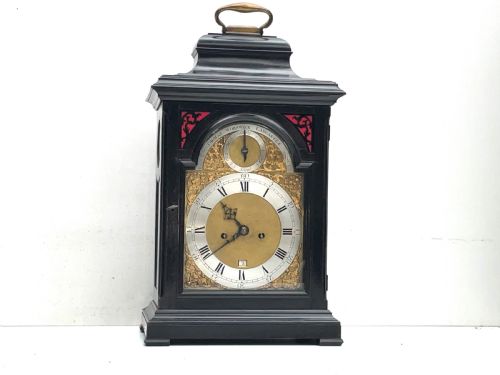


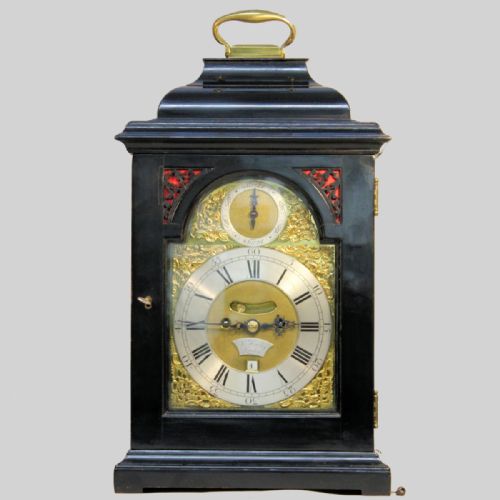


Georgian Bell Striking Clock
A georgian bell striking clock brings deep mechanical resonance into a room through brass, ebonised wood, and mahogany.
Georgian Bell Striking Clock
A georgian bell striking clock comprises both tall longcase clocks and compact bracket clocks made during the eighteenth century and the georgian era. These timepieces are sought after for their audible hour or multiple bell strikes and traditional mechanical movements.
What varies in quality
The distinction between standard and superior pieces rests on the complexity of the internal movement, such as verge escapements versus later designs, and twin chain fusee configurations. Cabinetwork also separates individual items, with fine flame mahogany veneer and crisp brass mountings indicating higher status.
Movements incorporate verge escapements, fusee mechanisms, and striking trains operating on single or multiple brass bells.
Somersall London·William Withers London·John Fletcher London·John Taylor London·Watson London·Benjamin Maud London·Isaac Hurley London·Joseph Lum of London·John Bishop of Sherborne·John Rapton of London·John Hancock of Yeovil·Robt Jackson of Gainsborough
The Georgian Bell Striking Clock Glossary
- Verge escapement
- An early type of escapement mechanism using a crown wheel and a verge rod with pallets. This arrangement controls the drop of weight or tension of a spring to regulate time.
- Fusee
- A conical pulley designed to equalise the torque of the mainspring as it winds down. It ensures even power delivery to the movement throughout the running period.
- Bell-top case
- A wooden clock case topped by a curved, bell-shaped wooden profile. This architectural styling is typical of eighteenth-century bracket clocks.
- Ebonised wood
- Timber treated with a dark stain or finish to imitate ebony. Cabinetmakers used this technique extensively on bracket clock cases during the georgian period.
- Longcase clock
- A tall pendulum clock housed in a wooden trunk with a base and hood. These pieces are often termed grandfather clocks by collectors.
Georgian Bell Striking Clock: Frequently Asked Questions
How do bell striking clocks work?
These clocks use a weight-driven or spring-driven movement that releases a hammer at the exact hour. The hammer strikes against a cast brass bell to produce an audible note.
Most examples on this page control this striking action through rack and snail or countwheel mechanisms linked to the gear train.
Where should I place a bracket clock?
Bracket clocks are designed to sit on sturdy tables, desks, or dedicated wall brackets. Their compact ebonised or mahogany cases suit secondary reception rooms and studies.
Keep them away from direct sunlight and damp walls to preserve the wood and interior brass components.
How do I identify a georgian longcase clock?
Georgian longcase clocks feature tall wooden trunks made from oak, mahogany, or flame mahogany. Their dials are typically brass or painted iron, often signed by the maker.
Many examples include banded inlay and hood doors flanked by slender columns.
What is a verge escapement?
The verge escapement is an early mechanical regulator found in eighteenth-century bracket clocks. It uses a swinging pendulum or balance connected to pallets that engage a spinning crown wheel.
This creates the characteristic ticking sound associated with antique clocks.