
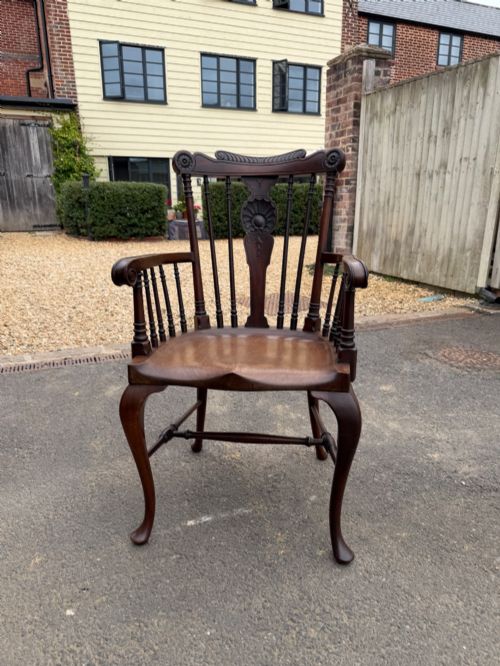


George II Style Carvers
George ii style carvers bring the robust proportion and carved ornament of the mid-eighteenth century into nineteenth- and twentieth-century dining rooms.
George II Style Carvers
George ii style carvers are substantial seating pieces designed with arms, taking inspiration from the mid eighteenth century and appearing frequently as nineteenth century revivals or early twentieth century dining sets. When you search for george ii style carvers, you encounter single armchairs, desk chairs, child's chairs, and large dining sets produced across Victorian and later periods.
The form embraces both individual armchairs and matched sets where single chairs accompany the carvers at the table. Makers adopted the heavy proportions and carved details of the original period, producing pieces that span walnut and mahogany timbers.
How they were made
Cabinetmakers worked primarily in solid mahogany and walnut, selecting dense timbers capable of holding deep carved relief on knees, rails, and splats. Joinery relied on traditional pegged mortise and tenon construction to support the generous proportions of the armchair frame.
Upholstery formed an integral part of the construction, utilising materials such as tapestry, velvet, fabric, and traditional textile coverings secured over padded seats. Brass details occasionally appear as structural or decorative elements on specific desk and armchair variants.
Listings feature mahogany and walnut timbers alongside upholstery in velvet, tapestry, and fabric across nineteenth and twentieth century periods.
What varies in quality
Quality rests in the crispness of the carved detail and the selection of the timber, where deeply moulded arms and sharply defined shell or foliage motifs distinguish finer workshop output. The weight and grain of the mahogany or walnut dictate the visual presence of the chair.
The integration of the arms to the upright supports and the retention of period upholstery materials or appropriate textiles affect the overall integrity of the piece. Sets demonstrate consistency in timber selection and carving depth across all matching dining chairs and carvers.
Robert Strahan Dublin
The George II Style Carvers Glossary
- Carver
- An armchair designed with open sides to accommodate clothing, traditionally placed at the heads of a dining table.
- Splat
- The vertical wooden strip down the centre of a chair back, frequently shaped and carved in mid eighteenth century revivals.
- Revival
- A nineteenth or twentieth century style period that consciously copies or adapts the design vocabulary of an earlier era such as george ii.
- Chippendale
- A style descriptor associated with mid eighteenth century cabinetmaking forms featuring carved mahogany and elaborate back splats.
George II Style Carvers: Frequently Asked Questions
What is a george ii style carver?
A george ii style carver is an armchair modelled on mid eighteenth century seating forms, featuring prominent wooden arms and carved details.
These pieces typically date from the nineteenth or early twentieth centuries, produced as revival items for grand dining rooms.
How do you use carver chairs?
Carver chairs traditionally sit at the head and foot of a dining table, paired with matching single chairs along the sides.
They also function as standalone desk chairs or reading seats in a library or study due to their supportive arms.
How are walnut and mahogany distinguished?
Walnut exhibits a rich brown tone with darker grain figuring, commonly found on earlier revival pieces and specific dining sets.
Mahogany displays a denser reddish brown hue that takes a sharp carved edge, favoured for heavy armchairs and Chippendale revival forms.
Are these chairs from the eighteenth century?
The majority of pieces found in this category date from the nineteenth century revival periods up to the early twentieth century.
They replicate the style of the mid seventeen fifties while employing the woodworking techniques of later Victorian and Edwardian workshops.