
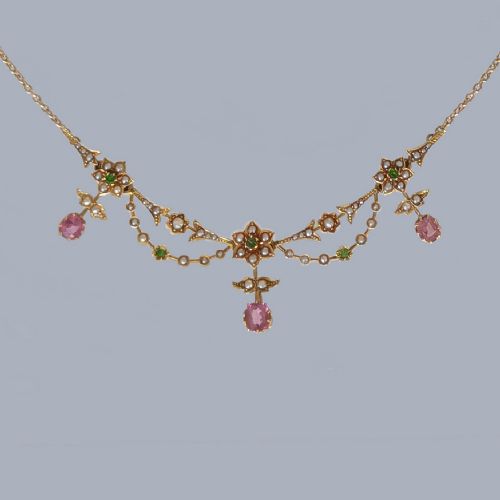
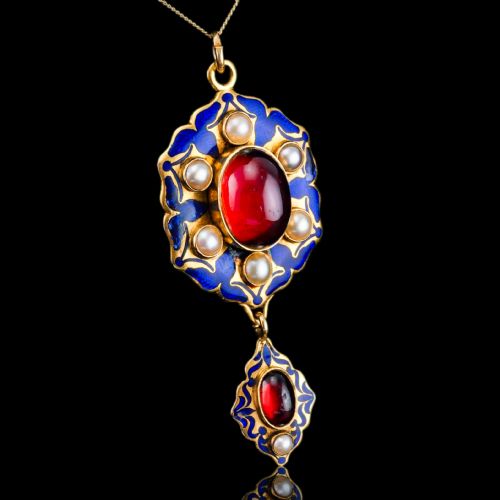


Garnet Drop Pendant
A garnet drop pendant brings deep crimson fire to the neckline, suspended in warm gold or silver as seen across Victorian and Edwardian designs.
Garnet Drop Pendant
A garnet drop pendant suspends deep red stones from fine chains or collars, appearing frequently in Victorian, Edwardian, and mid-century forms. Buyers seeking a garnet drop pendant encounter everything from elaborate revival pieces to simple pear-cut clusters.
The selections span distinct periods, including Victorian Renaissance Revival, Arts and Crafts, and vintage mid-century items. Pendant necklaces and lavalieres dominate the offerings alongside occasional drop earrings.
Materials and construction
Garnets are set in nine-carat and eighteen-carat yellow gold, silver, and occasionally platinum or gilt metals. Seed pearls, diamonds, and aquamarines frequently accent the central red stones.
Goldsmiths utilised techniques such as collet setting, wirework, and delicate granulation. Pieces range from cast gold mounts to intricate hand-assembled Arts and Crafts silver work.
Tiny seed pearls were often sewn onto silk threads inside Victorian pendants, meaning some necklaces hold quiet textile secrets beneath their gold.
Markers of quality
Quality rests in the depth of colour and cut of the garnets, from rich Bohemian rose cuts to bright mandarin and imperial stones. Superior pieces display matched gem pairings and secure, precise stone settings.
The artistry of the metalwork separates standard production from finer creations. Hand-wrought Arts and Crafts designs or detailed Victorian Etruscan revival wirework command greater appreciation than simpler cast settings.
John Paul Cooper
The Garnet Drop Pendant Glossary
- Garnet
- A silicate mineral group providing deep red, mandarin, and demantoid green stones used extensively in antique jewellery. These stones range from dark almandine to vivid pyrope varieties.
- Lavaliere
- A pendant featuring a primary drop suspended below a smaller motif, popular during the Edwardian era. This fluid form swings gently against the wearer's chest.
- Holbeinesque
- A Victorian revival style drawing on sixteenth-century portraiture with elaborate strapwork and dangling stones. These pieces often combine garnets with pearls and heavy gold frames.
- Seed pearl
- A very small natural or cultured pearl used in clusters or fringes around central gemstones. They add a delicate white contrast to the dark red garnet.
- Etruscan Revival
- A nineteenth-century design movement incorporating granulation and filigree modelled on ancient archaeological finds. This style frequently pairs gilt metals with garnets and paste stones.
Garnet Drop Pendant: Frequently Asked Questions
How do I date a garnet pendant?
Dating relies on material combinations, hallmarks, and stylistic cues like Edwardian lavaliere sweeps or Victorian closed-back settings. Gold purity marks and clasp types also help anchor the period.
Heavier gold work and Renaissance motifs typically point to the nineteenth century. Lighter filigree and seed pearl fringes often indicate the Edwardian era.
Are antique garnets fragile?
Garnets are durable enough for regular wear, rating around six and a half to seven and a half on the Mohs hardness scale. However, antique settings require gentle treatment to prevent stone loss.
Old claw settings and delicate seed pearl accents need periodic inspection by a jeweller. Avoid ultrasonic cleaners to protect glued pearls or foiled backs.
What is Bohemian garnet jewellery?
Bohemian garnet jewellery utilises rose-cut red stones clustered closely together to maximise sparkle without metal visibility. These pieces originate from the Czech region famous for its rich garnet deposits.
They frequently feature high stone counts set in gilt metal or low-carat gold. The dense mosaic effect creates a rich crimson surface.